All species › Passerines › Buntings › Cirl bunting
Cirl bunting | Emberiza cirlus
Cirlgors | Escribano soteño
At first glance a yellowhammer, until the male turns and shows a black throat and a black eyestripe — and the rump is olive-grey rather than chestnut. This is the bunting of warm, bushy farmland slopes, and it stays on the same slope all year.

Voice
The song is a dry, fast rattle on one pitch lasting two or three seconds: tsrrrrrrrrr — without the drawn-out final note of yellowhammer and without the acceleration of corn bunting. It sings through most of the year, peaking from March to August, from a treetop, a wire or a tall hedge. Call: a thin sharp sip, often repeated.
No freely licensed recording is available for this species yet.
Identification
A little smaller and more compact than yellowhammer, with a shorter tail. The male has a yellow face with a black eyestripe and a black bib, then a yellow band and an olive-green breast band; the flanks are chestnut-streaked and the rump is olive-grey. The female is a dull, yellow-brown, streaked bunting — but the olive-grey rump stays, and that is the character that counts. Both sexes show white in the outer tail feathers.
Confusion species
Separated from yellowhammer by the rump: olive-grey on cirl, warm chestnut on yellowhammer, in every plumage and at every age. The male gives itself away at once by the black throat, black eyestripe and olive breast band. Females are more finely and neatly streaked below and lack the yellow wash that yellowhammer keeps on belly and undertail. Rock bunting, which can share the same slopes on the Continent, has a grey head with heavy black stripes and unstreaked orange-brown underparts.
Habitat
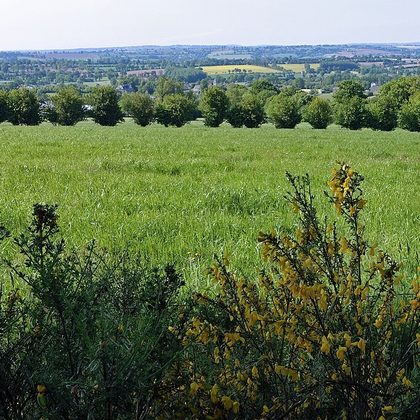
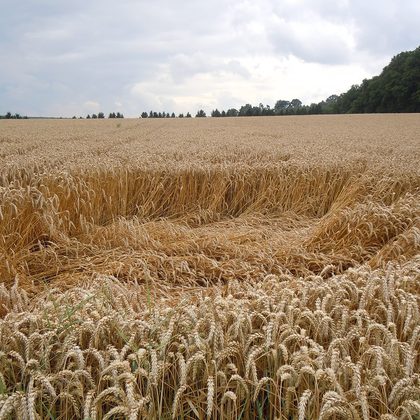
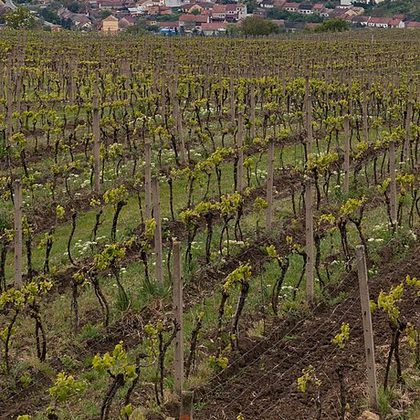
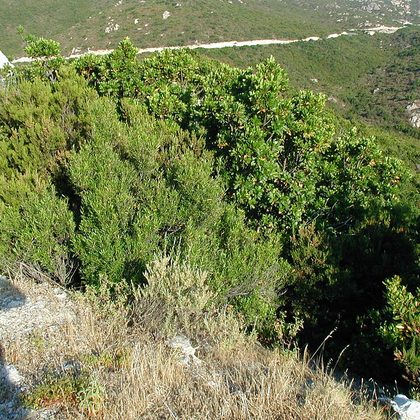
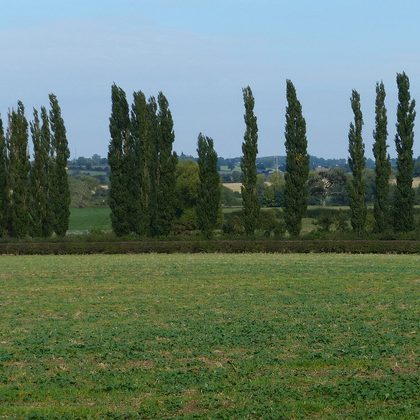
Warm, small-scale farmland slopes with hedges, hedgebanks, vineyards, olive and almond groves, plus open evergreen oak woodland, wood pasture and scrub along terraces. It needs tall song posts, dense low bushes to nest in and short insect-rich grassland to raise young; in winter, seed-rich stubble close to cover.
Where the bird is most at home, classified with EUNIS — the European standard for habitats.
Range and movements
Resident across southern Europe: Iberia, southern France, Italy and the larger islands, the Balkans and Greece, running out along the western coast of Turkey, and again through Morocco, Algeria and Tunisia. The northern limit crosses central France; beyond it only south-west England holds an isolated population, on the south-facing farmland of south Devon and now spreading into Cornwall.
- Resident
- Breeding (summer)
- Winter
- Passage
- dark = core range, pale = thinly spread
Where and when to look
In Devon, listen from a lane above a south-facing hedgebank between March and August for the flat rattle, which recalls a lesser whitethroat and gives the bird away before you see it; then check the top of an ash or a tall hedge. In winter a party at a weedy stubble is easiest — watch for the olive-grey rump as they flush.
Conservation status
Not globally threatened (IUCN: Least Concern) and still widespread in southern Europe, though declining where hedges and old groves give way to large-scale cultivation. At the northern edge it is fragile: the English population fell to a little over a hundred pairs in the late 1980s before targeted management with winter stubble, spring barley and flower-rich margins carried it back above a thousand pairs — one of the best-documented farmland recoveries in Europe.
Scientific name
Emberiza cirlus Linnaeus, 1766
Linnaeus described the species in 1766 and placed it straight away in the genus where it still stands. The genus Emberiza was introduced in 1758 by Linnaeus. Emberiza comes from Old German Embritz, a name for a bunting. cirlus comes from the local Italian name cirlo for a bunting, from zirlare, 'to chirp'. The specimen the first description was based on came from southern Europe.