All species › Passerines › Buntings › Black-headed bunting
Black-headed bunting | Emberiza melanocephala
Zwartkopgors | Escribano cabecinegro
A big, boldly coloured bunting: a jet-black hood, a chestnut mantle and underparts of unbroken lemon yellow. From a wire or a treetop above the olive groves of the Balkans and Turkey the male throws his surging phrase down the valley.

Voice
The song opens with a few scratchy, hesitant notes and builds into a loud, rich phrase that accelerates and ends in a surging flourish: tsri-tsri-cheree-cheree-churoo-ree. He sings from May to July from a high, open perch — a wire, a poplar, a telegraph pole — and keeps at it for long spells. Calls: a hard clicking chup and a rolling tsrit in flight.
No freely licensed recording is available for this species yet.
Identification
Large and long-tailed, with a heavy bill. The summer male has a black hood reaching below the eye, a rufous mantle and rump and entirely lemon-yellow, unstreaked underparts. By autumn the black is buried under brown fringes. The female is a pale sandy-brown bird with faint head streaking, yellowish undertail coverts and usually some yellow on the belly. Neither sex shows white in the tail — within this guide a character it shares only with corn bunting.
Confusion species
The male is unmistakable; the female is the problem. Take the combination: large, pale, almost unstreaked, with yellowish undertail coverts and no white in the tail. Corn bunting is bulkier and heavier, uniformly greyish brown, clearly streaked on the breast and without any yellow. Female yellowhammer and ortolan are smaller and always show white in the outer tail feathers, and ortolan has the yellow eyering as well. Female red-headed bunting, which breeds further east, is barely separable; within the map area geography does most of the work.
Habitat
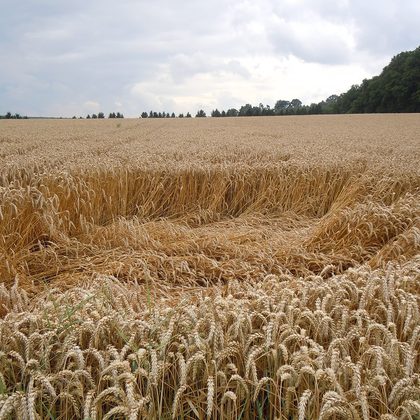
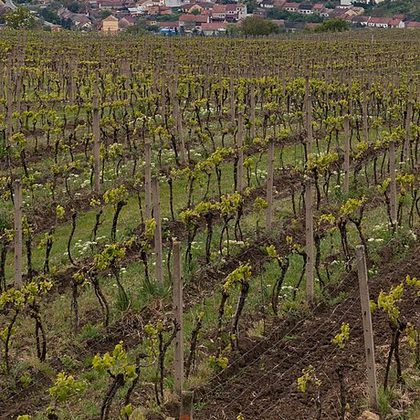
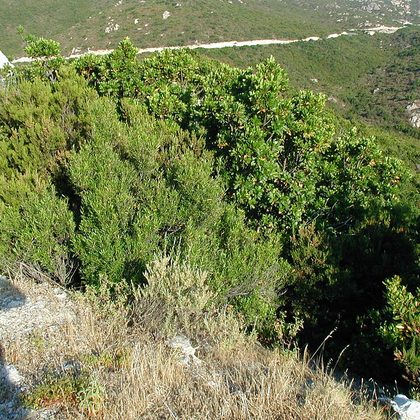
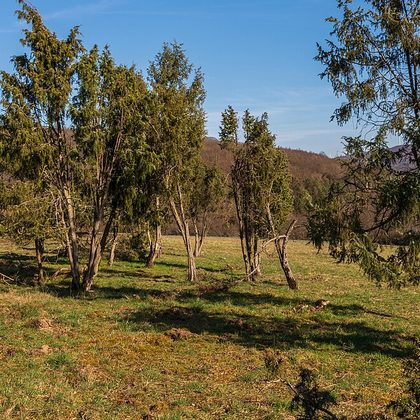
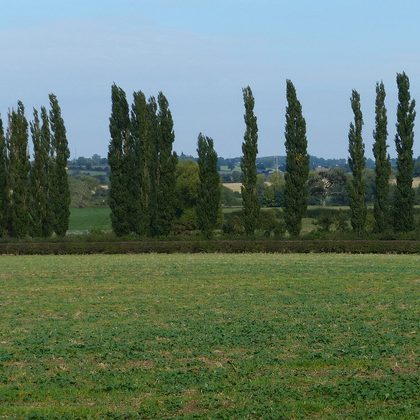
Open, warm farmland with scattered trees and bushes: cereal fields with hedges, olive and almond groves, vineyards, orchards and neglected ground, often right beside villages. Also dry slopes with thorn scrub. It needs tall song posts and dense low bushes to hold the nest.
Where the bird is most at home, classified with EUNIS — the European standard for habitats.
Range and movements
Breeds along the Adriatic coast of Italy, through the Balkans and Greece to Turkey, the Caucasus, Cyprus and Israel, and eastwards beyond the map area into Iran. It is a long-distance migrant with an unusual heading: not to Africa but to western India. It arrives late, in May, and is leaving again by August. In north-west Europe it is a rare vagrant, chiefly in late spring.
- Breeding (summer)
- Passage
- dark = core range, pale = thinly spread
Where and when to look
In June you hardly need to search in Greece or Turkey: drive past farmland with scattered trees and watch the wires and the treetops. The male sings in the open and stays put. Females are usually low in scrub, and then the tail decides it — a large pale bunting with no white in the tail is almost always this species here.
Conservation status
Not globally threatened (IUCN: Least Concern), but the European population is not steady: in Greece and the Balkans it has fallen back locally as small orchards were abandoned and pesticide use spread. In its Indian wintering grounds it is treated as a grain pest and controlled, which feeds through into the numbers.
Scientific name
Emberiza melanocephala Scopoli, 1769
Scopoli described the species in 1769 and placed it straight away in the genus where it still stands. The genus Emberiza was introduced in 1758 by Linnaeus. Emberiza comes from Old German Embritz, a name for a bunting. melanocephala is Ancient Greek, from melas, 'black', and kephale, 'head'. The specimen the first description was based on came from Carniola, Slovenia.