All species › Passerines › Buntings › Rustic bunting
Rustic bunting | Emberiza rustica
Bosgors | Escribano rústico
A bunting of the wet northern conifer forest, with a crest it raises at every alarm, a rusty breast band across snow-white underparts and a soft, fluty song that hangs between the spruces. Of all Europe's songbirds this is one of the steepest decliners.

Voice
The song is soft and musical, a short and faintly wistful series of four or five fluted notes falling away like a quiet sentence — nearer a robin or a dunnock than a bunting, and remarkably quiet for a bird of open forest. The call is a short hard tsip or tsik, sharper than a reed bunting's and without the downward slur; on migration in western Europe that call is usually all the bird gives away.
No freely licensed recording is available for this species yet.
Identification
A little larger than a little bunting, with a peaked crown that can be raised into a crest. The summer male has a black head with a broad white supercilium and a white spot behind the ear-coverts, a rufous nape and a sharply edged rufous breast band above a white belly with rufous flank streaks. Female and winter birds show the same pattern in brown instead of black. Add to that two white wing bars, a rufous rump, flesh-pink legs and a two-toned bill with a pale pink lower mandible.
Confusion species
The flank streaks are rufous, not black — the quickest separation from every other bunting on the coast in autumn. Reed bunting has a greyish-brown rump, black streaking and a dark malar stripe, and lacks both the crest and the white spot behind the ear-coverts. Little bunting is smaller and shorter-tailed, with a chestnut cheek, a creamy eyering and fine black streaks. A juvenile yellowhammer is larger, longer-tailed and keeps yellow on the belly. A bird sitting with its crown raised and rufous on nape, breast band and rump settles the matter.
Habitat
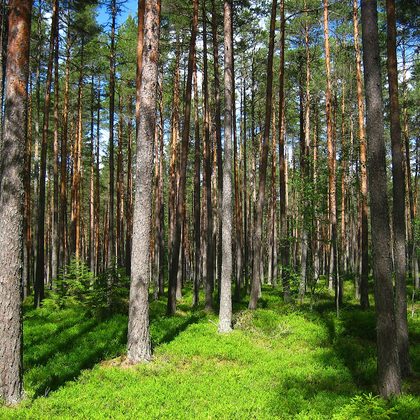
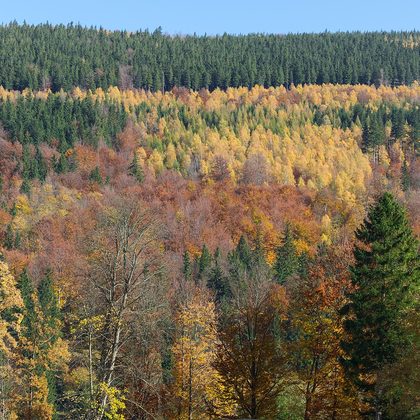
Damp to waterlogged conifer forest: spruce with sphagnum and dwarf shrubs, alder and birch carr along streams and forest pools, bog margins with scattered pines and old clear-fells growing back. It needs wet ground, a dense shrub layer to nest low in and song posts halfway up the trees. On passage in western Europe it turns up in coastal scrub, weedy field edges and gardens.
Where the bird is most at home, classified with EUNIS — the European standard for habitats.



Range and movements
Within the area of this guide the rustic bunting breeds in Finland — by far the main stronghold — and in northern Sweden, northern Norway and north-west Russia, eastwards deep into Siberia. The whole population winters in eastern Asia, from southern China to Japan, leaving in September and October. Britain gets a handful a year, chiefly on Shetland and Fair Isle from late September into October, with a smaller scatter of spring birds on the Northern Isles in May; the annual total has fallen along with the Finnish population.
- Breeding (summer)
- Winter
- Passage
- Migration direction
- dark = core range, pale = thinly spread
Where and when to look
In autumn work coastal scrub and weedy edges on the Northern Isles and listen for a bunting-like tsik harder than a reed bunting's. On every brown bunting check two things: the colour of the flank streaks and the shape of the crown. The real pleasure lies in Finland: walk a boggy forest edge at sunrise in June and search out the soft fluted phrase, which does not carry far and usually comes from halfway up a spruce.
Conservation status
Near Threatened (IUCN). That is already a striking listing for a northern forest bird, and the reason lies not in Europe but on the flyway and in the winter quarters: rustic bunting shares its reedbed and rice-field roosts in eastern Asia with yellow-breasted bunting and is caught there in mist-nets for food. On top of that comes the loss of damp old conifer forest in Fennoscandia to logging and drainage. The Finnish population has fallen by roughly four fifths since the 1980s, and that decline was steep enough to move the species off Least Concern. After yellow-breasted bunting it is the worst-placed bunting in this guide.
Scientific name
Emberiza rustica Pallas, 1776
Pallas described the species in 1776 and placed it straight away in the genus where it still stands. The genus Emberiza was introduced in 1758 by Linnaeus. Emberiza comes from Old German Embritz, a name for a bunting. rustica is Latin for 'rustic, plain'. The specimen the first description was based on came from Transbaikalia, Siberia.