All species › Passerines › Buntings › Little bunting
Little bunting | Emberiza pusilla
Dwerggors | Escribano pigmeo
The smallest bunting in the region, smaller than a reed bunting and, seen close, surprisingly crisply marked about the head: a rufous crown stripe between two black bands, a chestnut cheek and a creamy eyering. It breeds in Lapland and turns up in October standing motionless in a weedy coastal field.

Voice
The call is the handle: a short, hard, dry tik, like two pebbles knocked together — sharper and shorter than anything a reed bunting says, and without its plaintive fall. The song, seldom heard in western Europe, is a brief clear phrase of a second or two, closer to a robin than to a bunting; in Lapland the male sings from late June into mid-July from the top of a birch or a small pine.
No freely licensed recording is available for this species yet.
Identification
A small, compact bunting with a fairly short tail and white outer tail feathers. The head does the work: a rufous median crown stripe between two black bands, a chestnut ear-covert patch outlined in black behind and below, a narrow creamy eyering and a pale spot immediately in front of the eye. The underparts are white with sharp black streaks on breast and flanks, the legs are flesh-pink and the upper mandible is noticeably straight rather than curved. Male and female look much alike, and first-autumn birds already carry the chestnut face.
Confusion species
In autumn the trap is reed bunting: larger, longer-tailed, with a dark malar stripe below a pale submoustachial where little bunting has a plain chestnut cheek, no creamy eyering and a distinctly curved upper mandible. A juvenile yellowhammer gives itself away with the chestnut rump and some yellow on belly or undertail. Rustic bunting shares the white, finely streaked underparts but is larger, raises its crown feathers into a crest and shows a white spot behind the ear-coverts. In practice the bird is heard before it is seen.
Habitat
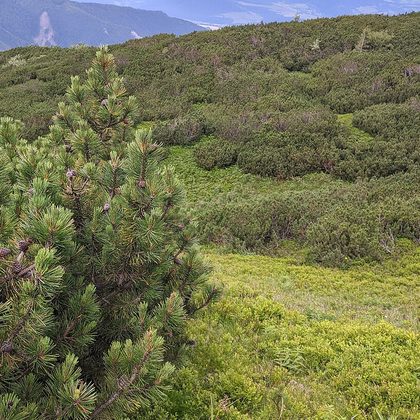
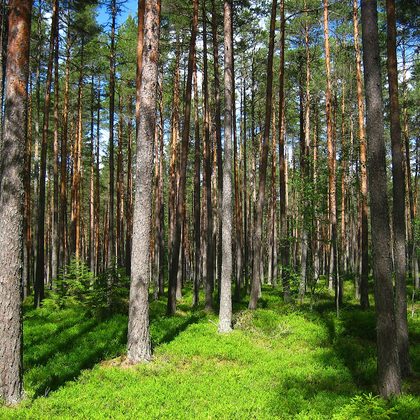
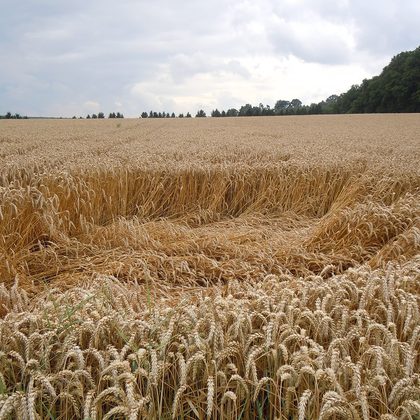
In the breeding season damp birch and willow scrub where taiga meets tundra, bog edges and boggy openings in northern conifer forest, always with a dense herb layer and open wet ground between. On migration it is a bird of low cover: saltmarsh, weedy field edges and potato fields, allotments behind the sea wall and the fringe of dune scrub, where it creeps about on the ground and is usually noticed only when it flushes.
Where the bird is most at home, classified with EUNIS — the European standard for habitats.


Range and movements
Within the area of this guide the little bunting breeds only in the far north: Finnish Lapland, the valleys of northern Norway out to Varanger, and the northern edge of Sweden, in numbers that vary from year to year. The whole population winters in south-east Asia, so what western Europe sees are autumn migrants that have overshot. Britain records roughly fifty to a hundred a year, most of them on Shetland and Fair Isle in late September and October and on Scilly a little later; a few winter, often at a feeding station or on a stubble.
- Breeding (summer)
- Winter
- Passage
- Migration direction
- dark = core range, pale = thinly spread
Where and when to look
This is a call bird. Stand at a coastal watchpoint at first light in October and learn that dry tik; once it is in the ear it stands out from a party of meadow pipits. When the bird settles, look at the cheek: a plain chestnut patch with a dark border means little bunting, and the creamy eyering shows at ten metres. Anyone who would rather meet the species at leisure should go to Lapland in late June and follow the song through the birch bog.
Conservation status
Not globally threatened (IUCN: Least Concern): the breeding range runs from Fennoscandia to the Pacific and the world population is large. European numbers are small and fluctuate but show no clear decline. The steady rise in western European records since the 1970s says more about observer numbers and knowledge of the call than about the bird. Like the other buntings of the Asian flyway it is caught in mist-nets on migration, though for this species that has not yet shown up as a fall in numbers.
Scientific name
Emberiza pusilla Pallas, 1776
Pallas described the species in 1776 and placed it straight away in the genus where it still stands. The genus Emberiza was introduced in 1758 by Linnaeus. Emberiza comes from Old German Embritz, a name for a bunting. pusilla is Latin for 'very small'. The specimen the first description was based on came from the Daurian Range, Siberia.