All species › Passerines › Buntings › Reed bunting
Reed bunting | Emberiza schoeniclus
Rietgors | Escribano palustre
The reed bunting is the bunting that settled for reeds: a black-hooded male jerking out his halting phrase from a swaying reed head, the white collar catching the light from a long way off. Outside the breeding season he leaves the marsh altogether and drifts in loose parties along ditches, field edges and rough ground.

Voice
The song is short, halting and unhurried, as though the bird kept losing the thread: tseee… tseee… tseee-tsississ, two or three separate notes and then a hurried ending. He sings from March to July from a reed head, a willow spray or a fence post. The call decides more than the song does: a plaintive, downslurred tseeoo that falls away at the end, and a sharp tsik when agitated.
No freely licensed recording is available for this species yet.
Identification
A slim bunting with a fairly long, notched tail and white on the outer two tail feathers. The summer male has a black head and throat, a broad white collar and a white submoustachial stripe dividing the black hood from the black bib; the mantle is warm brown with black streaks, the rump greyish brown. In winter the black is buried under brown feather fringes and only a ghost of the mask shows, which wear brings back by March. Female and juvenile are brown and streaked, with a creamy supercilium, a pale submoustachial stripe and, below it, a dark malar stripe that broadens towards the neck. The lesser coverts are chestnut and the belly is white with streaked flanks.
Confusion species
The summer male is unmistakable; the difficulty lies with the brown birds. Two things settle it: the malar stripe and the tail. Reed bunting shows a crisp dark malar stripe below a pale submoustachial, and white on the outer two tail feathers against a greyish-brown rump. Yellowhammer is larger and longer-tailed, with a warm chestnut rump and always some yellow on belly or undertail. Corn bunting is bulky, plain-headed and has no white in the tail. In poor light pipits get called reed buntings, but their bills are thin and pointed rather than short and conical. The southern reed buntings of Spain, Italy and Turkey stand out at once by their thick, bulbous bills and paler plumage.
Habitat
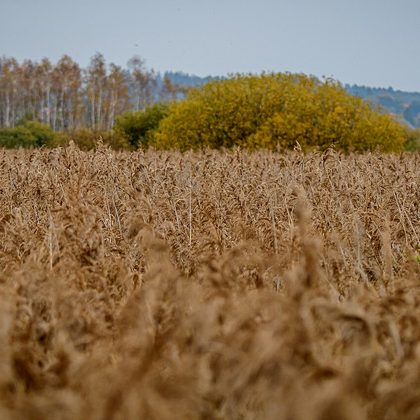
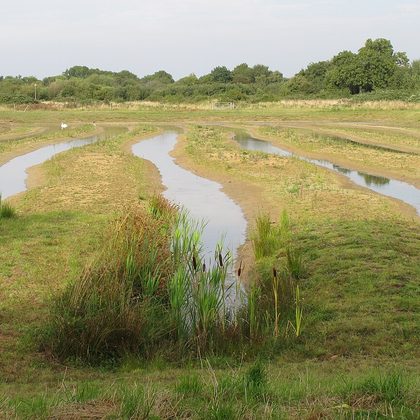
Reed fringes along pools, dykes and creeks, silting-up marshes, sedge beds and damp rough ground with young willows. It needs sturdy old reed stems to nest low in, lookout perches just above the vegetation, and wet ground or open mud to work for seeds and insects. Northern birds also use damp heath and young plantations, and after breeding the species spreads out over stubbles, ditch banks and rough corners well away from water.
Where the bird is most at home, classified with EUNIS — the European standard for habitats.



Range and movements
Breeds across nearly all of Europe, from northern Scandinavia to Iberia and eastwards deep into Siberia. Northern and eastern birds move south-west; in Britain and Ireland many stay put and are joined by continental arrivals. Around the Mediterranean, in Spain, Italy and Turkey, resident populations with strikingly heavy bills hold out in small, fragmented marshes.
- Resident
- Breeding (summer)
- Winter
- Passage
- Migration direction
- dark = core range, pale = thinly spread
Where and when to look
Walk a reedbed edge in April and look for the black head on the tallest reed head; the male sings briefly and falls silent for a long time, so give each patch a few minutes. In winter the call does the work: a single falling tseeoo over a field edge usually means a party sitting low in rough grass. As they flush, check for the chestnut shoulder and the white tail sides.
Conservation status
Not globally threatened (IUCN: Least Concern) and still numerous. Western European numbers fell through the twentieth century with drainage, annual reed cutting and the loss of damp corners, and wetland creation has since recovered part of that. The small thick-billed populations of Spain and North Africa are in real trouble and have disappeared from several areas.
Scientific name
Emberiza schoeniclus (Linnaeus, 1758)
Linnaeus described the species in 1758 as Fringilla schoeniclus; because it was later moved to another genus, the author and year stand in brackets. The genus Emberiza was introduced in 1758 by Linnaeus. Emberiza comes from Old German Embritz, a name for a bunting. schoeniclus is from Ancient Greek skhoiniklos, a name used by classical authors for a bird that can no longer be identified with certainty. The specimen the first description was based on came from Sweden.