All species › Passerines › Buntings › Striolated bunting
Striolated bunting | Emberiza striolata
Gestreepte gors | Escribano estriado
The bunting of the rock desert. In the bare wadis of the Negev, the Judaean desert, southern Jordan and Sinai it sits out the heat on a stone — small, cinnamon-brown, its head crisply striped in black and white — and flies up the gorge wall at the slightest sound.

Voice
The song is short and dry: a handful of quick, slightly jangling notes with a falling ending, usually repeated in short bursts from a boulder or a ledge, most often early in the morning and late in the afternoon. The call is a nasal, slightly rising tswee-ip that rings on between the rock walls and is often the first sign of the bird.
No freely licensed recording is available for this species yet.
Identification
Small and short-tailed, with no white in the tail. The head is grey with sharp black and white stripes — a white crown stripe between black bands, a white supercilium and a white stripe below the cheek, all three boldly marked. The mantle is grey-brown with clear dark streaks, the wings are rufous and the underparts warm cinnamon. The bill catches the eye: the lower mandible is orange-yellow and the upper one dark. The female is a little duller, with less contrast about the head.
Confusion species
Its closest relative is house bunting, exactly the same size and shape but living in north-west Africa; the two occur nowhere together, so place answers the question — this species east of the Nile, house bunting in the Maghreb. Within the Levant the confusion is with rock bunting: larger and longer-tailed, with white tail sides, a grey breast and heavier black head stripes, and living higher in the hills. Trumpeter finch is rounder, has a thick pink bill and no head striping at all. A female house sparrow has a far heavier bill and none of the fine white head stripes.
Habitat
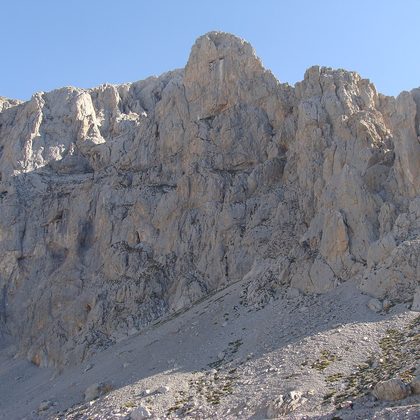
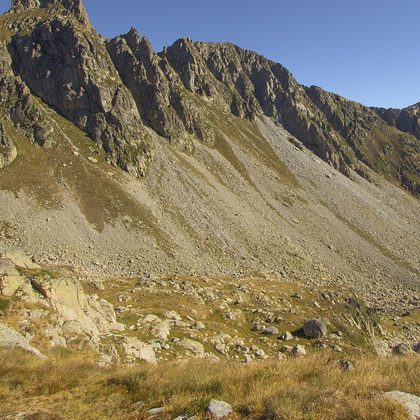
Bare rock desert: gorge walls and rock plateaus, steep wadi flanks, scree slopes and stony plains carrying little more than a withered bush. It nests in crevices and under overhanging stones, feeds walking over open ground, and depends for drinking water on springs, pools and leaking pipes — which is where it turns up near hamlets and livestock posts, though it does not move into the villages themselves.
Where the bird is most at home, classified with EUNIS — the European standard for habitats.


Range and movements
Within the area of this guide the striolated bunting reaches only the south-eastern corner: the Negev and the Eilat mountains, the Judaean desert and the flanks of the Dead Sea rift, the highlands of southern Jordan around Dana, Petra and Wadi Rum, and the mountains of Sinai. Eastwards its range continues across Arabia to Iran and India. It is resident, does not migrate and wanders only locally to water; in severe drought the birds concentrate at the few places that still hold any.
Where and when to look
Sit down at the drinking place. In the Eilat mountains, in Wadi Rum or at Ein Avdat the birds come to a spring or pool at set times — early morning and the last hour of the afternoon — and there you see them close instead of as a silhouette on a ledge. On the way listen for the nasal tswee-ip between the walls, then scan the bare rock ledges: in sunlight the black-and-white striped head jumps straight out of the grey.
Conservation status
Not globally threatened (IUCN: Least Concern) and widespread across a range running from the Sahel to India. In the Levant it is not numerous but it is stable; it lives in country with little to gain from it, and therefore little that changes. It does depend on open water in a dry land, so groundwater extraction and the failure of springs are felt locally. The pale bird of the villages of north-west Africa, long treated as a race of this one, is now handled as a separate species; what is called Emberiza striolata here is thus the bird of the deserts east of the Nile.
Scientific name
Emberiza striolata (Lichtenstein, 1823)
Lichtenstein described the species in 1823 as Fringilla striolata; because it was later moved to another genus, the author and year stand in brackets. The genus Emberiza was introduced in 1758 by Linnaeus. Emberiza comes from Old German Embritz, a name for a bunting. striolata is Latin for 'finely streaked', a diminutive of stria, 'streak', after the markings on head and back. The specimen the first description was based on came from Ambukol, Sudan.