All species › Passerines › Buntings › House bunting
House bunting | Emberiza sahari
Huisgors | Escribano sahariano
The bunting that moved in with people. In the villages and kasbahs of Morocco, Algeria and Tunisia it shuffles across courtyards, between café tables and up the steps of a stair, about as unbothered by us as a sparrow.

Voice
The song is a short, high, slightly jangling phrase of five or six notes with a falling ending, in tone somewhere between a yellowhammer and a sparrow, usually delivered from a roof edge, an aerial or a wall; it can be heard almost all year and is loudest early in the morning. The call is a thin, cheerful tsip, easily lost in street noise.
No freely licensed recording is available for this species yet.
Identification
A small, short-tailed bunting in warm cinnamon-brown. The head is grey with fine white stripes — a pale crown stripe, a pale supercilium and a pale stripe below the cheek — and the rest of the bird is unstreaked orange-brown, with rufous wings carrying two pale bars. The female is slightly duller and less crisply marked about the head. It feeds in short quick steps across pavement and doorstep and flies low on fluttering beats.
Confusion species
In Maghreb villages there is no other small brown bunting with a grey, finely white-striped head. Rock bunting is larger and longer-tailed, with heavy black head stripes above a grey breast. Striolated bunting, which lives far to the east in bare desert wadis and does not reach the Maghreb, is paler and colder in tone, more obviously streaked on mantle and head, and far shyer. A house sparrow has a much heavier bill, a streaked mantle and none of the plain cinnamon.
Habitat
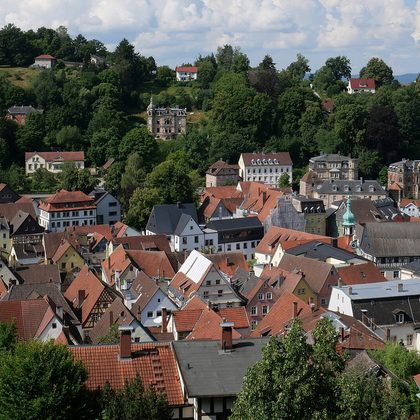
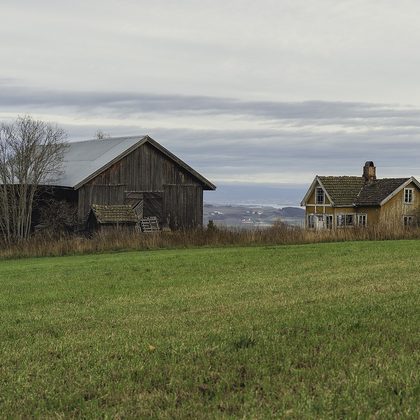
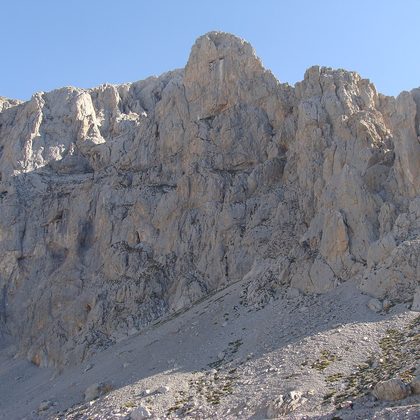
Villages, old town quarters, kasbahs, caravanserais, mosque courtyards and farmyards, and outside the buildings rocky wadis, gorge walls and stone piles. It nests in wall cavities, under roof tiles and in niches, and feeds in streets, courtyards and on the bare ground along the edge of the settlement.
Where the bird is most at home, classified with EUNIS — the European standard for habitats.

Range and movements
Resident in north-west Africa: Morocco, northern Algeria and Tunisia, from the coastal cities to the villages along the southern flank of the Atlas and the oases beyond. Within the area of this guide it occurs nowhere else. It does not migrate and barely wanders; over the twentieth century it spread northwards and took up breeding in the large cities as well.
- Resident
- Breeding (summer)
- Winter
- Passage
- dark = core range, pale = thinly spread
Where and when to look
No fieldwork required: sit down in a courtyard or on a roof terrace in Fez, Marrakesh or Tozeur and wait for a small brown bird to come picking about at your feet. Early in the morning the males sing from the roof edges. Look properly at the head pattern — the fine white on grey is a fine sight at half a metre.
Conservation status
Not globally threatened (IUCN: Least Concern) and anything but scarce in the Maghreb; the growth of towns and villages has suited it rather than harmed it. It is closely related to the striolated bunting of the eastern deserts and was long treated as a race of it; it is now handled as a separate species on plumage, voice and its wholly separate range.
Scientific name
Emberiza sahari Levaillant, 1850
Levaillant described the species in 1850 and placed it straight away in the genus where it still stands. The genus Emberiza was introduced in 1758 by Linnaeus. Emberiza comes from Old German Embritz, a name for a bunting. sahari means 'of the Sahara', after the desert edge where the species lives. The specimen the first description was based on came from southern Algeria.