All species › Passerines › Longspurs and snow buntings › Lapland longspur
Lapland longspur | Calcarius lapponicus
IJsgors | Escribano lapón
A bird of the open tundra that ends up on our stubbles and saltmarshes in autumn and makes itself as small as it can. Where the snow bunting draws the eye, the Lapland bunting does the opposite: it creeps mouse-like through the stubble, sits tight as you approach, and usually gives itself away only with a dry rattle as it bursts up at your feet.

Voice
On migration and in winter the call is the best handle: a hard, dry, rapid prrrt or tikkity-prrt, often followed by a clear, slightly falling tyuu. That rattle is how birds are picked up passing over a coastal watchpoint, and it is also the sound of a bird leaving a stubble field. The song, a short jingling phrase given in a song flight over the tundra, belongs to the far north and is not to be expected here.
No freely licensed recording is available for this species yet.
Identification
Solidly built, with a short tail, long pointed wings and a flat crown; on the ground it lies low and walks in short steps rather than hopping. In the winter plumage you will see here, the key is the wing panel: a chestnut field across the greater coverts, bounded above and below by a narrow white line. Add a rusty nape and a pale ear-covert patch ringed by a dark border that forms a lying C. The bill is yellow with a black tip and the flanks are streaked black. The summer male, rare here, has a black face, throat and breast, a chestnut nape and a white supercilium that bends down the side of the neck. The claw on the hind toe is long and straight, and it gives the species its scientific name.
Confusion species
Reed bunting is the critical species in the same stubbles: it has no chestnut wing panel, it does have white outer tail feathers, and its longer, slightly forked tail is often spread as it moves in a lighter, more hopping fashion. Lapland bunting keeps the tail closed and dark, which gives it a short, blunt rear end in flight. Snow bunting shows one large white wing field instead of two narrow lines. Against female and immature buntings in general, the decisive combination is chestnut nape, chestnut covert panel and the dark surround to the ear coverts; shades of brown on the upperparts will not settle anything, those three marks will.
Habitat
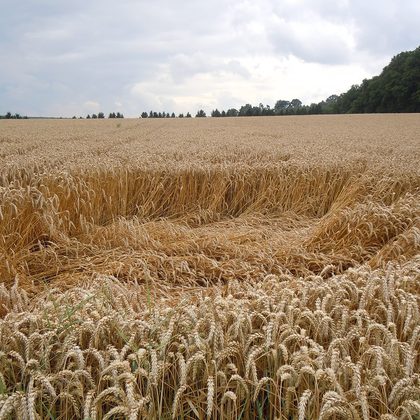
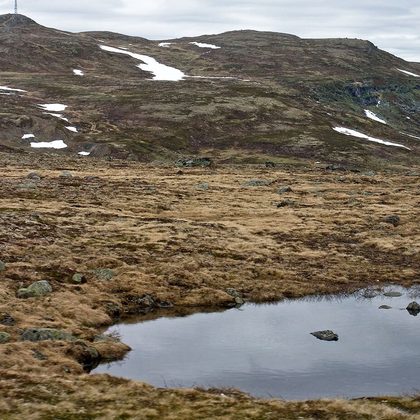
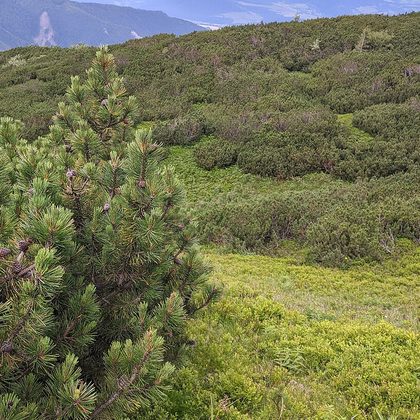
With us, stubble fields and freshly ploughed arable immediately behind the sea defences, saltmarsh, bare beach plains and the edge of tidal flats. It is always short, open, faintly rank ground in which a bird on the deck is invisible and where the seed of weeds and grasses lies. On the breeding grounds it is tundra with dwarf birch, willow scrub and sedge tussocks, and in Fennoscandia the belt of stunted birch and heath above the treeline.
Where the bird is most at home, classified with EUNIS — the European standard for habitats.


Range and movements
Breeds on the tundra of northern Russia, in the Scandinavian mountains and on around the Arctic; European birds move to the steppes of southern Russia and Kazakhstan, with part of the population reaching the North Sea coast. In Britain it is a scarce autumn migrant and local winter visitor to coastal stubbles and saltings, with occasional larger arrivals; in the Netherlands it passes from mid-September to mid-November along the Wadden and Zeeland coasts, and a few birds overwinter. In Spain it is a decided rarity, confined to the north coast.
- Resident
- Breeding (summer)
- Winter
- Passage
- Migration direction
- dark = core range, pale = thinly spread
Where and when to look
Early October, on a stubble field or a saltmarsh behind the sea wall, and on foot. Walk a strip slowly and listen for the dry rattle at your feet; a Lapland bunting will often let you approach to two metres and then drops in again a little further on. Once it is down, look deliberately for the chestnut covert panel. Scan flocks of skylarks and shore larks as well: this bunting seldom falls alone, and its call is clearly different from either.
Conservation status
Not globally threatened (IUCN: Least Concern), with a very large breeding range and a large population. Declines are recorded in Fennoscandia and along the southern edge of the Russian tundra, linked to warming and to scrub advancing over open tundra. In north-western Europe the issue is not protection but the loss of stubbles left standing through the winter, which leaves passage birds fewer places to refuel.
Scientific name
Calcarius lapponicus (Linnaeus, 1758)
Linnaeus described the species in 1758 as Fringilla lapponica; because it was later moved to another genus, the author and year stand in brackets. The genus Calcarius was introduced in 1802 by Bechstein. Calcarius is from Latin calcaria 'spurs', after the long claw on the hind toe. lapponicus means 'of Lapland', after the breeding grounds in the far north. The specimen the first description was based on came from Lapland.