All species › Passerines › Finches › Corsican finch
Corsican finch | Carduelis corsicana
Corsicaanse citroensijs | Verderón corso
The Corsican Finch occurs only on Corsica, Sardinia and Elba, and since the start of this century most lists have treated it as a species in its own right, separate from the Citril Finch of the mainland. On the islands it is no rarity but a common bird, found from the coastal maquis right up above two thousand metres.

Voice
The call is a nasal, slightly plaintive tsee-oo, essentially identical in timbre to the Citril Finch's and therefore no help in separating the two; in flight there is also a short rolling ti-ti-tit. The song is a fast, dry, slightly jangling babble with nasal flourishes, given from a pine top, a telephone wire or a boulder, and heard from March into July. On the islands the voice is useful for finding the bird rather than for naming it — the plumage does that.
No freely licensed recording is available for this species yet.
Identification
A small, compact finch with a short pointed bill and a short forked tail. The head is grey with a yellow forehead, a yellow supercilium and a yellow throat; breast and belly are bright yellow. The mantle is warm brown with dark streaks, the uppertail coverts are grey, and the flanks carry fine brown streaks. The female is paler, with less yellow and heavier streaking; juveniles are brown and streaked right across the underparts.
Confusion species
The comparison that counts is with the mainland Citril Finch, and a decent view settles it: the mainland bird has a plain grey-green, unstreaked mantle and unstreaked flanks, while the Corsican has a brown, streaked mantle and fine brown flank streaks. In the field they never meet in any case — Corsica, Sardinia and Elba hold only the Corsican, the mainland only the other. On the islands themselves the real confusion is Serin, which is smaller, shorter tailed, far more densely streaked across the whole underside, and shows a bright yellow rump and a stubby bill.
Habitat
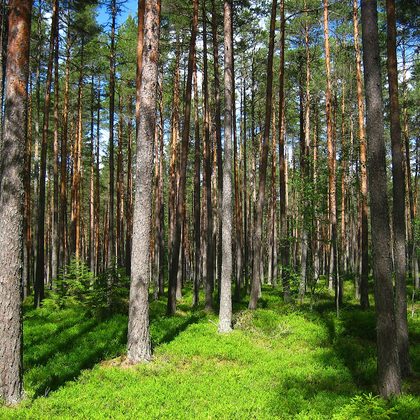
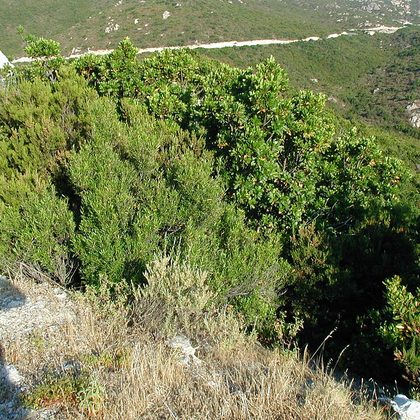
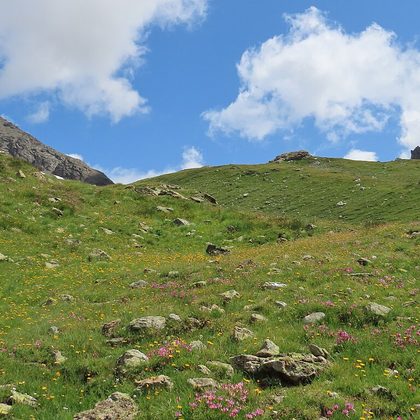
Whatever carries seed on the islands: the coastal maquis and strawberry-tree scrub near the sea, the chestnut and oak woods at middle levels, and above all the open Corsican pine forest higher up, right to the bare tops. It feeds a great deal on the ground, along tracks, on car parks and on short-grazed patches of turf.
Where the bird is most at home, classified with EUNIS — the European standard for habitats.
Range and movements
Corsica, Sardinia and Elba, with smaller numbers on Capraia and Gorgona. On Corsica it occurs from sea level to about 2,250 metres and can be met almost anywhere; on Sardinia it is patchier and more montane. In winter the mountain birds drop to the valleys and the coast. Away from these islands it is a considerable rarity.
- Resident
- Breeding (summer)
- dark = core range, pale = thinly spread
Where and when to look
On Corsica, drive to a pine-clad pass — the Col de Vergio or the Col de Sorba — and watch the verges, the car parks and the puddles along the road: parties come there to drink and pick seed, often at a few metres. Look hard at mantle and flanks, because those two characters are exactly what set the species beside the mainland bird.
Conservation status
Not globally threatened (IUCN: Least Concern). The bird is numerous on its islands, but its entire world range fits into a couple of hundred kilometres, and that makes it vulnerable: large fires in the Corsican pine forest and the scrubbing over of the high pastures are the real risks.
Scientific name
Carduelis corsicana (Koenig, 1899)
Koenig described the species in 1899 as Citrinella corsicana; because it was later moved to another genus, the author and year stand in brackets. The genus Carduelis was introduced in 1760 by Brisson. Carduelis is the Latin word for the goldfinch, derived from carduus 'thistle', whose seeds the bird eats. corsicana means 'of Corsica', the island the species was described from. The specimen the first description was based on came from Corsica.