All species › Passerines › Finches › Citril finch
Citril finch | Carduelis citrinella
Citroensijs | Verderón serrano
The Citril Finch is the finch of the treeline: a small yellow-green bird of the open mountain forests and alpine pastures of the Pyrenees, the Alps, the Black Forest and the Vosges. It eats the seeds of herbs and of spruce and pine, and feeds a great deal on the ground, running mouse-like between short turf and stone chippings.

Voice
The call is a nasal, slightly drawn tsee-oo or dzee, its timbre halfway between Siskin and Linnet, and at range it is the most usable character. In flight there is also a short rolling tit-tit-tit by which parties keep contact. The song is a fast, rattling, slightly jangling babble with nasal flourishes worked in, shorter and drier than a Serin's, delivered from a spruce top or in a slow butterfly-like song flight over the pasture; heard from April into July.
No freely licensed recording is available for this species yet.
Identification
Small and compact, with a short pointed horn-coloured bill and a short forked tail. Head and underparts are yellow-green, with a grey nape and grey sides to the neck lying like a scarf around the yellow head. The mantle is plain grey-green and unstreaked and the rump is yellow; the wing carries two yellowish bars. The female is duller and greyer; juveniles are brownish and finely streaked but already show the yellow rump and yellowish wingbars.
Confusion species
Corsican Finch is the critical species, and the difference really is visible: it has a warm brown, dark-streaked mantle and fine brown streaks on the flanks, where Citril Finch has a plain grey-green mantle and unstreaked flanks. They never meet in any case — Corsican Finch is confined to Corsica, Sardinia and Elba. What does occur alongside it in the mountains is Siskin, which is streaked on mantle and flanks, has a black crown and chin in the male, and a much finer bill. Greenfinch is a size larger, far heavier billed, and shows bright yellow flashes in wing and tail.
Habitat
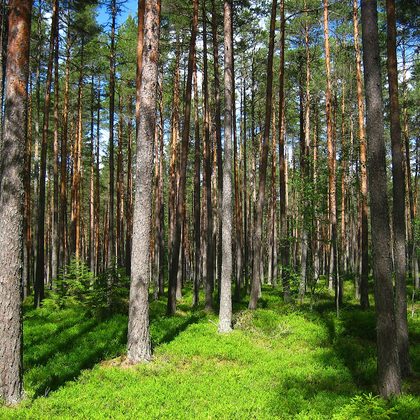
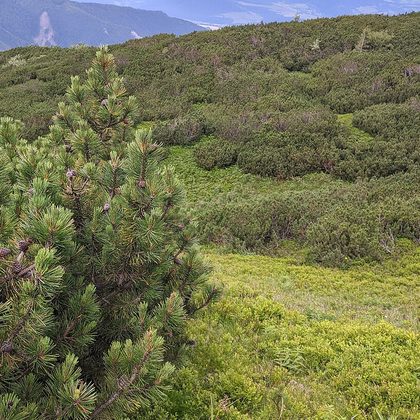
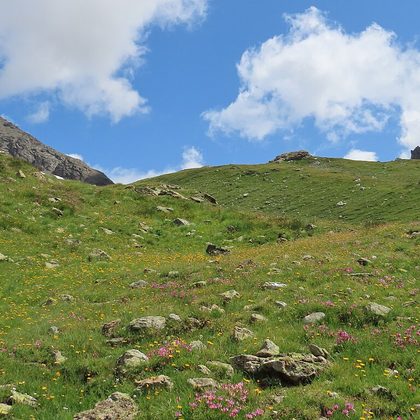
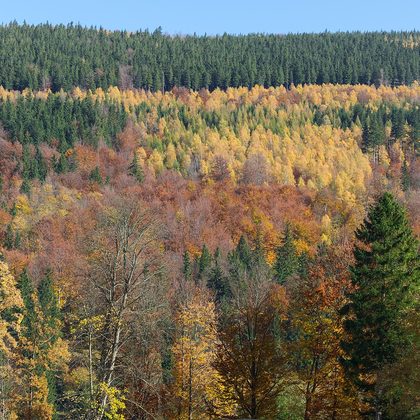
Open mountain forest of spruce, pine and larch between roughly a thousand and two thousand metres, the dwarf scrub at the treeline, and the short alpine pastures, ski runs and stony slopes above it, where it picks herb seed off the ground. In winter it drops to the valleys and feeds on fallow ground, weedy field edges and mountain roadsides.
Where the bird is most at home, classified with EUNIS — the European standard for habitats.
Range and movements
The mountain ranges of south-west and central Europe: the Cantabrians and Pyrenees, the Massif Central, the Vosges, the Black Forest, the Jura, the Alps and the Apennines, with further Spanish populations in the Iberian System, the Central System and the Sierra Nevada. It is a patchwork of separate populations, each tied to its own range, and there is scarcely any true migration. North of the mountains it is a great rarity; Britain has a single accepted record, on Fair Isle.
- Resident
- Breeding (summer)
- Winter
- Passage
- dark = core range, pale = thinly spread
Where and when to look
Go to the treeline in June and work the transition: the last spruces, then dwarf scrub, then grass. There the parties feed on the ground and fly to the nearest spruce top when disturbed. A car park or a ski run at two thousand metres is often the best spot, because it holds short turf full of seed and the birds come to drink at the meltwater channels.
Conservation status
Not globally threatened (IUCN: Least Concern). It is common in the Alps and Pyrenees; the scrubbing over of abandoned alpine pasture and the loss of open forest structure are the main concerns. In the Black Forest and the Vosges the population is small and has fallen in places.
Scientific name
Carduelis citrinella (Pallas, 1764)
Pallas described the species in 1764 as Fringilla citrinella; because it was later moved to another genus, the author and year stand in brackets. The genus Carduelis was introduced in 1760 by Brisson. Carduelis is the Latin word for the goldfinch, derived from carduus 'thistle', whose seeds the bird eats. citrinella is an Italian word for a small yellow bird, a diminutive of Latin citrinus 'citron-yellow'. The specimen the first description was based on came from Holland.