All species › Passerines › Finches › Red crossbill
Red crossbill | Loxia curvirostra
Kruisbek | Piquituerto común
The Crossbill runs its year on the cone crop rather than on daylight. In a wood where the spruce is heavy with cones it may have young in the nest in January, snow on the branches and all; when the crop fails it leaves in midsummer, in thousands. The crossed tips of the bill do one thing supremely well: they lever a cone scale open so the tongue can lift the seed out.

Voice
The call is the species' key character and at the same time the reason the whole genus is so troublesome. The flight call is a hard metallic chip chip chip, usually in runs of three to five and audible for several hundred metres; a party going over always announces itself that way first. Feeding flocks add a softer, excited tyup. The song is a long ramble of those same calls with rattles, trills and the odd clear whistle mixed in, delivered from a bare leading shoot or in a slow butterfly-like song flight. What matters to the birder: several distinct call types are recognised within Common Crossbill in Europe, each with its own flight call, and birds of one type keep largely to their own company. Recording calls and reading the sonogram takes you much further than listening alone — and even then some birds stay nameless.
No freely licensed recording is available for this species yet.
Identification
A heavy, thickset finch with a big head, a short deeply forked tail and a stout bill whose tips cross past each other. Males are brick-red to orange, females grey-green with a yellowish rump, and juveniles grey-brown, coarsely streaked on head, breast and back. Wings and tail are plain dark brown with no wingbar at all. The flight silhouette is distinctive: heavy at the front, short forked tail behind, and a fast bounding flight high over the treetops.
Confusion species
The other three crossbills are the real difficulty, and it is an honest one: they differ almost solely in bill depth and in call, and both characters overlap so widely that a proportion of birds simply cannot be named in the field. Only Two-barred Crossbill stands out at once, with two broad white wingbars and white tips to the tertials. Parrot and Scottish Crossbills have a deeper, more bulbous bill with less protruding crossed tips, but that is a matter of proportions on a sharp photograph, not of one look through the binoculars. Females are also passed off as Greenfinches, which have a straight conical bill and bright yellow flashes in wing and tail.
Habitat
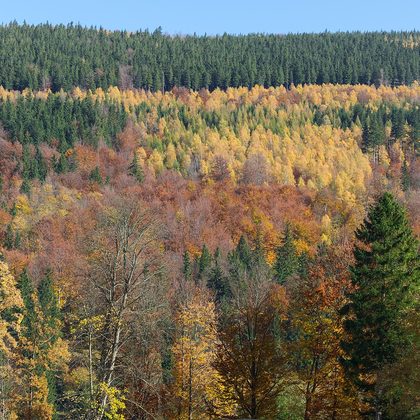
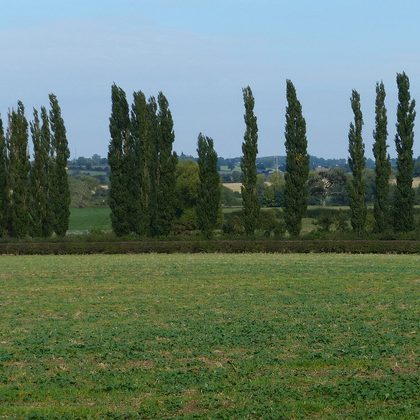
Conifers of every kind: spruce stands, Scots and Corsican pine, larch and Douglas fir, together with mixed woodland carrying plenty of conifer, shelterbelts, churchyards and parks with mature ornamental conifers. It feeds clambering and hanging in the canopy, often upside down on a cone. Away from the canopy it seeks water: shallow puddles on forest tracks, ditches, cattle troughs — a diet of dry seed makes for thirst.
Where the bird is most at home, classified with EUNIS — the European standard for habitats.


Range and movements
Breeds throughout Europe wherever conifers grow, from the Norwegian and Finnish taiga to the mountain forests of Spain, the Balearics, Corsica, the Balkans and Turkey, and beyond that in the Atlas. In Britain it nests in the pine forests of the Highlands, in Breckland and in the larger conifer plantations, in fluctuating numbers. Every three to five years or so an irruption arrives from the north-east from June onwards, and then crossbills turn up in small copses where they are otherwise unknown.
- Resident
- Breeding (summer)
- Winter
- Passage
- dark = core range, pale = thinly spread
Where and when to look
Look at the ground first. Fresh, shredded cones with the scales levered up under the spruce mean the birds are in that wood. Then stand in a clearing and listen upward: the hard chip chip nearly always arrives before the bird does. In a dry summer it pays to sit by a forest pool, because the whole party comes down to drink and for once you see them low.
Conservation status
Not globally threatened (IUCN: Least Concern). Numbers swing wildly from year to year with the cone crop, so any single count says little; over longer runs there is no decline. Locally the conversion of conifer plantation to broadleaf woodland works against it, but across its range the species is abundant.
Scientific name
Loxia curvirostra Linnaeus, 1758
Linnaeus described the species in 1758 and placed it straight away in the genus where it still stands. He introduced the genus Loxia in that same work. Loxia comes from Ancient Greek loxos 'crosswise', after the crossed tips of the bill. curvirostra is Latin for 'curved bill', from curvus 'bent' and rostrum 'bill'. The specimen the first description was based on came from Sweden.