All species › Passerines › Finches › Scottish crossbill
Scottish crossbill | Loxia scotica
Schotse kruisbek | Piquituerto escocés
The Scottish Crossbill is the only bird species that occurs nowhere but Britain: it breeds in the old pinewoods of the Scottish Highlands and nowhere else on earth. It is also the hardest bird in this book, because in the field it can be told only by its call and by where it is — and the first of those is still argued over.

Voice
Sound is the only field character there is, which is why it gets space here. The flight call is a hard, slightly tinny chip, fuller and deeper than Common Crossbill's and sharper than Parrot Crossbill's — halfway between, in other words, and that is exactly the trouble. The excitement call, given by resting and feeding parties, is a dry tyuk and is reckoned the most usable character of the three. The song is a run of rattles, calls and short trills from a pine top, not separable by ear from the other two. Even with recordings the matter stays contested: the three species overlap on sonograms and not every researcher draws the boundaries in the same place. Anyone expecting certainty here is expecting more than the bird gives.
No freely licensed recording is available for this species yet.
Identification
A crossbill of intermediate build: stouter than Common, less massive than Parrot, with a bill a little deeper than the first and a little less bulbous than the second. Male brick-red, female grey-green with a yellow rump, juveniles grey-brown and streaked — exactly as in the other two. There is no plumage character, no wingbar and no proportion that settles it on looks alone.
Confusion species
Common and Parrot Crossbill both breed in the same Highland pinewoods, and the bill measurements of the three form one continuous series with no gap. The consequence is that a photographed bird usually stays unnamed. Researchers therefore work from recordings: measurements of Scottish birds show a distinct flight call and excitement call, and birds pair largely with partners matching them in call and bill size. Outside Scotland the name has no meaning at all — any crossbill elsewhere is not this one.
Habitat
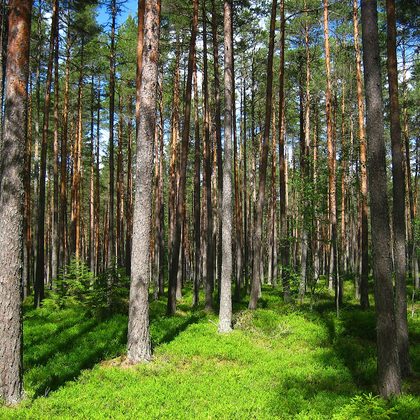
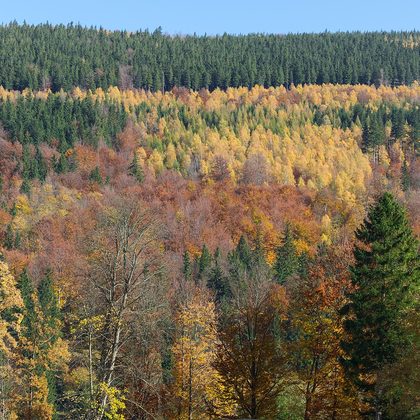
Old, open Scots pine forest in the Highlands — the remnants of the Caledonian forest — together with older pine plantation and mixed woodland with plenty of pine. It feeds on cones in the canopy and comes to the ground to drink at lochans, puddles and ditches along forest tracks.
Where the bird is most at home, classified with EUNIS — the European standard for habitats.
Range and movements
Scotland only, and within it mainly the Highlands north of the Great Glen and the Spey valley: Strathspey, Deeside, Easter Ross and Sutherland. The population is put at a few thousand birds, though every estimate is only as good as the identification behind it. Abernethy, Glen Tanar and Rothiemurchus are the classic places to look.
- Resident
- Winter
- dark = core range, pale = thinly spread
Where and when to look
Go to an old pinewood in Strathspey in March or April and take a recorder: with this species, listening and recording is the only method that gets past a hunch. Look early in the day at a forest pool, where parties come to drink and give the excitement call. And write down honestly what you have: 'crossbill sp.' is just as valuable a record.
Conservation status
Not globally threatened (IUCN: Least Concern), but it is a species with a small range and a small population, and therefore little margin. Keeping and extending old Highland pinewood is the measure that decides its future; loss of mature cone-bearing pine and replacement by spruce are the main threats. The contested taxonomy makes monitoring numbers harder still.
Scientific name
Loxia scotica Hartert, 1904
Hartert described the species in 1904 and placed it straight away in the genus where it still stands. The genus Loxia was introduced in 1758 by Linnaeus. Loxia comes from Ancient Greek loxos 'crosswise', after the crossed tips of the bill. scotica is Latin for 'Scottish', after the Scottish pine forests to which the species is confined. The specimen the first description was based on came from Ross-shire, Scotland.