All species › Passerines › Finches › Parrot crossbill
Parrot crossbill | Loxia pytyopsittacus
Grote kruisbek | Piquituerto lorito
The Parrot Crossbill is the pine specialist of the genus, with a bill built like a pair of pliers, heavy enough to lever open the hard closed cones of Scots pine. It breeds in the pine forests of Fennoscandia and north-west Russia and in small numbers in the Scottish Highlands, and in irruption years it reaches Denmark, Germany, the Low Countries and eastern England.

Voice
With this species the sound matters more than the sight, and even so it is not proof. The flight call is a deep, hard, slightly barking chop chop or kop kop, noticeably lower and slower than the sharp chip of Common Crossbill and with a full wooden timbre; anyone who hears both often knows it at once, but the lowest Common Crossbill call types come close. The excitement call from resting flocks is a deeper, more nasal tyuk. The song is built from the same materials as Common Crossbill's — calls, rattles and trills — but runs lower, slower and looser, with longer gaps. If you want certainty, record it: on a sonogram the Parrot's bands sit broader and lower, and that separates better than the ear alone.
No freely licensed recording is available for this species yet.
Identification
A crossbill with everything a size larger: a heavier head, a thicker neck and above all a deep bulbous bill whose lower mandible curves markedly upward and whose crossed tips barely protrude. The head looks square, with a steep forehead running almost straight into the bill. Males are brick-red, females grey-green with a yellow rump, juveniles grey-brown and streaked — the plumage adds nothing to separating it from Common Crossbill.
Confusion species
Everything turns on Common Crossbill, and the division is less clean than a plate suggests. Big-billed male Common Crossbills reach the bill measurements of small Parrot Crossbills, so a proportion of birds cannot be named in the field; that is a property of the group, not a failure of the observer. Watch the ratio of bill depth to bill length — in Parrot the bill is nearly as deep as it is long — and the near-straight line from forehead to bill tip. Scottish Crossbill sits precisely between the two, but occurs only in Scotland. Two-barred Crossbill is ruled out by its broad white wingbars.
Habitat
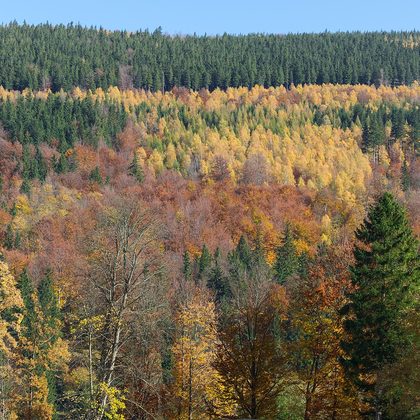
Mature Scots pine forest, above all on poor sandy soils and along the edges of raised bogs, where old low-branched pines carry heavy cone crops. In irruption years also in pine plantation and on pine-grown heath far outside the breeding range. It feeds almost entirely in the pine canopy and comes to the ground only to drink.
Where the bird is most at home, classified with EUNIS — the European standard for habitats.


Range and movements
Breeds in Norway, Sweden, Finland and north-west Russia, with small numbers in Estonia, Latvia and the Scottish Highlands. After a failed pine crop, flocks move south-west and reach Denmark, northern Germany, the Low Countries and Britain, where a pair has occasionally stayed to breed after an influx — the Budby Common and Norfolk birds are the best-known British examples. In other years it is genuinely rare west of the Baltic.
- Resident
- Breeding (summer)
- Winter
- Passage
- Migration direction
- dark = core range, pale = thinly spread
Where and when to look
In an irruption winter, work old low-branched Scots pines on a heath or a large estate, and listen for the deep chop among the ordinary crossbills. Record the call if you can, because that is the only thing that stands up afterwards. Otherwise watch the head profile: a forehead and bill forming one straight line, with the tail looking oddly short, means you are on the right track.
Conservation status
Not globally threatened (IUCN: Least Concern). The species depends entirely on mature pine forest with a regular cone crop; where old pines are felled or replaced by spruce it disappears. Restoring old pinewood, in Scotland as in Fennoscandia, is therefore the measure that counts.
Scientific name
Loxia pytyopsittacus Borkhausen, 1793
Borkhausen described the species in 1793 and placed it straight away in the genus where it still stands. The genus Loxia was introduced in 1758 by Linnaeus. Loxia comes from Ancient Greek loxos 'crosswise', after the crossed tips of the bill. pytyopsittacus is Greek, from pitus 'pine' and psittakos 'parrot', after the heavy bill with which the bird prises open pine cones. The specimen the first description was based on came from Sweden.