All species › Falcons › Falcons › Eleonora's falcon
Eleonora's falcon | Falco eleonorae
Eleonora's valk | Halcón de Eleonor
A long-winged Mediterranean falcon whose whole year is tuned to bird migration: it lays in late July so that its young are raised on the stream of small songbirds crossing the sea in September. At a colony dozens hunt together in front of the cliff.

Voice
Noisy at the colony: a hard, nasal, grating kyeh-kyeh-kyeh-kyah, deeper and rougher than a Hobby's call, and a sustained shrill alarm as soon as anyone approaches the cliff. Silent away from the colony. August and September are the months when the sound carries almost continuously over the nesting cliffs.
No freely licensed recording is available for this species yet.
Identification
Clearly larger and longer than a Hobby, with strikingly long, narrow wings and a long tail that projects well beyond the wingtips in a glide. Two colour morphs occur, independent of sex. The light morph is dark above, with a cream throat and cheek, a broad black moustache and warm rufous, dark-streaked underparts; in flight the blackish underwing coverts contrast sharply with paler flight feathers, and at range that contrast is the best mark. The dark morph is almost uniformly sooty brown to black, with only slightly paler flight feathers below. In adults the cere and eye-ring are yellow on the male and blue-grey on the female. The flight is easy and buoyant, with long glides on slightly bowed wings broken by very fast stoops.
Confusion species
Hobby is the main confusion species and resembles a light-morph Eleonora's most closely, but it is smaller and more compact, with a short tail that barely reaches past the wingtips, a sharp black-and-white head pattern, creamy white rather than rufous underparts and pale rather than dark underwing coverts. Red-footed Falcon is smaller again and shorter-winged; the male is uniform slate-grey with red legs, the female has an orange crown, unstreaked orange underparts and a small eye mask, never the broad moustache and two-toned underwing of Eleonora's. A dark-morph Eleonora's can suggest a Black Kite in silhouette, but that has far broader wings and a forked tail. Peregrine shares the same sea cliffs but is bulkier, broader-based in the wing and barred rather than streaked below.
Habitat
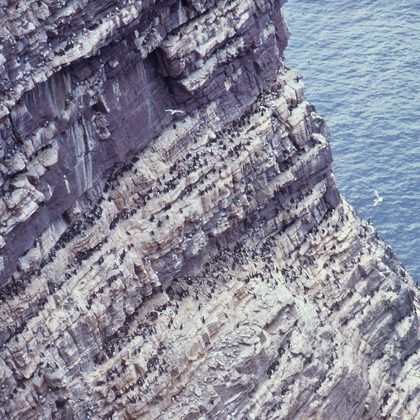
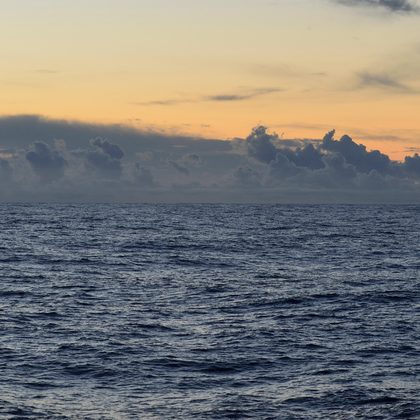
Rocky islets, steep sea cliffs and uninhabited coastal rocks, with the open sea in front of them as the hunting ground. It nests on ledges and in niches without building a nest, and in late summer hunts high over the water: the birds of a colony hang in a loose wall offshore and intercept songbirds attempting the crossing. Before the breeding season, when no migrants are moving yet, it takes mainly insects on the wing over coastal plains and river mouths.
Where the bird is most at home, classified with EUNIS — the European standard for habitats.
Range and movements
Breeds almost entirely on islands and cliffs in the Mediterranean — the great majority in Greece — and further on the Balearics, the Columbretes, Sardinia, Crete and Cyprus and along the Moroccan and Canarian coasts. The entire world population winters on Madagascar, travelling there right across the African continent rather than over the sea. In Britain and the Netherlands it is a major rarity with only a handful of records.
- Breeding (summer)
- Passage
- dark = core range, pale = thinly spread
Where and when to look
Late August and September at a colony: a boat trip along the cliffs of Mallorca, Sardinia or the Aegean islands, or a walk to a headland such as Cap de Formentor. Pick a day with onshore wind, sit down and watch seaward; the birds hunt hardest in the early morning and in the last hour of light. On every bird measure the tail against the wingtips and check the dark underwing coverts — at range that is what separates it from a Hobby.
Conservation status
Not threatened (IUCN: Least Concern) and stable to slightly increasing in Europe over recent decades, now that many colonies are wardened. The species remains vulnerable because nearly all of it sits on a limited number of islets: disturbance by boats, fishermen and climbers in the breeding season, feral cats and rats on nesting cliffs, illegal shooting on migration and the loss of woodland and hunting habitat on Madagascar therefore weigh heavily.