All species › Passerines › Finches › Eurasian bullfinch
Eurasian bullfinch | Pyrrhula pyrrhula
Goudvink | Camachuelo común
Everyone knows the Bullfinch from pictures: the rose-pink male with the black cap. In the field it is a surprisingly unobtrusive bird that works quietly through the scrub and gives itself away with a soft, mournful whistle.

Voice
The call is the best character the species has: a soft, low, plaintive piped peuu, a single slightly descending note that carries through cover and is given all year. The song hardly deserves the name — a hesitant, creaking, wheezy mumble at low volume, audible only at close range and mostly in March and April.
No freely licensed recording is available for this species yet.
Identification
A stocky finch with a short, deep, black bill, a black cap that reaches below the eye, and a broad pure white rump that flares as the bird turns away. The male has a bright rose-pink breast and cheeks over a blue-grey mantle; the female is grey-brown in the same places. Both have a black tail, black wings crossed by one pale grey bar, and a white belly. Juveniles lack the black cap.
Confusion species
Adults are unmistakable, and the white rump against the black tail settles it at range. Juveniles, with no black cap, get taken for young Linnets or female Chaffinches, but neither has the broad white rump or the short, bulbous black bill. Northern Bullfinches, which arrive in irruption years, are noticeably bigger and paler pink and give a trumpeting call.
Habitat
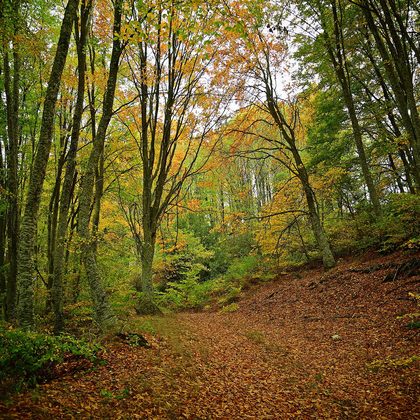
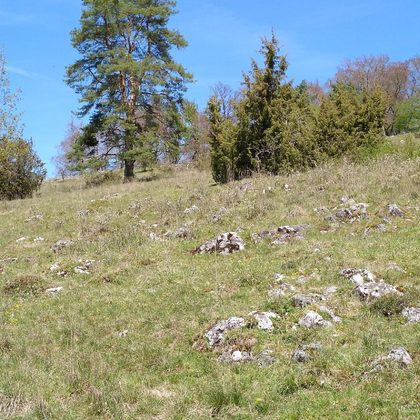
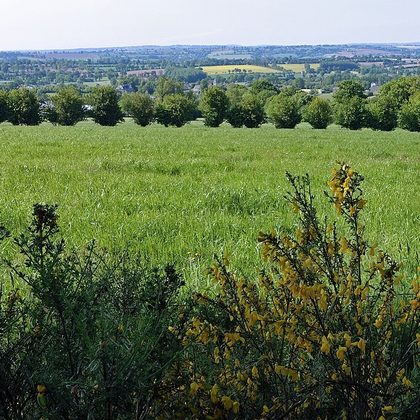
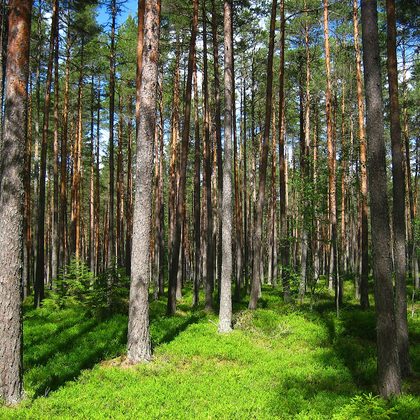
Woodland edge, young plantation, hedgerows, thickets, nurseries, large gardens and churchyards; in the mountains and in the north also mature conifer forest. It feeds on the seeds of ash, maple, bramble and herbs, and in late winter on the buds of fruit trees and blackthorn.
Where the bird is most at home, classified with EUNIS — the European standard for habitats.

Range and movements
Almost all of Europe, from northern Scandinavia to northern Spain and the Balkans, and in the south confined to the mountains. In Britain and the Low Countries it is a widespread but never numerous bird of edges and hedges, reinforced in winter by birds from the north-east.
- Resident
- Breeding (summer)
- Winter
- Passage
- Migration direction
- dark = core range, pale = thinly spread
Where and when to look
Walk a woodland edge with plenty of ash in November or December and listen rather than look: the soft peuu reaches you before the bird does. Then stand still and search low in the scrub, because Bullfinches feed slowly and move very little, so patience gives you a proper view. Against snow the white rump shows at a hundred metres.
Conservation status
Not globally threatened (IUCN: Least Concern). It declined across north-west Europe through the second half of the twentieth century, most likely with the loss of scrub, rough ground and dense woodland edge; the fall has since levelled off. The old persecution in orchards, where the bird was killed for taking buds, no longer plays any part.
Scientific name
Pyrrhula pyrrhula (Linnaeus, 1758)
Linnaeus described the species in 1758 as Loxia pyrrhula; because it was later moved to another genus, the author and year stand in brackets. The genus Pyrrhula was introduced in 1760 by Brisson. Pyrrhula goes back to Greek purrhoulas, the name of a red-breasted bird, from purrhos 'flame-red'. The specific name repeats the genus name. The specimen the first description was based on came from Europe.