All species › Passerines › Finches › Azores bullfinch
Azores bullfinch | Pyrrhula murina
Azorengoudvink | Camachuelo de las Azores
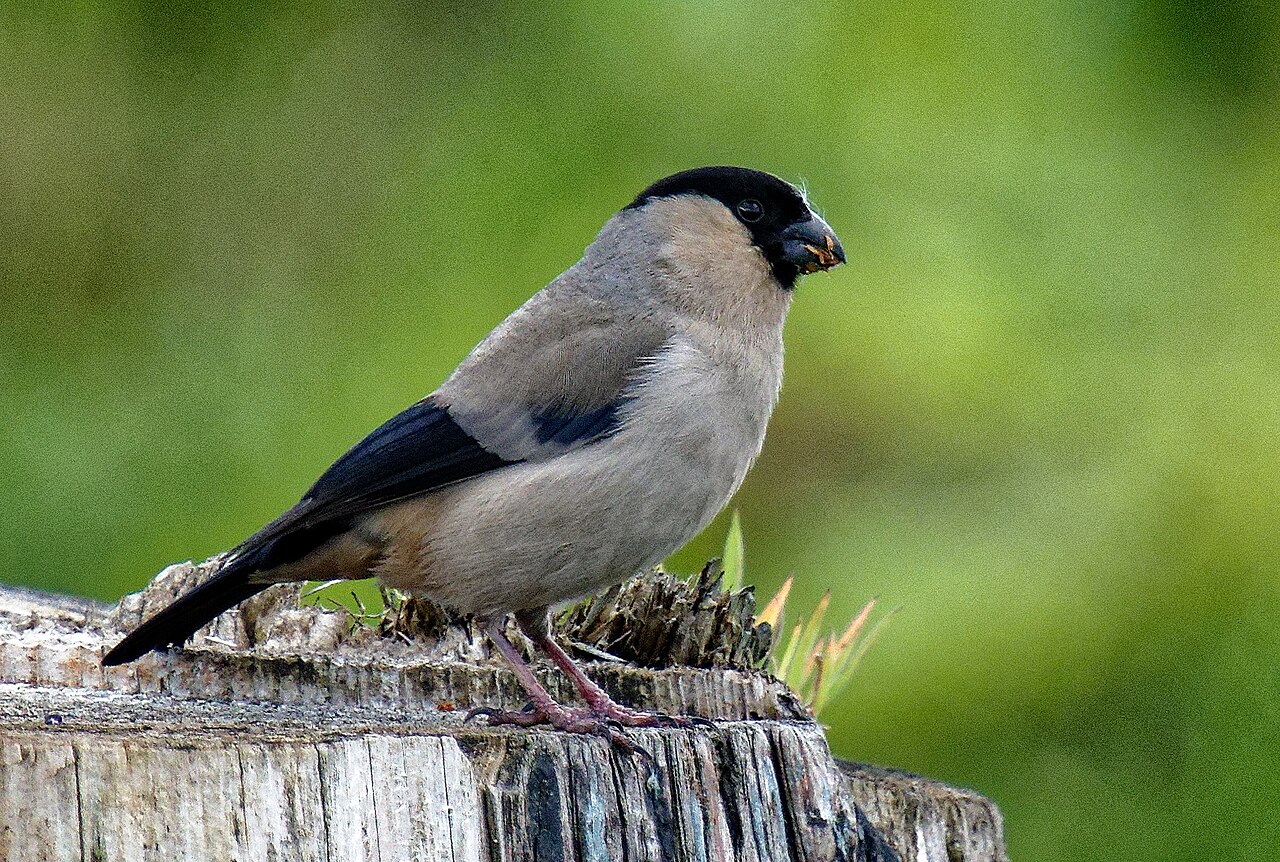
The priolo, as it is known on the Azores, lives in a single stretch of laurel forest in the east of São Miguel: the Serra da Tronqueira around Pico da Vara, a few hundred hectares on an island in the ocean. It is a bullfinch that has lost the pink — a big, grey-brown bird with a black cap and a heavy bill. Twenty years ago it counted as one of Europe's most threatened songbirds; it is now one of the few species in this guide where management has genuinely worked.
Voice
The call is the best character here too: a soft, low, plaintive piped peuu, one slightly descending note, a shade fuller and hoarser than Eurasian bullfinch's and given all year. Often it is the only sign you get of the bird, which works quietly and hidden in the foliage. The song is a hesitant, soft, creaking mumble audible only at close range, with wheezing and piping notes threaded through it, mostly in spring.
No freely licensed recording is available for this species yet.
Identification
Larger and heavier than Eurasian bullfinch, with a strikingly thick, broad black bill. Black cap running down below the eye, black chin, and beyond that a plain grey-brown body: head, back, breast and belly all the same dull mouse-grey, the male at most with a faint pink or wine wash across breast and flanks. Wings and tail are black with a blue gloss, one pale grey bar crosses the wing, and the rump is white — the same white flash that shows as the bird turns away as in Eurasian bullfinch. Male and female look much alike; sex cannot be settled with certainty in the field. Juveniles lack the black cap and are a warmer brown.
Confusion species
On São Miguel there is nothing to confuse it with: it is the only bullfinch on the archipelago and by a wide margin the largest seed-eater on the island. Eurasian bullfinch does not occur on the Azores; seen side by side, this species plainly lacks the male's bright rose and the blue-grey mantle and stays one dull tone from head to tail, with a noticeably heavier bill. Inside the forest the thing to guard against is writing it off as a blackbird or a starling: the white rump, the bulbous black bill and the slow, silent way it feeds settle it.
Habitat
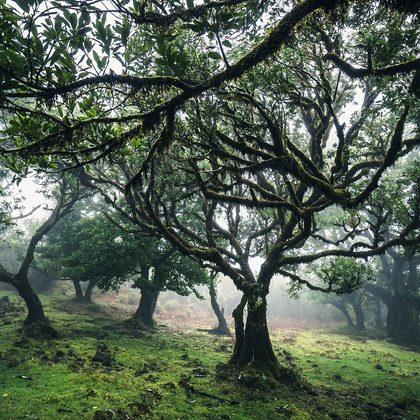
The native laurel forest of the summit ridge, with laurel, holly, Azores juniper and tree heath, between about three hundred and nine hundred metres, plus the adjoining scrub and open woodland edges where it feeds on herbs and ferns. Its diet turns with the season as few birds' do: flower buds in spring, seeds and fruit through summer and autumn, fern spores and tree buds in winter — a calendar only a varied native forest can complete.
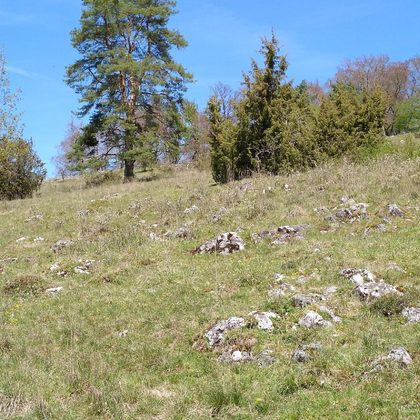
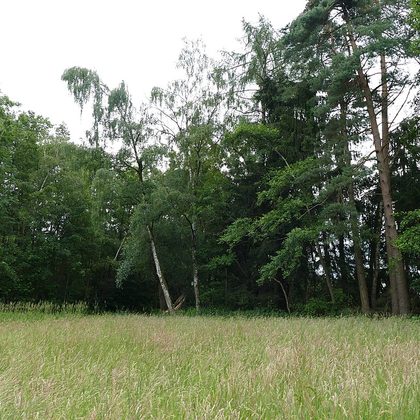
Where the bird is most at home, classified with EUNIS — the European standard for habitats.
Range and movements
The eastern end of São Miguel in the Azores and nowhere else: the Serra da Tronqueira and the slopes around Pico da Vara, with birds also around Salto do Cavalo in autumn. The entire world range covers a few hundred hectares of woodland. The other Azorean islands do not have it, and it leaves its forest for a few kilometres at most.
- Resident
Where and when to look
Go to the Priolo visitor centre at Cancela do Cinzeiro or to the road over Salto do Cavalo, early in the morning, and listen first: the soft peuu reaches you before the bird does. Then stand still and search low and mid-height in the foliage, because it moves very little. August to November is the best season, when the birds come to the seeding shrubs along the forest edge. Take waterproofs; this ridge is one of the wettest places on the Azores.
Conservation status
Vulnerable on the IUCN Red List — which is good news, because it formerly stood in a much heavier category. The problem was never hunting or the felling of the forest but its smothering by introduced plants: Japanese cedar, lily-of-the-valley tree, Australian cheesewood and above all kahili ginger crowded out the native shrubs and with them the run of food sources the bird lives on through the year. Since the start of this century exotic growth has been systematically cleared from the Serra da Tronqueira and native forest replanted, and the population has risen with it: 775 birds were counted in 2008, against a few dozen pairs in the 1970s. The area is protected as a Special Protection Area, but the species stays dependent on management continuing.
Scientific name
Pyrrhula murina Godman, 1866
Godman described the species in 1866 and placed it straight away in the genus where it still stands. The genus Pyrrhula was introduced in 1760 by Brisson. Pyrrhula goes back to Greek purrhoulas, the name of a red-breasted bird, from purrhos 'flame-red'. murina is Latin for 'mouse-grey', from mus, muris 'mouse', after the drab grey-brown plumage. The specimen the first description was based on came from São Miguel, Azores.