All species › Passerines › Finches › Pine grosbeak
Pine grosbeak | Pinicola enucleator
Haakbek | Camachuelo picogrueso
The Pine Grosbeak is Europe's largest finch, a bird the size of a Mistle Thrush: bulky, long-tailed and slow-moving, with a short thick bill whose upper mandible ends in a small hook. It belongs to the northern conifer forests of Fennoscandia and Russia, where it is so unafraid that it lets you walk to within a few metres.

Voice
The call is soft and whistled and matches the bird's unhurried manner: a clear, usually three-syllable tew-tew-tew or pui-lee-lee that carries surprisingly far, its pure whistled tone recalling a distant Redwing. Feeding parties add a soft nasal tyut. The song is a short, hesitant but very musical series of whistles and yodelling flourishes, usually from a treetop in May and June. In irruption winters outside the breeding range you almost always hear only the whistled call, and that is the best way to find a party in the rowans.
No freely licensed recording is available for this species yet.
Identification
Large and long-tailed, with a rounded head, a short hooked bill and two white wingbars on a dark grey wing. The male is rose-red to carmine over head, breast and back, with a grey belly and flanks; females and young birds are grey with an olive- or orange-yellow head and rump. The posture is notably calm and upright and the flight slow and deeply undulating, with that long tail trailing.
Confusion species
On size and posture there is little to confuse it with, but a bird judged too small ends up as a Bullfinch. Bullfinch is far smaller, has a black cap and a broad white rump; Pine Grosbeak has no black on the head and a dark rump. Female and immature Pine Grosbeaks look like huge yellow-headed female Bullfinches, but are a third larger, much longer tailed and show two clear white wingbars. Crossbills are smaller, shorter tailed and have the crossed bill tips.
Habitat
Old, open spruce and pine forest in the northern taiga, often with an understorey of birch and juniper, plus the birch belt and dwarf scrub at the treeline. In winter it becomes a bird of berry-bearing trees and shrubs: rowan above all, and beyond that apple, hawthorn and ornamental berries in village gardens and along roads.
Where the bird is most at home, classified with EUNIS — the European standard for habitats.
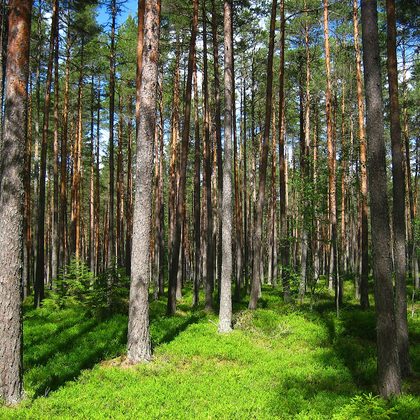
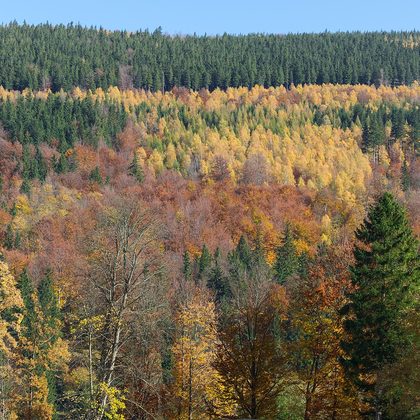
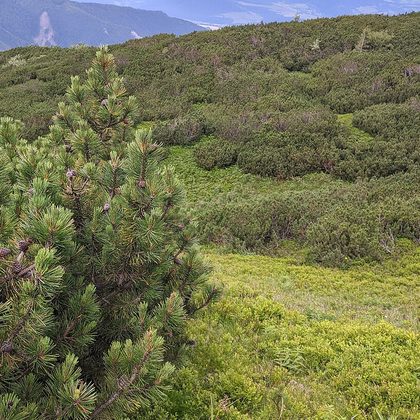

Range and movements
Breeds in Norway, Sweden, Finland and across northern Russia. In winters when the northern rowan crop fails, flocks move south and reach southern Scandinavia, the Baltic states and Poland. Further west — the Low Countries, Britain — it is a major rarity, with only a handful of records, most of them on Shetland and the Northern Isles.
- Resident
- Breeding (summer)
- Winter
- Passage
- dark = core range, pale = thinly spread
Where and when to look
In the north, simply find the rowans in November and December, along a road or at the edge of a village; the flocks stay for days and allow an approach to five metres. Listen for the soft whistled tew-tew, which carries through the trees while the birds themselves stay hidden. Then stand still and wait: too much movement drives them off sooner than too little distance does.
Conservation status
Not globally threatened (IUCN: Least Concern). The species is widespread and numerous across the northern taiga, though numbers swing with the berry and seed crops. Felling of old conifer forest in Fennoscandia is the main concern; otherwise there is no indication of decline.
Scientific name
Pinicola enucleator (Linnaeus, 1758)
Linnaeus described the species in 1758 as Loxia enucleator; because it was later moved to another genus, the author and year stand in brackets. The genus Pinicola was introduced in 1808 by Vieillot. Pinicola is Latin, from pinus 'pine' and colere 'to dwell in': a dweller of the conifer forests. enucleator is Latin for 'one who removes the kernel', from enucleare, after the way the bird shells seeds out of fruits and cones. The specimen the first description was based on came from Sweden.