All species › Passerines › Finches › Great rosefinch
Great rosefinch | Carpodacus rubicilla
Grote roodmus | Camachuelo grande
The Great Rosefinch is much the largest rosefinch in the region and lives in its harshest corner: the bare screes and boulder fields of the Caucasus, well above the treeline. It reaches this book's map only at its eastern edge, and seeing one means walking up to a high pass.

Voice
The call is a loud, low, clear whistled tew-eet or dju that carries a long way among rocks, and is usually the first sign of the bird. The song is a slow series of deep, melancholy whistles with short gaps between them, far slower and heavier than the brisk phrase of Common Rosefinch, delivered from a boulder or a low shrub.
No freely licensed recording is available for this species yet.
Identification
A heavy, long-bodied finch, far bigger than a Common Rosefinch and closer to a Hawfinch in bulk, with a thick grey bill and a long tail. The old male is deep rose to carmine on head, breast and belly, with fine silvery-white spotting over forehead, cheeks and breast that looks at close range like a dusting of frost; mantle and wings are grey-brown. Females and young birds are plain grey-brown with faint diffuse streaking and, as in Common Rosefinch, a flat unmarked face with a big dark eye.
Confusion species
In the Caucasus the only real confusion is with Common Rosefinch, and the difference is one of size and build: the Great is a quarter longer, bigger headed, longer tailed and much heavier billed. The red of the old male differs too — silvery spangled rather than an even carmine. Females are harder, but a Great Rosefinch stays large, long-tailed and heavy-billed, and lives higher up, in bare rock country that Common Rosefinch does not use.
Habitat
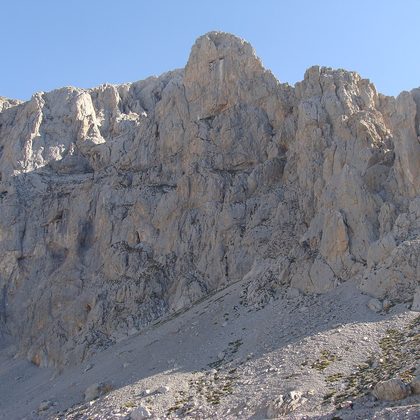
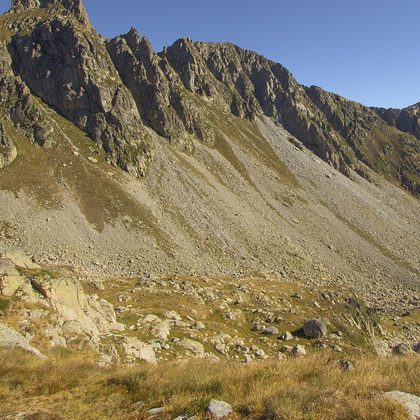
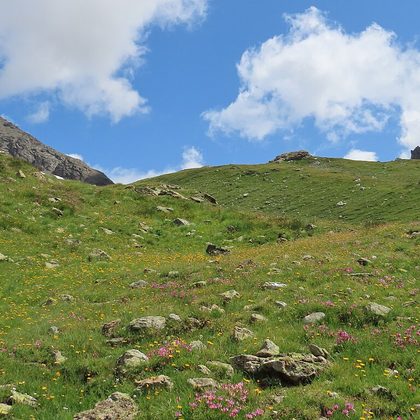
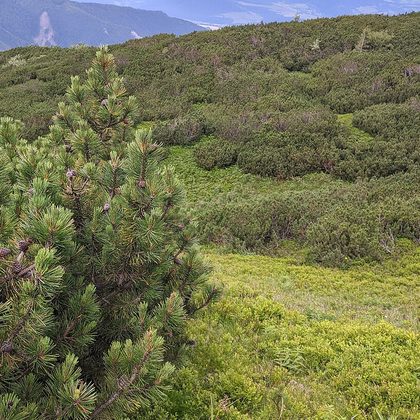
Bare high mountain country between roughly 2000 and 4000 m: screes, rock faces, boulder fields and the thin grass and dwarf scrub between them, often near snow patches and meltwater rills. In winter it drops to the upper valleys and works berry scrub, sea buckthorn above all.
Where the bird is most at home, classified with EUNIS — the European standard for habitats.
Range and movements
Within the area of this guide it occurs only in the Caucasus, on the far eastern edge of the map: the high ranges of North Ossetia, Kabardino-Balkaria, Georgia and Armenia. Beyond that the range runs east through the mountains of Central Asia, from the Pamirs to the Himalaya. It is resident and moves only up and down the mountain, high in summer and lower in winter.
- Passage
- dark = core range, pale = thinly spread
Where and when to look
Search in June and July above 2000 m, on the broad screes around a pass or below a glacier snout. Walk slowly and listen for the low whistle; the birds like a projecting boulder as a perch and, living far from people, often allow a close approach. In October and November the wintering birds in the sea buckthorn thickets of the valleys are an easier option.
Conservation status
Not globally threatened (IUCN: Least Concern). It is nowhere numerous but lives in terrain that barely changes, and the Caucasian population is regarded as stable. Heavier grazing of the high pastures and the building of ski areas are the only local pressures.
Scientific name
Carpodacus rubicilla (Güldenstädt, 1775)
Güldenstädt described the species in 1775 as Loxia rubicilla; because it was later moved to another genus, the author and year stand in brackets. The genus Carpodacus was introduced in 1829 by Kaup. Carpodacus is Greek, from karpos 'fruit' and dakno 'to bite'. rubicilla contains the Latin rubeus 'red'; how the second element was formed cannot be established with certainty. The specimen the first description was based on came from the Caucasus.