All species › Passerines › Finches › Sinai rosefinch
Sinai rosefinch | Carpodacus synoicus
Sinaïroodmus | Camachuelo del Sinaí
The Sinai Rosefinch is the bird of bare rock desert: it lives in the canyons and sandstone walls of the Negev, the Arava, the mountains of Edom and Sinai, and at Petra it is so at home that it hops about among the visitors. Here too only the old male carries the pink; every other bird is sandy and almost featureless.

Voice
A quiet, undemonstrative bird. The call is a short, faintly sparrow-like chip or a soft rolling chirrp, often from a party shuffling over the rocks. The song is a brief, thin, hesitant twitter with a few higher whistles in it, given from a ledge; it carries poorly and is easily lost in the draught of a canyon.
No freely licensed recording is available for this species yet.
Identification
A medium-sized, pale finch with a short, thick, blunt horn-coloured bill and a flat, unmarked face dominated by a large dark eye. The old male is pink on forehead, face, throat and breast, with a silvery frosting over forehead and cheeks, and sandy-pink elsewhere with grey-brown wings. Females and young birds are plain sandy brown with at most a hint of streaking, and that washed-out, colourless look is itself the character.
Confusion species
Trumpeter Finch shares the same ground and is the comparison that matters: it is smaller and more compact, short-tailed, grey-headed and, above all, has a stubby bill that is coral-red in summer, plus that unmistakable buzzing call. Sinai Rosefinch is longer, slimmer and longer-tailed, with a horn-coloured bill and a soft, sparrow-like voice. Females of both are pale and plain, and then bill colour, size and tail length settle it.
Habitat
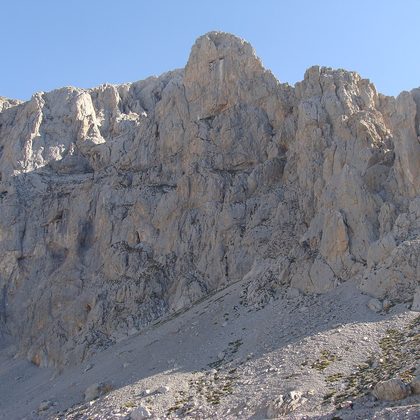
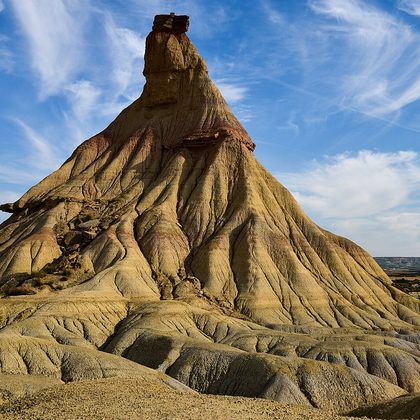
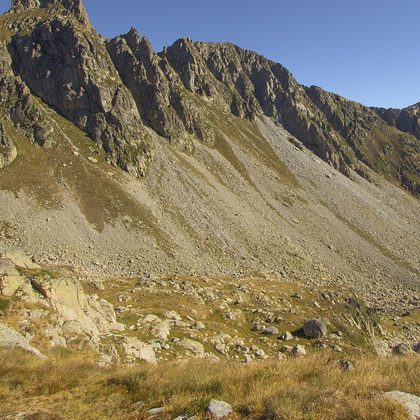
Bare rock desert: sandstone and limestone walls, narrow boulder-strewn wadis, screes and weathered rock pavements with almost no vegetation. It nests in crevices and cavities in the rock face and feeds on the ground below it, on the seed of the few desert herbs. Never far from drinking water — a spring, a seep, a damp patch at the foot of a cliff.
Where the bird is most at home, classified with EUNIS — the European standard for habitats.
Range and movements
Within the area of this guide, Sinai, the Negev, the Arava rift and the Edom mountains of Jordan, with Petra the best-known site of all. Related rosefinches replace it eastwards in the mountains of Central Asia. It is resident and moves at most within its own massif; away from the desert mountains it is simply absent.
- Resident
- Winter
- Passage
- dark = core range, pale = thinly spread
Where and when to look
Be early at a cliff with water. At Petra the birds around the rock tombs are at their most active and confiding at sunrise; in the Negev the wadis of Ein Avdat, Timna and Makhtesh Ramon all work. Check bill colour and tail length before you start looking for pink, which only a small part of any party will show.
Conservation status
Not globally threatened (IUCN: Least Concern). It lives where no farming is possible and so faces little pressure; locally it even profits from drinking troughs at visitor centres and desert camps. Disturbance at nesting cliffs on busy tourist sites is the one point to watch.
Scientific name
Carpodacus synoicus (Temminck, 1825)
Temminck described the species in 1825 as Pyrrhula synoica; because it was later moved to another genus, the author and year stand in brackets. The genus Carpodacus was introduced in 1829 by Kaup. Carpodacus is Greek, from karpos 'fruit' and dakno 'to bite'. synoicus goes back to the Greek sunoikos 'dwelling together'; what exactly the name alludes to cannot be established with certainty. The specimen the first description was based on came from Mount Sinai, Egypt.