All species › Passerines › Finches › Common rosefinch
Common rosefinch | Carpodacus erythrinus
Roodmus | Camachuelo carminoso
The Common Rosefinch has been pushing west for decades, from the Baltic states into Poland, Germany and the Low Countries, with a scatter of singing males reaching Britain each summer. Only the old male is truly red; nearly every bird you actually see is a plain grey-brown one, so this is a finch you learn by its song rather than by its colour.

Voice
The song is the giveaway: a clear, slightly wistful whistled phrase of four or five notes that slides up and down, often rendered pleased to meet you. It is repeated endlessly from an open twig or a wire from late May into July. The call is a short, rising, faintly nasal oo-eet, usually heard from inside a bush before the bird shows.
No freely licensed recording is available for this species yet.
Identification
A compact finch with a large head, a short tail and a strikingly thick, blunt bill. The face is flat and completely unmarked — no supercilium, no eye-stripe, no cheek patch — so the big dark eye stands out like a bead on an empty face. Males of three years and older have a carmine head, breast and rump over a brown mantle, with two narrow pale wingbars. Females, young birds and second-year males are grey-brown with vague diffuse streaking on breast and flanks and the same two wingbars, and carry no red at all.
Confusion species
Assume the bird in front of you is brown. A female House Sparrow is similar in shape but has an obvious head pattern with a pale supercilium and a streaked mantle; Linnet shows white wing flashes and white tail sides and has a finer bill; Siskin is greenish-yellow with a yellow wingbar. The Rosefinch has the plainest face, the largest dark eye and the stoutest, bluntest bill of any of them, and that combination holds in every plumage, red male included.
Habitat
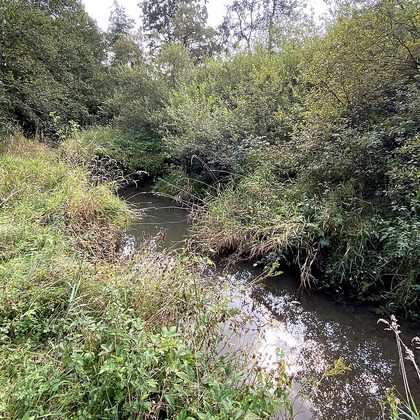
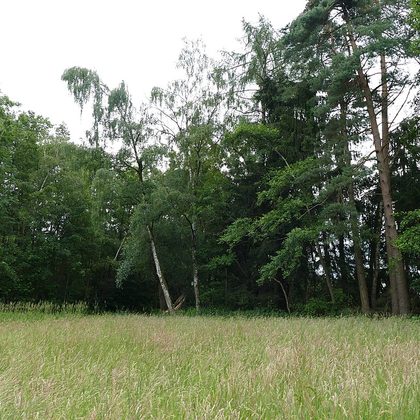
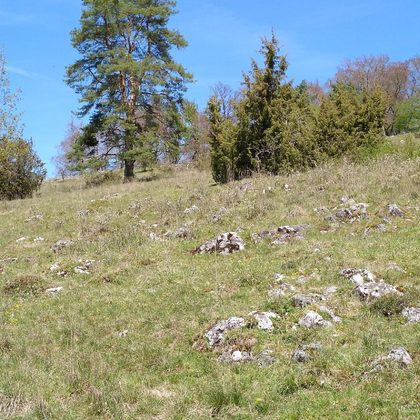
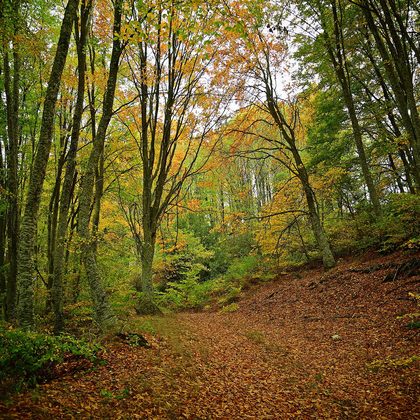
Damp overgrown scrub: willow and alder thickets along streams and rivers, neglected pasture with hawthorn and elder, woodland edges, young plantations, broad scrubby verges and, in the north of the range, large parks and derelict gardens. Always bushes with open ground between them, and usually water nearby.
Where the bird is most at home, classified with EUNIS — the European standard for habitats.
Range and movements
Breeds from Scandinavia and the Baltic east across Russia into Siberia, and further south in the mountains of Turkey and the Caucasus. Through the twentieth century the western edge moved steadily on, so that Poland, Germany, Denmark and the Low Countries are now inside the range, though only by tens of pairs. In Britain singing males turn up annually, chiefly on the Northern Isles and the east coast in late spring, and breeding has been proved only a handful of times. The whole population winters in India and South-East Asia, which is why it arrives so late and leaves so early.
- Breeding (summer)
- Passage
- dark = core range, pale = thinly spread
Where and when to look
Go in the first half of June and nowhere else in the calendar: in mid-May the birds are not in yet, and by August they have gone. Work a scrubby river valley or a damp thicket and listen; the singer usually sits on top of a bush or on a wire, in full view. Do not hold out for a red bird — most western records involve a brown, singing second-year male.
Conservation status
Not globally threatened (IUCN: Least Concern). The westward spread has stalled: along the newly won edge, the Low Countries and Denmark included, numbers have fallen again since about 2000, while the core population in eastern Europe and Russia stays large and stable. Leaving stream valleys to grow rank and sparing riverside scrub are the only levers available at this end of the range.
Scientific name
Carpodacus erythrinus (Pallas, 1770)
Pallas described the species in 1770 as Loxia erythrina; because it was later moved to another genus, the author and year stand in brackets. The genus Carpodacus was introduced in 1829 by Kaup. Carpodacus is Greek, from karpos 'fruit' and dakno 'to bite'. erythrinus goes back to Greek eruthros 'red', after the carmine plumage of the male. The specimen the first description was based on came from the Volga and Samara rivers.