All species › Passerines › Finches › Hawfinch
Hawfinch | Coccothraustes coccothraustes
Appelvink | Picogordo común
The Hawfinch carries the heaviest bill of any European songbird, a blue-grey wedge that cracks a cherry stone no pair of human hands will open. It is also a shy treetop bird, heard passing overhead far more often than it is seen perched.

Voice
The call is a sharp, short, metallic tzik or tick, very like a robin's ticking note but harder and drier; this is how you pick the bird up over the canopy. The song is unremarkable: a hesitant string of the same ticks with a few thin whistles between, given from March to May.
No freely licensed recording is available for this species yet.
Identification
A big, short-tailed finch with a top-heavy head and a huge conical bill, steel blue in summer and horn-coloured in winter. Orange-brown head, grey collar, dark brown mantle and pinkish underparts, with a black bib and black lores. The wing is blue-black with a broad white bar, and the primaries end in curious flattened, hooked tips. The short tail has a wide white terminal band. The female is paler and shows grey on the secondaries.
Confusion species
No other European songbird combines that bill with a white wing bar and a white tail tip. In flight it can pass for a starling: check the short white-tipped tail, the broad white wing flash and the heavy, front-loaded head. Perched, the proportions decide it — head and bill make up nearly a third of the bird.
Habitat
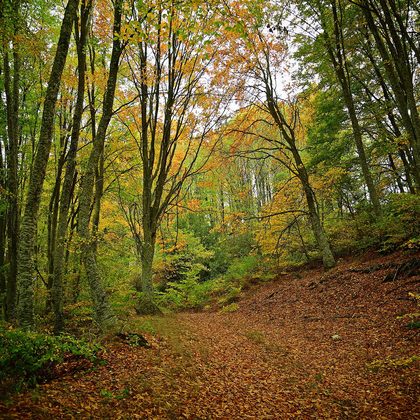
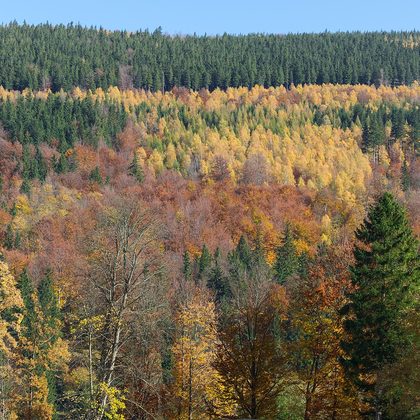
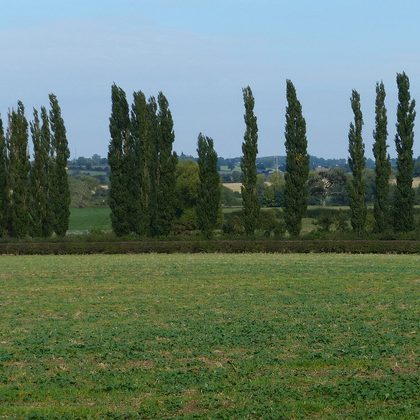
Mature broadleaved woodland with hornbeam, wild cherry, elm, maple and beech, and also parks, estates, old cemeteries and orchards. It feeds high in the canopy and, in early spring, on the ground beneath the trees where last year's stones lie.
Where the bird is most at home, classified with EUNIS — the European standard for habitats.

Range and movements
Scattered across almost all of Europe, from southern Scandinavia to the Mediterranean, and on into Turkey and the Caucasus. Northern and eastern birds move out in winter and small parties then turn up in unexpected places. In Britain it has become a genuinely difficult bird, largely confined to a handful of traditional woods.
- Resident
- Breeding (summer)
- Winter
- Passage
- dark = core range, pale = thinly spread
Where and when to look
Go early to a hornbeam or cherry wood in March or April and stand still, listening for the sharp tick overhead. Better still, find a spot where cherries or hornbeam nutlets fell heavily last autumn: in February and March the birds feed on the ground there and are at last properly visible.
Conservation status
Not globally threatened (IUCN: Least Concern). Across north-west continental Europe it has increased as woodland has aged and hornbeam has been planted. The British population, by contrast, has fallen sharply for reasons that are still not well understood.
Scientific name
Coccothraustes coccothraustes (Linnaeus, 1758)
Linnaeus described the species in 1758 as Loxia coccothraustes; because it was later moved to another genus, the author and year stand in brackets. The genus Coccothraustes was introduced in 1760 by Brisson. Coccothraustes is Greek, from kokkos 'kernel, seed' and thrauo 'to break', after the heavy bill that cracks stones and pips. The specific name repeats the genus name. The specimen the first description was based on came from Italy.