All species › Passerines › Finches › Crimson-winged finch
Crimson-winged finch | Rhodopechys sanguineus
Rode bergvink | Camachuelo alirrojo asiático
The Crimson-winged Finch is a bird of high bare mountainsides: scree, rock and cropped turf above the treeline, from the Atlas of Morocco through Turkey and Lebanon to the Caucasus. On the ground it is an unobtrusive sandy finch, but the moment it flies the rose-pink wing panels flare and there is nothing else it could be.

Voice
The call is a light rolling, faintly nasal chrrit or chilp-chilp, often in short series in flight. The song is a short, dry, slightly jangling twitter with nasal notes in it, given from a boulder or in a brief song flight; it is a modest sound and is quickly lost in mountain wind.
No freely licensed recording is available for this species yet.
Identification
A big, large-headed finch with a thick pale yellow to horn-coloured bill. The body is warm sandy brown, the breast washed pink; the male has a black cap running back past the eye. Wing and tail carry the picture: broad rose-red panels in the wing, black and white in the primaries and a black tail with white sides, all best seen in flight. The female is duller, with less pink and a browner crown.
Confusion species
Trumpeter Finch is far smaller and more compact, with a grey head, no black cap and a coral-red bill in summer; its pink is a wash, never a panel. Desert Finch also has a pink wing panel, but is sandier, black-billed and lacks the black crown. Linnet shows white, not pink, in wing and tail and is much slimmer. Size, black cap and the rose-red panel together are conclusive.
Habitat
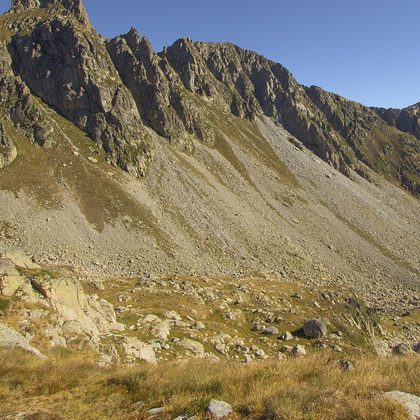
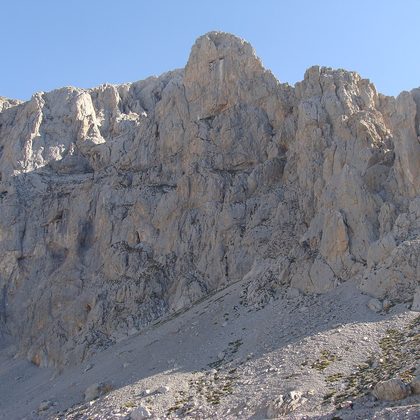
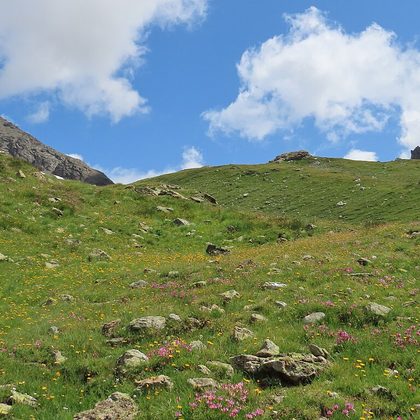
High bare slopes between roughly 1800 and 3000 m: screes, boulder fields, weathered rock pavements and the thin turf and dwarf scrub between them. It feeds walking over the ground on the seed of mountain herbs, often near snow patches. In winter it moves down to lower slopes, field edges and the surroundings of mountain villages.
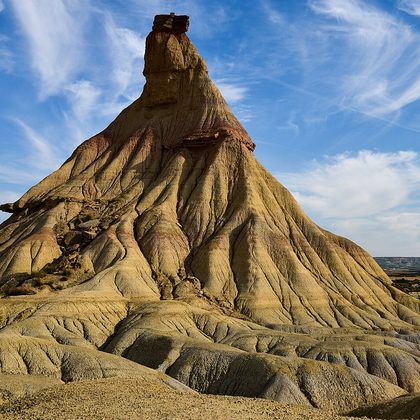
Where the bird is most at home, classified with EUNIS — the European standard for habitats.
Range and movements
A strikingly patchy range. Within this guide: the High and Middle Atlas of Morocco and the mountains of Algeria, the Taurus and eastern Anatolian ranges of Turkey, Mount Lebanon and the Anti-Lebanon, and the Caucasus at the eastern edge of the map. Eastwards it continues to Iran and Central Asia. Resident everywhere, with only altitudinal movement.
- Resident
- Breeding (summer)
- Winter
- Passage
- Migration direction
- dark = core range, pale = thinly spread
Where and when to look
In June drive to a high pass — the Tizi n'Tichka or the Oukaïmeden plateau in Morocco, the Taurus plateaux in Turkey — and scan the bare gravel flats. The birds walk among the stones and are easy to overlook; rather than flushing them, wait for a party to lift and show the pink wings. Springs and meltwater pools are equally good places to sit.
Conservation status
Not globally threatened (IUCN: Least Concern), but thinly spread everywhere and tied to a narrow altitude band. Heavy grazing of the high pastures and, in the Atlas, the loss of springs and meltwater are the real risks; the Moroccan and Lebanese populations sit in small, isolated blocks.
Scientific name
Rhodopechys sanguineus (Gould, 1838)
Gould described the species in 1838 as Fringilla sanguinea; because it was later moved to another genus, the author and year stand in brackets. The genus Rhodopechys was introduced in 1851 by Cabanis. Rhodopechys is Greek, from rhodon 'rose, rose-red' and pēkhus 'forearm, wing', after the pink in the wing. sanguineus is Latin for 'blood-red', from sanguis 'blood'. The specimen the first description was based on came from Erzurum, Turkey.