All species › Passerines › Finches › Trumpeter finch
Trumpeter finch | Bucanetes githagineus
Woestijnvink | Camachuelo trompetero
The Trumpeter Finch sounds exactly like a toy trumpet: a buzzing, nasal note that carries across a bare stony plain and that no one who has heard it ever confuses with anything else. It is not some exotic stray either but a European breeding bird, nesting in south-east Spain, right across the Canary Islands, through the Maghreb and into Israel.

Voice
The call is the trademark: a long, nasal, buzzing chzeee with the timbre of a tin toy trumpet or a kazoo, often in short series from the ground or in flight. The song strings a few of these buzzes together with drier rattling notes between them, from a stone, a wall or in a short fluttering song flight.
No freely licensed recording is available for this species yet.
Identification
A small, dumpy finch with a big head, a short tail and a strikingly heavy, blunt bill. The head and neck are silvery grey, the mantle sandy brown and the underparts pale sandy pink, with pink fringes in wing and tail that catch the light. The breeding male has a brilliant coral-red bill, the single most obvious feature the species owns. In the female and in winter that bill is yellowish horn and the whole bird is duller and sandier, with less pink.
Confusion species
Take away the bill colour and it is a pale, plain little bird, so structure and voice do the work. Linnet is slimmer, with white wing flashes and white tail sides, and is clearly streaked. Sinai Rosefinch, its neighbour in the Middle East, is larger and longer-tailed with a horn-coloured bill. Desert Finch has a black bill and a black-and-white wing. Trumpeter Finch is the smallest and roundest of them all, with the heaviest bill on the smallest body — and one call ends the discussion.
Habitat
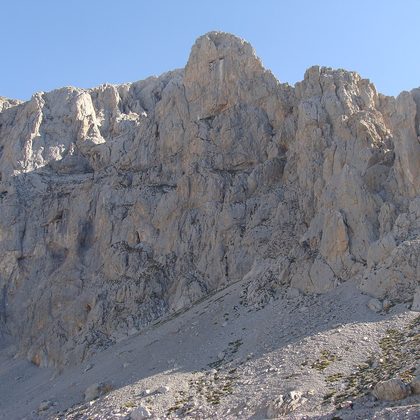
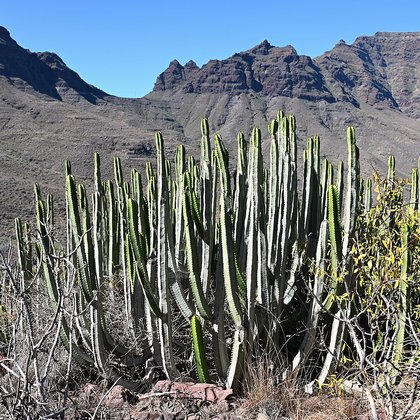
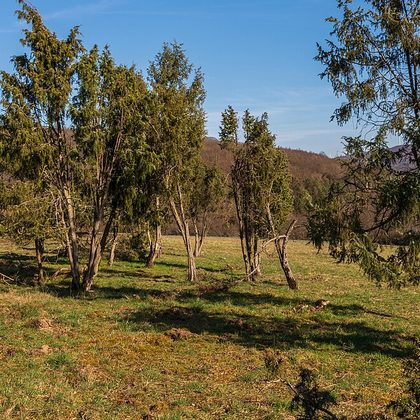
The barest ground there is: stone desert, badlands, dry ramblas, gravel flats, lava fields, abandoned quarries and steppe slopes with a scatter of low bushes. It nests in a crevice or under a stone and feeds walking over open ground on the seed of annual herbs. It must drink daily, which keeps it within reach of a spring, a cattle trough or a small reservoir.
Where the bird is most at home, classified with EUNIS — the European standard for habitats.

Range and movements
In Europe it is confined to south-east Spain — Almería, Murcia, Granada and southern Alicante — which it colonised from the 1960s and where a few thousand birds now live. Beyond that it occupies all the Canary Islands, being common on Lanzarote and Fuerteventura, and ranges through the Maghreb, Egypt, Sinai, Israel and Jordan. Outside these areas it is a major rarity: north-west Europe has only a few dozen records, mostly in late spring, and it remains one of the classic British megas.
- Resident
- Breeding (summer)
- Winter
- Passage
- dark = core range, pale = thinly spread
Where and when to look
Be on a stony plain with water at first light — the country around Cabo de Gata, the Tabernas desert, or on Fuerteventura any cattle trough beside an abandoned cortijo. Sit down and listen; the buzz betrays the birds long before you see them, because walking over gravel they are all but invisible. By the middle of the day the ground is empty and searching is pointless.
Conservation status
Not globally threatened (IUCN: Least Concern). The Spanish population is small and squeezed into a strip under heavy pressure from plastic greenhouses, solar farms and building; on the Canaries and across North Africa the species is numerous and doing well. Keeping drinking places open is the simplest way of helping it.
Scientific name
Bucanetes githagineus (Lichtenstein, 1823)
Lichtenstein described the species in 1823 as Fringilla githaginea; because it was later moved to another genus, the author and year stand in brackets. The genus Bucanetes was introduced in 1851 by Cabanis. Bucanetes is Greek, from bukanētēs 'trumpeter', from bukanē 'horn', after the nasal call. githagineus is Latin, formed on Githago, the corn cockle, from gith 'coriander' and -ago 'resembling'; Temminck believed the bird's name derived from that of the plant. The specimen the first description was based on came from Deram, Upper Egypt.