All species › Passerines › Finches › Desert finch
Desert finch | Rhodospiza obsoleta
Vale woestijnvink | Camachuelo desertícola
The Desert Finch is a sand-coloured finch with two features you will not find together anywhere else: a jet-black bill and a black-and-white wing with a rose-pink panel. It reaches this book's map only in the south-eastern corner — Israel, Jordan and south-east Turkey — and there it lives not in the desert itself but in the orchards and tamarisk belts along its edge.

Voice
The call is a soft, faintly nasal and plaintive shreee, Linnet-like in tone but slower and softer. The song is an unhurried, lightly rolling twitter with nasal and buzzing notes worked into it, from a treetop or a wire; it is a pleasant sound but carries poorly and is easily missed.
No freely licensed recording is available for this species yet.
Identification
A medium-sized, slim finch, evenly sandy brown to pale buff and unstreaked. The bill is black and stays black all year; the male also has black around the bill base and on the chin. The wing carries the pattern: black feathers with broad white tertial edges and a soft rose-red panel on the greater coverts, which shows in flight as a pink stripe. The tail is black with white sides. The female is much the same, a shade duller and without the black chin.
Confusion species
Trumpeter Finch is smaller and dumpier, with a grey head, a thick yellowish-horn to coral bill and no black and white in the wing. Crimson-winged Finch also has a pink wing panel, but is bulkier, black-crowned and pale-billed. Linnet is streaked and shows white, not pink, in wing and tail. A plain sandy finch with a black bill can be nothing else.
Habitat
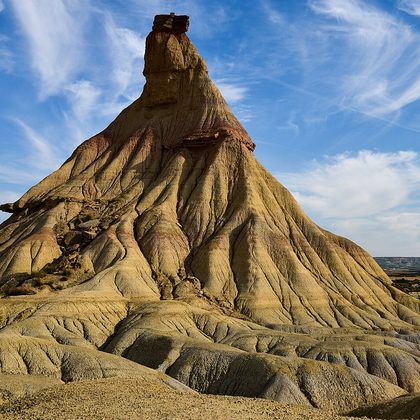
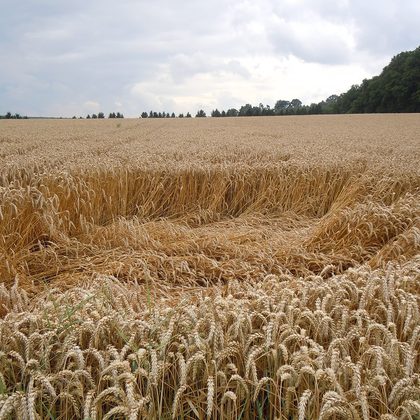
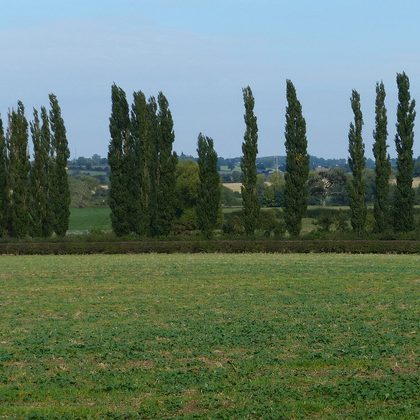
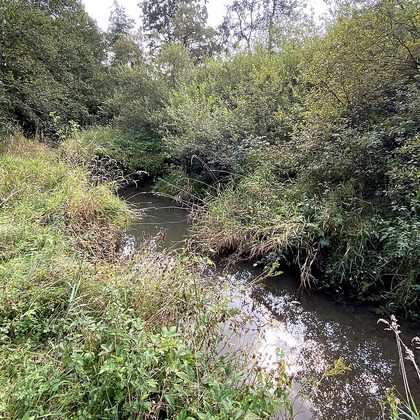
The edge of the desert where people bring water: orchards, almond and pomegranate groves, lines of poplar and tamarisk along wadis and irrigation channels, village edges, field margins and acacia scrub. It nests in a tree or tall bush and feeds on the ground and at seeding herbs, usually in small parties.
Where the bird is most at home, classified with EUNIS — the European standard for habitats.
Range and movements
The bulk of the range lies in Central Asia and Iran; within this guide only its western fringe is involved: south-east Turkey along the Euphrates and Tigris, Syria, Jordan and Israel, which it colonised during the twentieth century and where it has since spread through the Arava and around the Dead Sea. Resident, with some wandering to lower, warmer ground in winter.
- Resident
- Breeding (summer)
- Passage
- dark = core range, pale = thinly spread
Where and when to look
In winter work the orchards and tamarisks of the Arava, around Eilat, Yotvata and the kibbutz fields, when parties gather and the birds are easiest to find. In Turkey the field edges and poplar lines around Birecik and Diyarbakır are the classic spots. Look for the black bill first: it shows even on a bird sitting quietly in the shade of a tree.
Conservation status
Not globally threatened (IUCN: Least Concern). The species actually gains from human use of the desert edge, and irrigation, orchards and planting have given it a clear expansion in Israel and Jordan. Only where old orchards and tamarisk belts give way to bare intensive cropping does it drop out again.
Scientific name
Rhodospiza obsoleta (Lichtenstein, 1823)
Lichtenstein described the species in 1823 as Fringilla obsoleta; because it was later moved to another genus, the author and year stand in brackets. The genus Rhodospiza was introduced in 1888 by Sharpe. Rhodospiza is Greek, from rhodon 'rose, rose-red' and spiza 'finch', after the pink in the wing. obsoleta is Latin for 'plain, faded', after the uniform sandy-brown plumage. The specimen the first description was based on came from near Bukhara, Uzbekistan.