All species › Passerines › Finches › European greenfinch
European greenfinch | Chloris chloris
Groenling | Verderón común
The Greenfinch is the heavy-built garden finch with the yellow wing flash and the wheezy song. For years it was a fixture at the feeding station, until a parasitic disease — trichomonosis — cut its numbers across north-west Europe within a few seasons. The feeding station itself turned out to be where the parasite passed from bird to bird.

Voice
The song has two parts that are often heard separately: a fast tinkling trill from a treetop or during a slow, bat-like song flight, and a long, nasal, wheezing dzweeeh that sounds like a sigh. Heard from March into August. The flight call is a hard rattling chup-chup-chup.
No freely licensed recording is available for this species yet.
Identification
A solid, short-tailed finch with a large head and a thick pinkish conical bill. The male is olive-green with bright yellow edges to the primaries and yellow patches at the base of the tail; those two yellow flashes are the best character in flight. The female is greyer green and finely streaked, with less yellow. Juveniles are browner and clearly streaked but already carry yellow in wing and tail.
Confusion species
Siskin is the bird it is most often confused with, and two things settle it. The Siskin is much smaller — 11 to 12.5 against 14.5 to 16 centimetres — and it has a clear yellow bar running across the wing, where the Greenfinch shows only a yellow edge along the folded wing. The Siskin is also heavily streaked on the flanks and has a fine, pointed bill against the Greenfinch's heavy pink cone.
Habitat
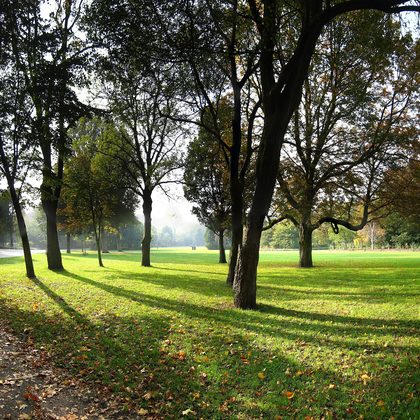
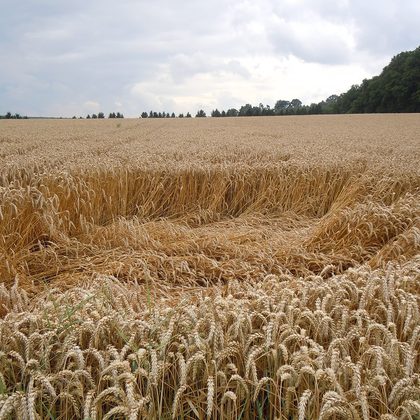
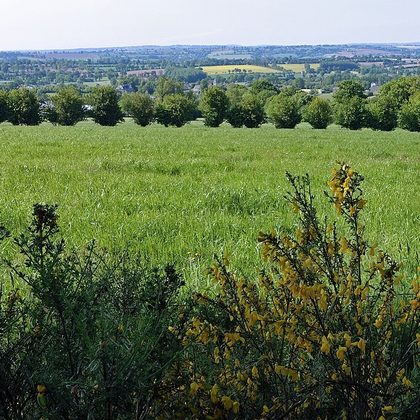
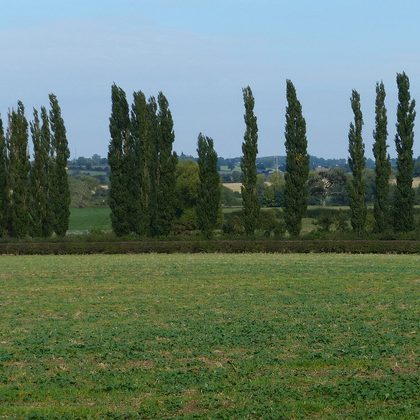
Gardens, parks, churchyards, village edges, orchards, hedgerows and field margins with standing trees. It nests in dense conifers, ivy and hedges, and feeds on large seeds: sunflower, oilseed rape, rosehips and, in winter, on food put out for it.
Where the bird is most at home, classified with EUNIS — the European standard for habitats.
Range and movements
All of Europe apart from the far north, and on into North Africa and Turkey. In Britain and the Low Countries it is a common bird of built-up areas, gathering in winter on stubbles and at feeders. In southern Europe it is numerous in olive groves, market gardens and city parks.
- Resident
- Breeding (summer)
- Winter
- dark = core range, pale = thinly spread
Where and when to look
In April and May find a village street or cemetery with dense conifers and listen for that wheezing dzweeeh: no other finch makes anything like it. If you feed them, do not keep the feeder in one fixed spot — move it regularly and clean it, because wet, soiled feeding places are exactly where trichomonosis spreads.
Conservation status
Not globally threatened (IUCN: Least Concern), but sharply reduced across north-west Europe. From 2006 a strain of the single-celled parasite Trichomonas gallinae spread through Greenfinches and Chaffinches; affected birds cannot swallow and starve with a swollen throat. British and Dutch breeding numbers fell by half or more within a few years. Cleaning and moving feeding stations is the only practical response.
Scientific name
Chloris chloris (Linnaeus, 1758) (GBIF: Carduelis chloris)
Linnaeus described the species in 1758 as Loxia chloris; because it was later moved to another genus, the author and year stand in brackets. The genus Chloris was introduced in 1800 by Cuvier. Chloris is the Ancient Greek name for this bird, khloris, from khloros 'green'. The specific name repeats the genus name. The specimen the first description was based on came from Sweden.