All species › Passerines › Cardinals › Indigo bunting
Indigo bunting | Passerina cyanea
Indigogors | Azulillo índigo
In the books this is the bird that is deep indigo blue from head to tail. In the field here it almost never is: the birds that cross the ocean are females, first-year birds and males in winter plumage, and those are a warm milk-chocolate brown. Anyone waiting for blue will look straight past it.

Voice
The song is a clear, unhurried series of notes delivered two at a time, a pair and then another pair at a different pitch: sweet-sweet, chew-chew, seet-seet. It lasts two to four seconds and is sung from a high open perch, a wire or a treetop. The call is a dry, sharp spit, followed in flight by a buzzy bzeep. An autumn vagrant is as a rule silent, so do not count on any of this.
No freely licensed recording is available for this species yet.
Identification
A small, compact bird with a short, slightly notched tail and a heavy conical bill, dark on the upper mandible and pale blue-grey on the lower. The brown plumage you will see here is warm and even above and a little paler below, with faint, washed-out streaking on the breast and a pale throat, plus two weak buff wingbars. The usable mark is a cold blue-grey cast on rump, tail and wing edges, which in good light always shows somewhere; first-year males often carry scattered blue feathers as well. The breeding male is deep blue over the whole body with a black lore and blackish flight feathers. That blue is not a pigment but a property of the feather's structure, which scatters blue light back: the same bird in shadow, or against the light, is simply dark brown.
Confusion species
In brown plumage this is one of the hardest vagrants there is, and it turns on three firm marks. One: the heavy conical bill with a curved upper edge and a conspicuously pale lower mandible. Two: the short, notched tail without a trace of white, which rules out chaffinch, brambling and linnet, all of which show white in wing or tail. Three: the blue-grey wash on rump and tail edges. A female linnet has white wing flashes and white tail edges; a female chaffinch two broad white wingbars and white outer tail feathers; a female house sparrow is greyer, streaked above and plain-faced. If there is white in the wing or tail, it is not an indigo bunting.
Habitat
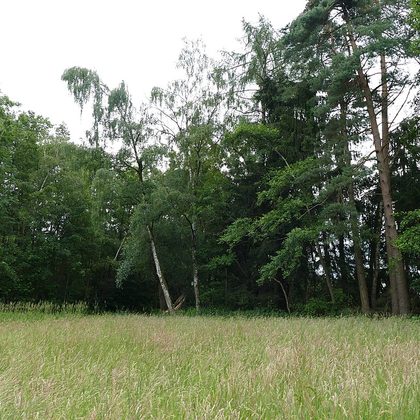
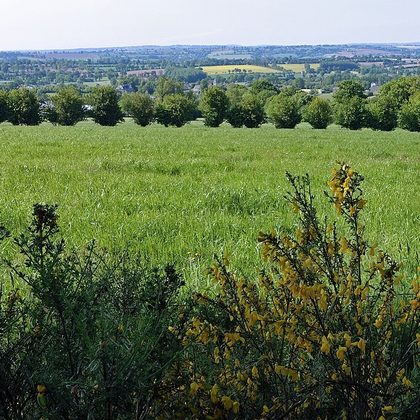
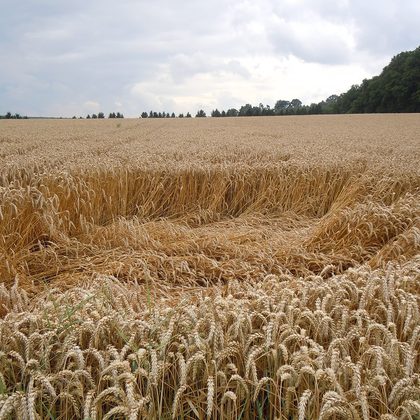
Here it means rank ground near the coast: weedy field margins, thistle and nettle patches, a bracken slope on an island, hedges along a path and the edge of a vegetable plot. It feeds low in the seeding herbs and on the bare ground beneath them, and dives into the densest bush when disturbed. At home it is the same edge bird: woodland margins, clear-fells, railway banks, ditch sides and rough pasture, always with a high song post within reach.
Where the bird is most at home, classified with EUNIS — the European standard for habitats.

Range and movements
Breeds in the eastern and central United States and the far south of Canada and winters in Central America and the Antilles, a journey flown partly across the Gulf of Mexico; it is birds on that crossing that are thrown off course by sustained westerlies. Within the map area it is a decided rarity, with autumn as the arrival season and the western islands and coasts as the place. Britain has accepted only a few; the first was a first-winter male on Ramsey Island in Pembrokeshire in October 1996, while a bird at Holkham in Norfolk in 1988 was found unacceptable. Ireland has one, on Cape Clear in Co Cork in 1985. On the Azores the species turns up more often than on the mainland.
Where and when to look
The first half of October, a few days after a low has run quickly from Newfoundland to Ireland, at a western island station or a coastal reserve. Work the seeding weeds and watch for a small, short-tailed brown bird with a heavy bill lifting out of the vegetation. Photograph the spread tail and the rump at once — that is where the blue-grey sits — and photograph the legs and the wingtips too. With this species those are looked at deliberately.
Conservation status
Not globally threatened (IUCN: Least Concern), with a large population that until recently was increasing, helped by clear-fells and rank field edges. For Europe a different question comes first, and it weighs more heavily here than with the American sparrows: the indigo bunting is kept as an aviary bird in Europe, so alongside the usual doubt about ship assistance, escape is a real possibility. Committees therefore look at wear on tail and wingtips, at missing flight feathers, at rings and at tameness; a bird in clean plumage in October, on a western island, after a run of Atlantic depressions, makes the strongest case.
Scientific name
Passerina cyanea (Linnaeus, 1766)
Linnaeus described the species in 1766 as Tanagra cyanea; because it was later moved to another genus, the author and year stand in brackets. The genus Passerina was introduced in 1816 by Vieillot. Passerina derives from Latin passer 'sparrow', applied to small sparrow-like songbirds. cyanea is Latin for 'blue', after the deep blue breeding plumage of the male. The specimen the first description was based on came from South Carolina.