All species › Owls › Typical owls › Long-eared owl
Long-eared owl
Asio otus | Ransuil | Búho chico
The Long-eared Owl is probably the commonest owl in the Netherlands and at the same time the least seen: by day it sits motionless and elongated against a trunk, and only after sunset does it hunt over the meadows. In winter it gathers at traditional roosts, sometimes in the middle of a village.

Voice
The male's territorial call is a soft, low, utterly monotonous hoo … hoo … hoo, about one note every two or three seconds, which carries surprisingly far but is so deep that it is easily missed; listen from February to April in the early night. More useful to birders is the begging call of the young: from late May well into July, fledged juveniles call all night with a high, plaintive, squeaking pseeeh … pseeeh, exactly like a rusty gate swinging open. It carries for hundreds of metres and is by far the most reliable way to find a breeding pair — walk a wood edge or village edge on a windless June evening and listen. At the nest site the bird also claps its wings beneath the body, and the female may give a barking, nasal wek-wek.
Recording: Benjamin Mayer — CC BY-SA 4.0 · Wikimedia Commons
Identification
A medium-sized, slim owl with long, conspicuous ear tufts that it raises when uneasy and lays flat in flight. The plumage is warm rufous with dense, fine dark streaking and vermiculation, so that against bark it more or less disappears. The eyes are orange-red and the facial disc is rusty with a black line running from eye to bill, giving a surprised, slightly lopsided expression. In flight: long, fairly narrow wings, an ochre panel at the base of the primaries, a less sharply defined dark carpal patch than in Short-eared Owl, and streaking that continues onto the belly. The flight is supple and soft, with quicker beats and shorter glides than a Short-eared Owl's. In alarm it stretches into a thin upright post — the pose you get at a roost.
Confusion species
The Short-eared Owl is the main confusion species, and with a little practice the difference is clear: Short-eared is paler and sandier with yellow eyes, a white face with black eye surrounds, a sharply defined black carpal patch and breast streaking that stops on the belly; Long-eared is warmer rufous, with orange eyes and streaking that runs the whole length of the underparts. Short-eared often hunts by day and sails on stiff, raised wings; Long-eared is nocturnal and flaps faster and more loosely. The Tawny Owl is shorter, rounder and far bulkier, lacks ear tufts and has black eyes and a round head. The Eagle Owl is enormous, with orange eyes in a heavy head. A perched Long-eared with its tufts flattened can also suggest a Tawny; then go by eye colour and the slim, upright posture.
Habitat
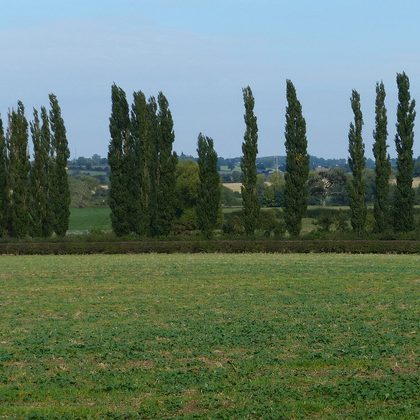
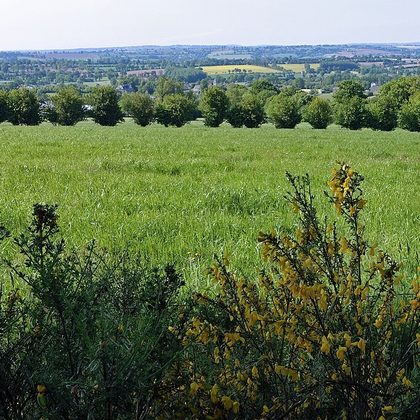
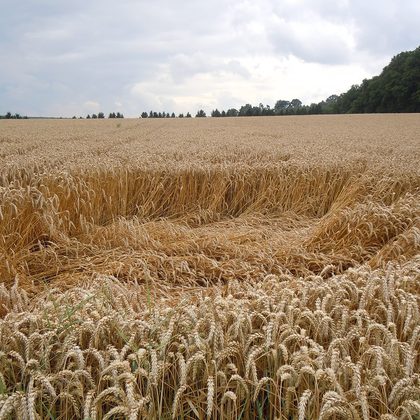
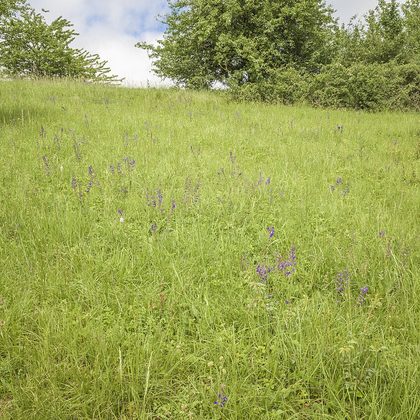
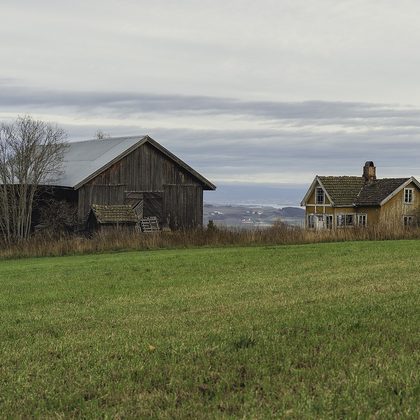
Small-scale landscape: copses, hedgerow trees, shelterbelts, farmyards, parks, cemeteries and pine clumps beside open grassland or arable. It builds no nest of its own but uses old magpie and crow nests. It hunts almost exclusively for voles over open ground, floating and hovering low over the vegetation. In winter it uses traditional communal roosts in dense conifers, ivy or pleached limes, regularly in the middle of a village, with sometimes dozens of birds in a single tree.
Where the bird is most at home, classified with EUNIS — the European standard for habitats.

Range and movements
Breeds across almost all of Europe, from Spain to Scandinavia and Russia, with northern birds moving south-west. In the Netherlands it is widespread but inconspicuous, concentrated on the sandy soils, in the river district and in small-scale farmland, with well-known winter roosts in villages and on countless farmyards and cemeteries. In Spain it breeds scattered through the northern half and in the mountain forests, and in winter is joined by birds from central and northern Europe, right down into the olive groves and pine clumps of the south.
- Resident
- Breeding (summer)
- Winter
- Passage
- Migration direction
- dark = core range, pale = thinly spread
Where and when to look
Two moments work. In December and January find a known winter roost in a village or farmyard — ask local birders, because the sites are often used for years — and look up into the conifer or the ivy-covered wall in the late afternoon: pellets and white splashes on the ground give the tree away. And on a windless evening in June or July, walk a wood edge or farmyard and listen for the squeaking begging call of the young; that is how most Dutch Long-eared Owls are found.
Conservation status
Not globally threatened (IUCN: Least Concern), but declining in western Europe. The main causes are the loss of vole-rich, herb-rich grassland and field margins, the clearance of hedgerows and farmyard planting, and strong competition and predation from increased Goshawks and Tawny Owls. Rodenticides used against voles play a part too. Because Long-eared Owls are so inconspicuous, trends are often noticed late, which makes counting winter roosts an important tool.