All species › Owls › Typical owls › Pharaoh eagle-owl
Pharaoh eagle-owl | Bubo ascalaphus
Woestijnoehoe | Búho desértico
The eagle-owl of the desert: hardly bigger than a buzzard, sand-coloured as the rock it sits on, and the only true eagle-owl of North Africa. Where the Eurasian eagle-owl in Europe keeps to woods and quarries, this bird keeps to bare stone, wadis and the few palms around a spring.

Voice
A short, deep, slightly falling booh of a single syllable, repeated at intervals of roughly eight seconds. It sounds higher and more clipped than the drawn-out two-syllable call of the Eurasian eagle-owl and lacks its stress on the first syllable. The female gives the same note at a higher pitch. In courtship the pair adds a three-syllable variant in which the pitch steps between syllables. In the silence of a desert night the call carries remarkably far along a wadi wall; calling is concentrated in the first hours after sunset, from December to March.
No freely licensed recording is available for this species yet.
Identification
A medium-sized eagle-owl of forty-five to fifty centimetres, a good head shorter than its Eurasian relative and under half its weight; the female is clearly the heavier bird. The plumage is pale ochre-sand to creamy white, with black drop-shaped streaks on the upper breast and fine rufous vermiculation on belly and flanks, so that a perched bird almost dissolves into a ledge. The facial disc is plain creamy with a thin rim of black speckles, the eyes orange, the bill dark. The ear tufts are short and pointed and are often laid flat, keeping the outline round. Legs and toes are wholly feathered in sand. Birds of the Atlas are larger and warmer-toned, those of the Sahara smaller and paler. In flight broad and round, with a strikingly pale, almost ghostly underside.
Confusion species
The Eurasian eagle-owl is the only confusion, and the two meet only in the Levant; there is no Eurasian eagle-owl in Morocco, Algeria or Tunisia, so any eagle-owl there is this bird. Where they do meet the differences are wide: the Eurasian is a third longer and up to twice as heavy, warm dark ochre-brown with heavy black blotching, and carries long ear tufts angled outwards. The Pharaoh eagle-owl is pale sand with a conspicuously pale, near-plain face, short and often flattened tufts, and a much lighter, more open outline. Voice settles it at once: one short falling hoot instead of a two-syllable call. Behaviour helps too — the Pharaoh eagle-owl often sits out in the open on a rock in the last sunlight well before dark, which its Eurasian relative rarely does.
Habitat
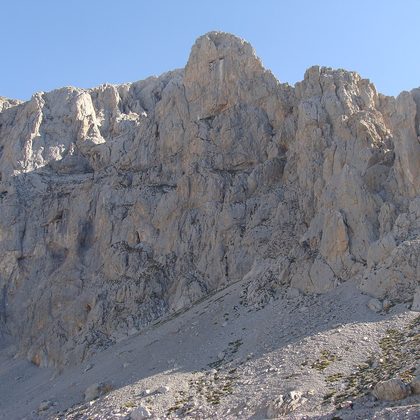
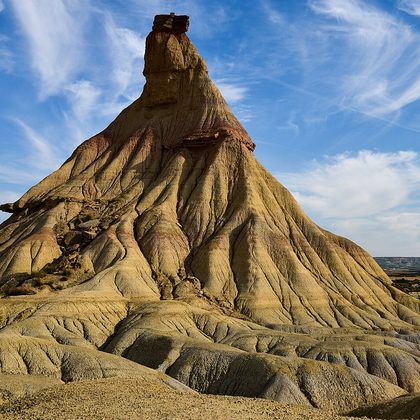
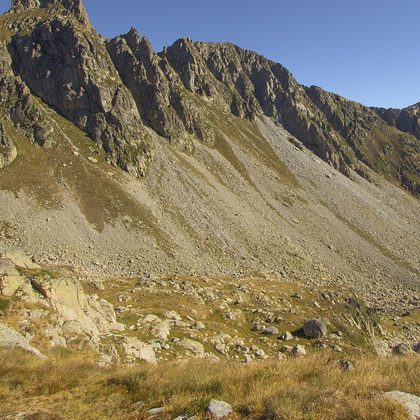
Rock and stone desert: steep-sided wadis, jebels and mesas, gorges, screes and weathered outcrops, with bare gravel plains alongside to hunt over. Breeds without a nest on a ledge or in a crevice of the rock face, sometimes in an abandoned building, a ksar or an old well. Forages over stony plains, the edges of oases and date gardens and the surroundings of villages, taking rats, jerboas, hedgehogs, lizards, big beetles and prey up to doves and partridges.
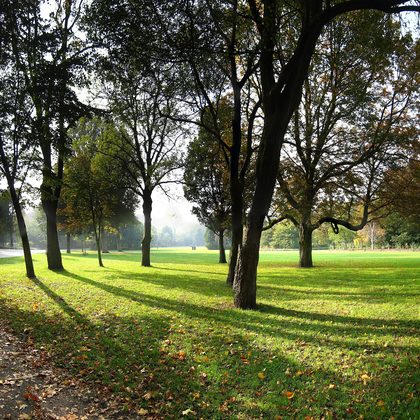
Where the bird is most at home, classified with EUNIS — the European standard for habitats.
Range and movements
From Morocco, Western Sahara, Algeria and Tunisia east through Libya and Egypt, and from Sinai through Israel and Jordan into Arabia. Within the region covered here it is the owl of the Maghreb and of the Levantine deserts; it does not occur in Europe. In Morocco it is easiest along the southern edge of the High Atlas and in the wadis around Boumalne Dadès, Todra and Merzouga. In Israel and Jordan it holds the Negev, the Arava and Wadi Rum. Resident, with rock faces that stay occupied for years on end.
- Resident
- Winter
- Passage
- dark = core range, pale = thinly spread
Where and when to look
In February or March pick a wadi or a steep rock face, settle well back before sunset with the face in the light, and scan the ledges with a telescope: the pale underside of a perched bird often shows in low sun as a bright patch. Then stay put and listen for an hour after dark. Do not approach the face and do not climb it; a breeding Pharaoh eagle-owl will give up a ledge if anyone passes above or below it.
Conservation status
Not globally threatened and spread across an enormous desert range, but everywhere at low density and therefore hard to count. The damage is done at the edges: electrocution on medium-voltage pylons along new desert roads, collisions on those same roads, and poisoning through rodenticides around villages and orchards. Direct persecution is added to that — in North Africa owls, and this species in particular, are still traded in markets for traditional magic. Wind farms and the sharp growth of tourism in gorges and wadis put local breeding faces under pressure as well.