All species › Owls › Typical owls › Snowy owl
Snowy owl
Bubo scandiacus | Sneeuwuil | Búho nival
The Snowy Owl is the big white owl of the Arctic tundra, and the only owl you are likely to see in broad daylight sitting on a boulder like a heap of snow. Old males are almost pure white, while females and young birds are heavily barred with black. In western Europe it remains an exceptional sight.

Voice
Over the breeding ground the male gives a deep, rough, barking hooh … hooh, usually two to six notes in a row, carrying for kilometres across the flat tundra; the female sounds higher and hoarser. Around the nest come a rapid, barking krek-krek-krek and a shrill, gull-like kyew, often with bill-snapping. Calling is concentrated in May and June, and in the light of the polar night it can come at any hour. Away from the breeding grounds the species is essentially silent: a wintering or vagrant Snowy Owl will not be heard.
No freely licensed recording is available for this species yet.
Identification
A heavy, broad-shouldered owl with a large round head and no visible ear tufts, bright yellow eyes and a black bill almost buried in dense facial feathering; the legs and toes are feathered white right to the claws. Plumage differs strongly with sex and age: an old male is almost entirely white, with at most a few scattered dark flecks on crown and wing, while a female carries dense dark barring across breast, belly, flanks, back and wings and keeps only the face, throat and underwing white. Young birds are barred more heavily still than their mother. The female is clearly larger and heavier than the male, by roughly half a kilogram. In flight the species shows long, broad wings, a short tail and slow, powerful, even beats, low and straight across open country with short glides in between; it hunts by day and rests between flights on a stone, a post or a low mound.
Confusion species
The main pitfall is not plumage but provenance: a white owl inland in the Low Countries or Britain is more often an escaped falconry or zoo bird than a wild Snowy Owl, so look first for a ring on the leg, for leather jesses on the tarsus, and for a bird that lets you walk up to it or sits on a barn roof. From the Short-eared Owl it differs in everything but behaviour: that species is far smaller and paler and sandier, with yellow eyes, a white face with black eye surrounds, a sharply defined black carpal patch and breast streaking that fades away on the belly, and it sails on stiff, raised wings rather than using the flat, powerful beat of a Snowy Owl. An old male Hen Harrier also looks white at range and also hunts by day, but is far slimmer, with black wingtips, a white rump and a long narrow tail. A heavily barred female can suggest an Eagle-Owl, which is warm ochre-brown, orange-eyed and long-tufted. And a white patch on a distant field turns out to be a Great Black-backed Gull or a sheet of plastic more often than an owl.
Habitat
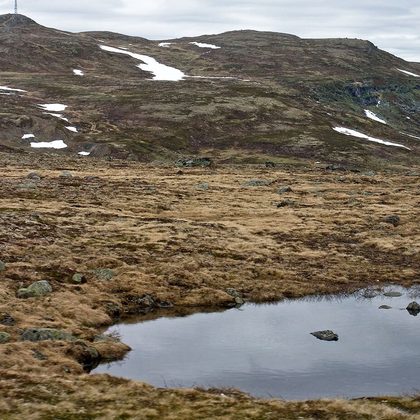
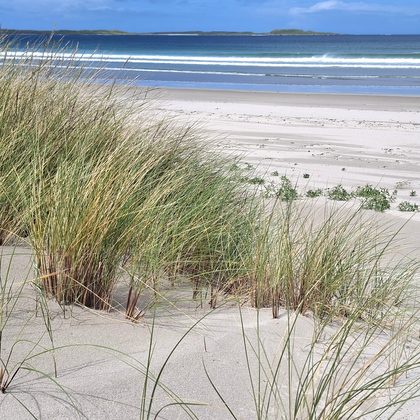
Open Arctic tundra with short vegetation and scattered stones, ridges and hummocks that serve as lookouts; the nest is no more than a scrape on a dry rise that clears of snow early. Outside the breeding season it keeps to open ground: coastal dunes and saltmarsh, wide arable land and polders, airfields, sea walls and the edge of the pack ice. Trees are avoided; a Snowy Owl would rather take a rock or a fence post.
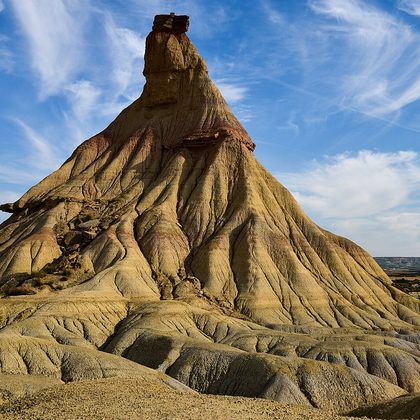
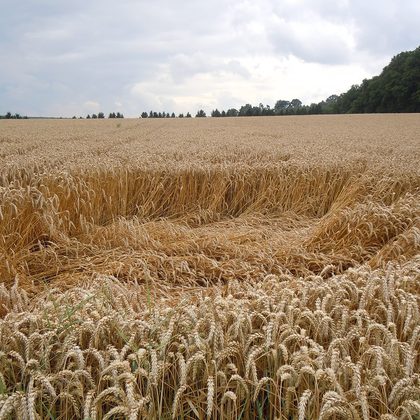
Where the bird is most at home, classified with EUNIS — the European standard for habitats.
Range and movements
A breeding bird of the tundra belt around the North Pole. Within Europe that means Finnmark in Norway, Swedish and Finnish Lapland and the tundra of northern Russia, but occupation is highly irregular: in years with few lemmings not a single pair breeds in the whole of Scandinavia, while in a good lemming year dozens of pairs appear at once. Beyond that it is a rare wanderer. Britain has a scatter of records, including breeding on Fetlar in Shetland between 1967 and 1975 and long-staying birds in the Northern Isles and the Cairngorms; the Netherlands has twenty-two accepted records between 1806 and 2014, in small waves in 1980 and 1981, in 1992 and in 2013 and 2014. Chances of a wild bird therefore depend entirely on the lemming year in the north.
- Resident
- Winter
- Passage
- dark = core range, pale = thinly spread
Where and when to look
Anyone who wants to be sure of the species should head north: the Varanger peninsula in northern Norway and Finnish Lapland are the nearest places, in May or June of a year with a high lemming count — birders in Scandinavia report that every spring. Scan the higher hummocks and boulders from the road with a telescope for white patches; the birds sit out in the open by day and show up at a great distance. Stay well away from a nest site, because the parents leave quickly and will also attack. If a white owl turns up in the Low Countries or Britain, check the leg and tarsus for a ring or jesses first.
Conservation status
Vulnerable (IUCN: Vulnerable). The species was long listed as not threatened, but at the last revision the world population proved far smaller than assumed — of the order of fourteen to twenty-eight thousand mature birds — and clearly reduced over three generations. Its nomadic habits make counting hard, since the same birds may breed in Siberia one year and in Canada the next. Changing snow cover and disrupted lemming cycles in the north are the main concern, along with collisions with vehicles and power lines and local persecution.