All species › Swifts › Swifts › Plain swift
Plain swift | Apus unicolor
Eilandgierzwaluw | Vencejo unicolor
The swift of Madeira and the Canary Islands, and a breeding bird nowhere else on earth. It races along the same barranco walls as the rock doves and along the same cliffs as the mainland swifts — but it is still there in January, and that is the handiest field character in existence.

Voice
A scream in the manner of common swift but thinner, higher and more whistling, and more clipped: sree-sree-sreee, usually in chorus from a party working a rock face or a street. Unlike the mainland swifts, this is heard all year round — including on a still January afternoon above a village square.
No freely licensed recording is available for this species yet.
Identification
Smaller and slimmer than common swift, with proportionately longer, narrower wings and a longer tail with a deeper fork; the silhouette is a crossbow. The plumage is dark and even, sooty brown to almost black, with no pattern. There is a throat patch, but it is small, ill-defined and greyish rather than white, and at any distance it simply disappears. Very close and in good light, pale feather fringes give the underparts a finely scaled look. The flight is more nervous and more agile than a common swift's, with quick beats and sharp banking turns between the rock walls.
Confusion species
Everything turns on three things: colour, silhouette and date. Common swift is bigger and more solidly built, with a broader-based wing, a shallower tail fork and a more obvious pale throat — on juveniles strikingly white. Pallid swift is browner and paler, with a large, diffusely edged pale throat, a dark eye mask against a paler forehead and a pale panel in the inner wing; it looks blunter-winged and slower in the beat. Plain swift is the darkest and slimmest of the three, and its throat shows least. Honestly, single birds passing against a grey sky often cannot be named with certainty; wait instead for a bird that comes low along a wall with the sun behind you. Date helps enormously: in December and January common swift is in Africa, and over a Canarian barranco almost any dark swift is then this one. Alpine swift is far bigger with a white belly, and little swift has a white rump and a short, square tail.
Habitat
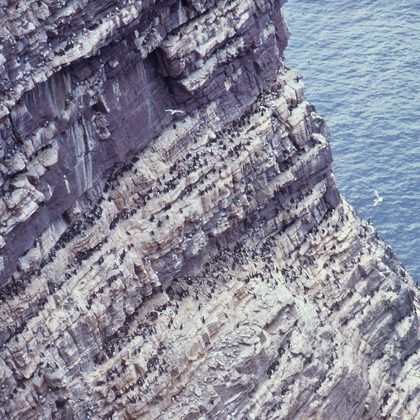
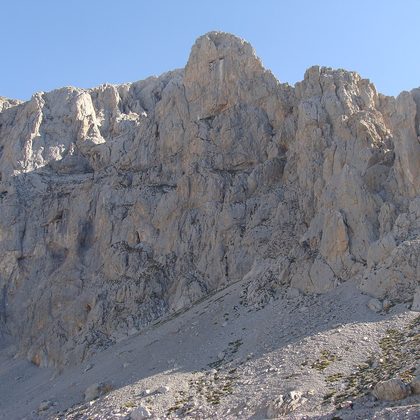
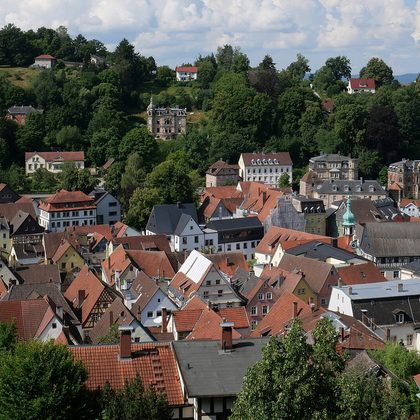
Nests in crevices and holes in sea cliffs, offshore stacks, barranco walls and inland rock faces, and also in buildings and under bridges, from sea level to high in the mountains. The nest is a saucer of plant fluff and feathers glued with saliva, deep inside a crack. It hunts over everything — coast, town, banana terrace, laurel forest and caldera — but what characterises it is the rock wall: that is where it breeds, where it roosts and where you watch it sliding past all year.
Where the bird is most at home, classified with EUNIS — the European standard for habitats.
Range and movements
Breeds on Madeira with Porto Santo and the Desertas, and on all the main Canary Islands, where it is scarcer on Fuerteventura and Lanzarote than on the western islands. It breeds nowhere else; records from the Selvagens and along the Atlantic coast of Morocco concern wanderers and migrants. Some birds leave the archipelagos in October and return in late winter or early spring, while others stay all year — above all in the Canaries, where the species can be seen in every month.
- Resident
Where and when to look
Stand at the lip of a barranco or on a clifftop with the sun behind you and look down rather than up: the birds then pass at eye level and you see colour, tail fork and throat as they really are. Tenerife and La Gomera are easy, with birds over almost every village. If you want certainty over the identification, come in December or January; if you want all three swifts side by side, come in May instead and settle in below a busy wall.
Conservation status
Not globally threatened (IUCN: Least Concern). The species is numerous on the islands and breeds largely in rock, which leaves it far less dependent on buildings than the mainland swifts — precisely where those are struggling. The range is small and wholly insular, though, and that makes it vulnerable in principle: disturbance of cliffs, demolition and restoration of old buildings, and the decline of flying insects are the things to watch. Anyone building on the islands can do a great deal by leaving a few crevices open in a wall.
Scientific name
Apus unicolor (Jardine, 1830)
Jardine described the species in 1830 as Cypselus unicolor; because it was later moved to another genus, the author and year stand in brackets. The genus Apus was introduced in 1777 by Scopoli. Apus is Latin for a swift, from Greek a- 'without' and pous 'foot', the ancients taking it for a kind of swallow without feet. unicolor is Latin for 'of one colour', from unus 'one' and color 'colour', after the uniformly dark plumage. The specimen the first description was based on came from Madeira.