All species › Waders, gulls and terns › Stone-curlews › Senegal thick-knee
Senegal thick-knee | Burhinus senegalensis
Senegalese griel | Alcaraván senegalés
The stone-curlew of the riverbank. Where Eurasian thick-knee wants dry stony steppe, this one wants water, and by day it stands motionless on a sandbar or a rock island in the Nile. At dusk it opens a shrill, accelerating whistle that carries far downriver, with none of the curlew-like melancholy of its relative.

Voice
A clear, piercing whistled series that opens with a few separate notes and then accelerates into a long even run, pi-pi-pi-pi-pi-pi, rising at first and falling away at the end. Sharper and much faster than the wailing coor-leee of Eurasian thick-knee. Birds on different sandbars answer one another so the sound bounces back and forth across the river. It starts shortly before sunset and continues in bouts through the night; when alarmed, a short hard kik-kik.
No freely licensed recording is available for this species yet.
Identification
Sandy brown, with the round head, thick neck and staring yellow eye of a thick-knee but smaller and neater throughout. The bill is long and straight and largely black, with a yellow patch only at the base of the upper mandible. A broad white area surrounds the eye, bordered above and below by dark lines. The closed wing carries a plain grey panel, cut off below by a black line and edged with white above. Legs greenish yellow, with the swollen joint that gives the family its English name. In flight the upperwing shows a single broad white bar, and the bird looks broad-winged and slow.
Confusion species
Only Eurasian thick-knee, and in Egypt and Israel the two overlap. Bill: long and largely black with a yellow base here, shorter and largely yellow with a black tip in Eurasian. Wing: a plain grey panel with one black border here, a bold black-white-black bar across the greater coverts in Eurasian, and one white primary patch in flight against two. Size: at 32–38 cm this is clearly smaller and slimmer than Eurasian at 40–44. Habitat settles most cases, since Senegal thick-knee is rarely more than a stone's throw from water and Eurasian is a bird of dry ground.
Habitat
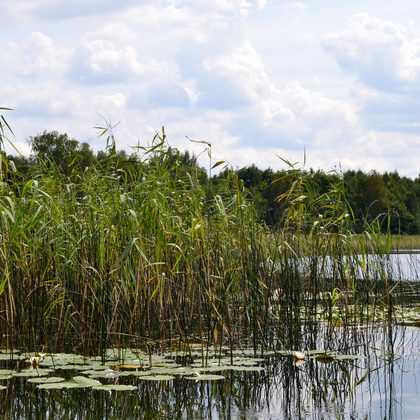
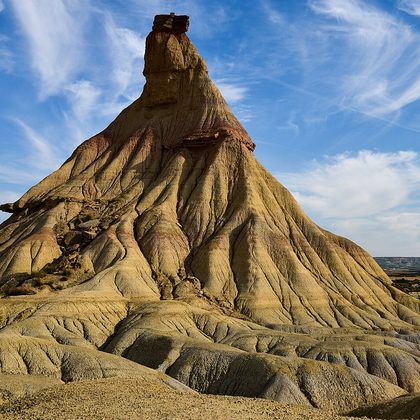
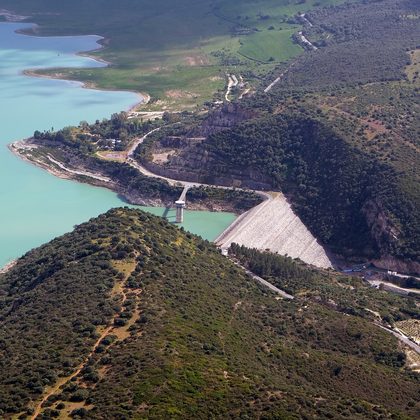
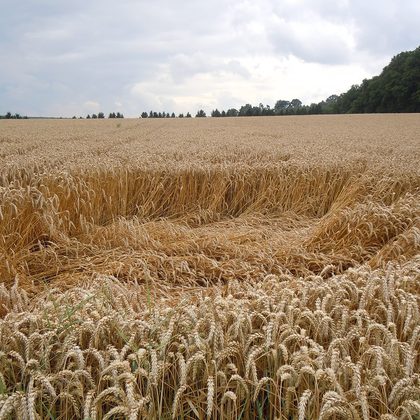
Sandbars, gravel and rock islands in large rivers, the margins of lakes and fish ponds, and the bare open ground immediately behind them. It feeds at night on insects and worms on bare soil and farmland, and nests in a scrape on sand, gravel or stone. In Egypt it has also become a town bird: flat gravel roofs in Cairo, Luxor and Aswan serve as nest sites, with the river within walking distance.
Where the bird is most at home, classified with EUNIS — the European standard for habitats.
Range and movements
An African bird by origin, spread in a broad band from Senegal and The Gambia east to Sudan and Ethiopia. Inside the map area it is the Egyptian race inornatus that counts, present all year and common throughout the Nile valley from the Delta to Aswan. Since about 2015 it has also turned up in Israel, first as singles and then settled at the Ma'ayan Tzvi and Ma'agan Michael fish ponds on the Carmel coast and at Kfar Ruppin in the Bet She'an valley, where records are climbing fast. Further north it remains a vagrant.
- Resident
- Winter
- Passage
- Migration direction
- dark = core range, pale = thinly spread
Where and when to look
In Egypt this is easy: take a felucca out to the rock islands around Elephantine at Aswan, or walk the Luxor corniche in the late afternoon. Israel is harder. Work the fish pond margins at Ma'ayan Tzvi in the last two hours of light, when birds walk out from the roost onto open mud. Trust your ears, because the whistling starts before the birds show themselves, and keep the lamp off.
Conservation status
Not globally threatened, and inside the map area it is gaining rather than losing ground. Fish ponds, irrigation canals and flat roofs all suit it, and the Israeli colonisation is new. It does suffer where riverbanks are canalised and revetted, where dams and sand extraction remove the bars it needs, and where free-running dogs and livestock trample nests. It is one of very few birds in this guide whose range inside the map is growing.