All species › Falcons › Falcons › Sooty falcon
Sooty falcon | Falco concolor
Woestijnvalk | Halcón pizarroso
A slim, uniformly slate-grey falcon of desert cliffs and Red Sea islands. Like Eleonora's falcon it puts its breeding season off until high summer so that the young are raised on the autumn stream of small birds — but it does so over desert rather than over the sea, and almost the whole world population winters on Madagascar.

Voice
At the nest ledge a high, grating kee-kee-kee-kee, thinner and sharper than a peregrine's call, and a sustained alarm as soon as anyone approaches the cliff. Away from the nest it is silent. Loudest in August and September, with young in the niches.
No freely licensed recording is available for this species yet.
Identification
Long and narrow, with very long pointed wings whose tips reach beyond the tail when perched, and a tail of middling length. The adult is uniform blue-grey, a little darker on the primaries, unmarked below and without any contrast in the underwing; cere, eye-ring and legs are bright yellow and the head is pale, with at most a faint dark moustache. Juveniles are grey-brown above and creamy below with dark streaks, and show a dark trailing edge to wing and tail. It has no colour morphs of the kind Eleonora's falcon shows. The flight is light and buoyant, with long glides broken by sudden very fast stoops.
Confusion species
Eleonora's falcon is the only real confusion species, and its dark morph is the hardest bird of all: sooty brown to black rather than blue-grey, longer-tailed, and always showing dark underwing coverts against paler flight feathers, where sooty falcon is evenly grey right across the underwing. Check the wingtips too: on this species they project past the tail at rest. The male red-footed falcon is also slate-grey but much smaller, with red legs and cere and rufous vent. Juvenile sooty falcons get called hobbies, but hobby is more compact, shorter-winged and has a sharp black-and-white head pattern. The two ranges touch but barely overlap: Eleonora's belongs to the Mediterranean, sooty falcon to the Red Sea and the deserts around it, and in late summer both pass Eilat and Sinai.
Habitat
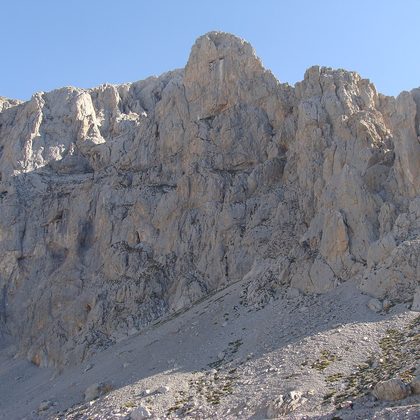
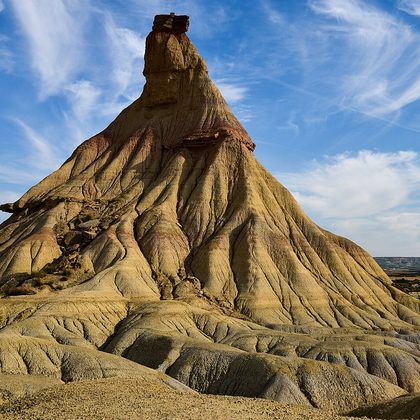
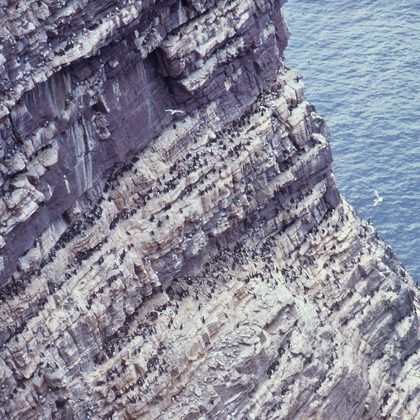
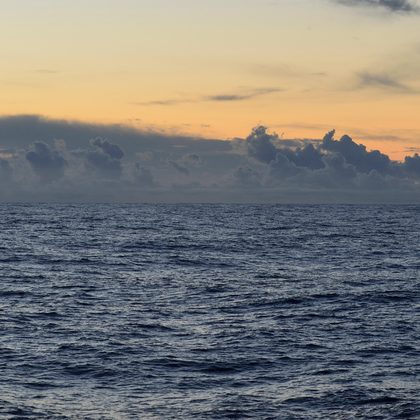
Bare desert rock: inland cliffs and wadi walls, rocky desert islands in the Red Sea and the Gulf, and steep coastal crags. It builds no nest but lays on a shaded ledge or in a niche, out of the sun. It hunts over the desert around it and out over the sea: first large insects and bats at dusk, and from August mainly migrants crossing the desert. The cool of early morning and the last of the light are its busiest hours, and it goes on hunting well after sunset.
Where the bird is most at home, classified with EUNIS — the European standard for habitats.
Range and movements
Breeds from Libya and Egypt across the Red Sea islands into Israel, Jordan and Arabia, and east to Pakistan. Within the area of this guide that means the deserts and cliffs of the Negev, the Judean desert and the Eilat mountains, Wadi Rum and Wadi Araba in Jordan, and the Egyptian Eastern Desert, Sinai and the Red Sea islands; Israel holds only a few dozen pairs. In October the entire population leaves for Madagascar and East Africa, travelling right across the African continent, and does not return until late April or May. There are no accepted records for Britain, Ireland or the Netherlands.
- Breeding (summer)
- Passage
- Migration direction
- dark = core range, pale = thinly spread
Where and when to look
Eilat in September and October: take a viewpoint in the mountains or stay at the salt pans and watch for a slim, evenly grey falcon hunting high and easily over the land. In Jordan the walls of Wadi Rum and Dana give the best chance in August and September. Sit down towards sunset and stay until it is nearly dark: that is when the bird is busiest, and when the long narrow-winged silhouette stands out most sharply against the sky.
Conservation status
Vulnerable (IUCN, assessed in 2017), with a world population estimated at two to a little over three thousand mature birds and falling; an international species action plan was adopted in 2024. The heaviest pressures are disturbance of the island colonies by fishing, tourism and building along the Red Sea, illegal trapping for falconry, collision and electrocution on power lines, and the loss of woodland and hunting habitat in the Madagascan wintering grounds. On top of that, pesticides remove the large insects it lives on before the migration season begins.