All species › Passerines › Wagtails and pipits › Tree pipit
Tree pipit | Anthus trivialis
Boompieper | Bisbita arbóreo
Tree pipit is the pipit with a tree, and that is essentially the whole species. It nests on the ground like a meadow pipit, but it sings from a top — a birch at the edge of a heath, a pine crown above a clearfell, a post along a forest ride. From there it climbs at an angle, checks, and parachutes back down to the same perch on stiff wings while delivering the slowest and finest ending in the family: see-a … see-a … see-a. Walk a heath with scattered trees in May, or a young conifer plantation in Wales or the Scottish glens, and it is everywhere; and once you have seen the song flight, you never need the plumage again.

Voice
The song is one of the loudest in the spring woodland edge, and it is recognised by its ending. It opens loud, clear and canary-like: a series of ringing, accelerating tseet-tseet-tseet notes and rolling trills, carrying right across a heath. Then comes the character: five to ten slow, drawn-out, descending notes — see-a … see-a … see-a … see-a — delivered as the bird floats down from the top of its climb on raised wings and spread tail, landing back on a treetop. No other bird in the region combines a loud, hurried opening with a slowing, spun-out close. The song flight almost always starts and finishes on a perch; sung from the ground and landing on the ground, it will be a meadow pipit. The call is a single hoarse buzzing note, bzeet, with a distinctly rasping, almost electric quality, given on flushing and by migrants passing overhead. In late August and September that note, high over a coastal watchpoint, is often all you get of a tree pipit.
No freely licensed recording is available for this species yet.
Identification
A little larger and more solid than meadow pipit at 15–16 cm, and warmer in tone: olive-buff to yellowish-brown above with vaguer streaking, and creamy yellow across the breast fading to white on the belly. The decisive character is the pattern of the streaking: the breast carries heavy, broad black streaks, but on the flanks they become abruptly much finer and thinner, so that in profile the underparts read in two parts — boldly marked above, finely pencilled at the side. The bill is clearly stouter than a meadow pipit's, with a pink base. The legs are pale flesh, and the hindclaw is short and curved, shorter than the hind toe — the exact opposite of meadow pipit, and the one structural feature that always works on a photograph. The face is better marked: a pale supercilium broadening behind the eye, a dark eye-stripe, and a pale spot on the rear ear-coverts with a small dark spot just below it. The wing shows two rows of coverts with dark centres and broad buff tips, forming a clear double bar. It walks steadily and horizontally, gently pumping the tail, and when disturbed almost always goes up into a tree — which meadow pipit does not.
Confusion species
Everything turns on meadow pipit, and the shortest answer is: listen. Tree pipit calls once, loud and hoarse, a buzzing bzeet with a rasping edge; meadow pipit calls thin and high and repeats it, two to four stuttered notes in a row. If you can see the bird, check the flanks (finely against heavily streaked), the bill (stouter), the hindclaw (short and curved) and where it lands (a branch). The breast is also a warmer yellow-buff, where meadow pipit is colder and whiter. Olive-backed pipit, an annual autumn scarcity on the North Sea coasts, is the second candidate and is described next; the difference is the olive-green, almost unstreaked mantle and the sharply drawn spot on the rear ear-coverts. Red-throated pipit has a streaked rump and blacker, heavier flank streaks. Rock and water pipits are bigger, colder and dark-legged. Tawny pipit is clearly bigger, paler, longer-legged and clean-breasted — except as a juvenile, when leg length is the better guide.
Habitat
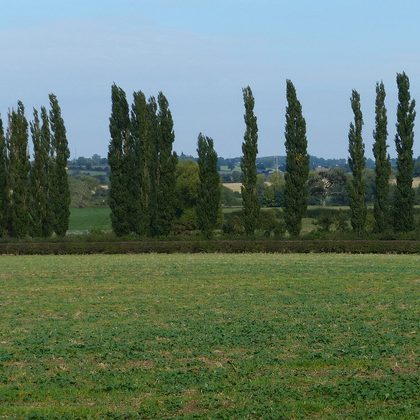
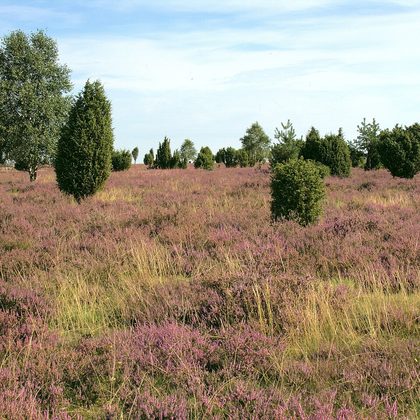
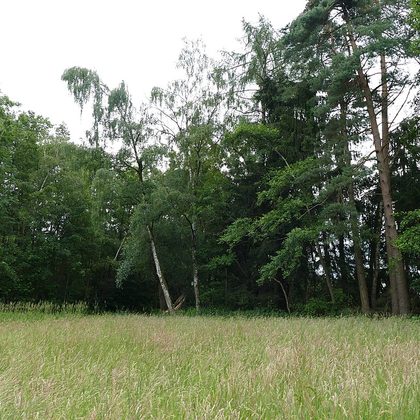
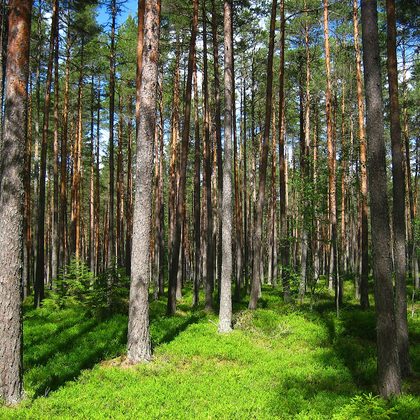
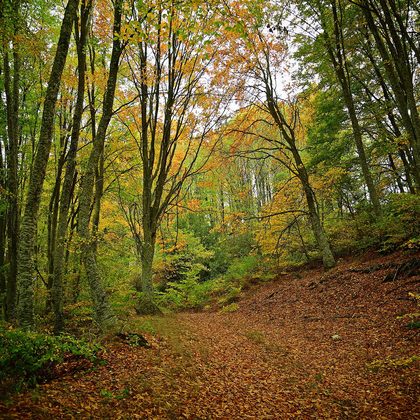
Transitions between woodland and open ground, and that is more precise than it sounds: the bird needs bare ground to nest and feed on, a field layer to disappear into, and tall isolated song posts. In practice that means heathland with scattered birch and self-sown pine, clearfell and restocked plantation, forest rides and firebreaks, open pine woods with bilberry, upland birch woods and bracken slopes with a few trees, wood pasture, and scrubby chalk grassland. As soon as the canopy closes or the last trees go, the bird goes. The nest is on the ground in a tussock or under a bilberry clump, well hidden.
Where the bird is most at home, classified with EUNIS — the European standard for habitats.
Range and movements
Breeds from Ireland and northern Spain to central Siberia, and from northern Scandinavia south into the mountains of southern Europe, Turkey and the Caucasus — one of the most widely distributed songbirds of the continent. Every bird winters in sub-Saharan Africa. In Britain it is now overwhelmingly a bird of the north and west: Wales, the Welsh borders, the Peak District, northern England and the Scottish Highlands, in young plantations, upland birch and bracken slopes with scattered trees. It has been almost entirely lost from the heaths and woodlands of southern and eastern England, where it was once widespread. In Ireland it is scarce and local. Migrants pass along both coasts in April–May and again from mid-August to late September.
- Breeding (summer)
- Passage
- Migration direction
- dark = core range, pale = thinly spread
Where and when to look
The last two weeks of April and the whole of May, on a heath or a young plantation with scattered trees: the Surrey and Breckland heaths for the remnant southern birds, or better, a Welsh or Highland hillside with birch and bracken. Find the tallest crown on the slope and wait — the song flight comes without any effort on your part, and it is worth half an hour of standing still. Watch deliberately where the bird lands, because that is the difference from meadow pipit that actually stays with you. For the call, take a coastal watchpoint in the second half of August: the single buzzing bzeet going over among the stuttering meadow pipits is exactly the contrast you need.
Conservation status
Not globally threatened (LC), with an enormous range from Ireland to Siberia and a population in the tens of millions. The picture in north-west Europe is much less comfortable. In Britain the breeding population has fallen very steeply since the 1970s and the species has all but vanished from lowland England, a decline usually put down to a combination of changing woodland management — fewer open clearings and rides, closed canopies, the loss of coppice and heathy woodland edge — and problems on migration and in the West African wintering grounds. In the Netherlands and Germany numbers also dropped hard until about 2000 and have since stabilised where heath and drift sand are actively kept open. Across central and eastern Europe and Scandinavia it remains common and numerous.
Scientific name
Anthus trivialis (Linnaeus, 1758)
Linnaeus described the species in 1758 as Alauda trivialis; because it was later moved to another genus, the author and year stand in brackets. The genus Anthus was introduced in 1805 by Bechstein. Anthus is the Latin name Pliny the Elder gave to a small bird of grasslands. trivialis is Latin for 'common, ordinary', from trivium 'public street'. The specimen the first description was based on came from Sweden.