All species › Passerines › Wagtails and pipits › Richard's pipit
Richard's pipit | Anthus richardi
Grote pieper | Bisbita de Richard
The biggest pipit in the region, and a bird from Siberia: it breeds from the Altai to Mongolia and China and belongs in India for the winter, yet every autumn a share of the young birds turns up in north-west Europe. Once you have heard the call you will never mistake it again — that harsh rasping shout is the single most important character the species has.

Voice
For this species sound is not a supporting character but the character. The call is a loud, hard, rasping shout: shreep or pshee-oo, explosive, with a grating burr in it, and carrying so far that you hear the bird before you see it — most British and Dutch records are of calling birds passing overhead. It suggests a House Sparrow, but is longer, coarser and more emphatic. An agitated bird repeats it rapidly from the ground. This is also where Blyth's is separated: its call is softer, shorter and less rasping, a nasal pshee-oo that falls away rather than grates, and it is often followed by a short dry chep. There is overlap, and anyone in doubt should record the bird. The song, a simple repeated phrase from a high song flight, is never heard in our region.
No freely licensed recording is available for this species yet.
Identification
Big and heavy at 17–20 cm, with the size and impression of a wagtail: long tail, long legs and a tall, upright stance in which it stretches its neck to look over the grass. The bill is long and stout, almost thrush-like, with a yellow base. The upperparts are warm brown with strong dark streaking; the breast is creamy with a band of short heavy streaks, while the flanks are buff and unstreaked — streaks on the breast but not the flanks is a useful split in this group. A broad black malar stripe runs down each side of the throat and ends in a dark patch. The outer tail feathers are white to dirty white. The character the books lean on is the hindclaw: very long in this species, up to a centimetre, only slightly curved and longer than the hind toe itself, and on a walking bird in a telescope it can genuinely be seen. In flight it looks heavy and undulating, sometimes hangs briefly on the wind over the grass, and almost always calls.
Confusion species
Blyth's pipit is the real problem and has its own account further on: smaller, more compact, shorter-billed and with a clearly shorter hindclaw, but every one of those differences is a matter of degree. The most usable plumage feature is on the median coverts. On Richard's each feather has a dark centre that tapers to a point towards the tip, with a diffuse pale fringe; on Blyth's the dark centre is cut off square and the broad, sharply defined pale tip stands above it like a block. That needs fresh feathers and a good photograph. In the end the call decides. Tawny pipit is the same length but slimmer and far paler, with a clean unstreaked breast, a lighter bill, a short hindclaw and a dark bar across the median coverts. Meadow and tree pipits are markedly smaller and shorter-legged, with streaked flanks. A juvenile tawny with a lightly streaked breast is the classic cause of a wrong claim; look then at the weight of the bill and at the malar stripe.
Habitat
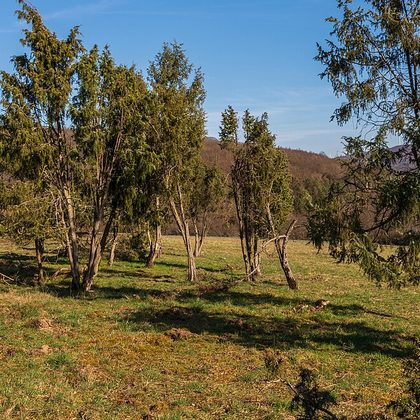
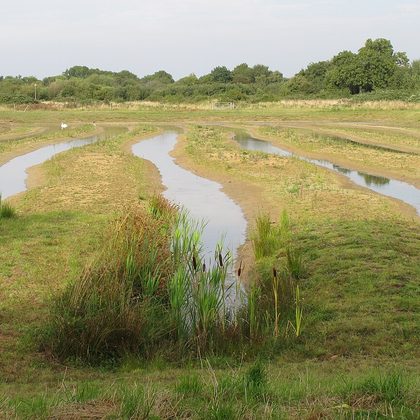
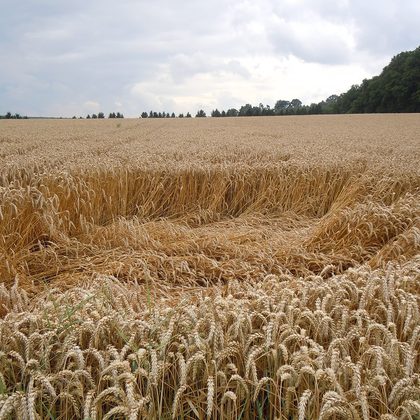
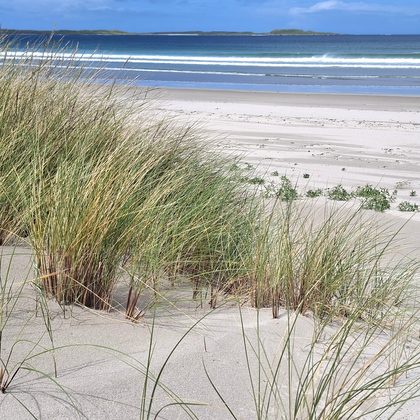
On passage and in winter it wants rank, tall grass with open patches in it: rough grassland and the upper edge of saltmarsh, field margins and set-aside, damp pasture and ditch banks, drained mud, airfields, waste ground behind dunes and the fringes of reedbeds. It avoids both close-mown turf and dense closed vegetation; what it needs is grass it can vanish into and stretch up out of. On its breeding grounds, far outside this map, it is a bird of open steppe and damp river plains.
Where the bird is most at home, classified with EUNIS — the European standard for habitats.
Range and movements
Breeds in southern Siberia, Mongolia and northern and central China and winters in India and South-East Asia. Within the map area it is a passage migrant in a narrow, dependable window: mid-September into November, peaking in the second half of October, chiefly along North Sea coasts and on the British and Irish islands. Britain records a few hundred birds in a good autumn, with Shetland, Fair Isle, Scilly and the east coast headlands taking most of them; the Netherlands and Belgium get a few tens each. Since the 1960s a small but growing number has also wintered in southern France, north-east Spain and Italy, in rice fields and damp grassland, staying from November to March.
- Winter
- Passage
- dark = core range, pale = thinly spread
Where and when to look
October on an east-coast headland or an island, with the wind in the east. Walk the rough grass and the field edges and listen upward above all: nine out of ten Richard's pipits are found on the call. If one flushes you get a big, long-tailed bird flying off heavily and undulating before dropping back into the grass some way on. Do not chase it — wait. It will walk out onto a bare patch of its own accord, and then a single view gives you the upright stance, the heavy bill and, with luck and a scope, the long hindclaw.
Conservation status
Not globally threatened (LC): the Asian breeding range is vast and the population large and stable. For Europe the bird is no more than an annual visitor, so the numbers appearing here say little about how the species is really faring. What is striking is the pattern in autumn: British and Dutch records climbed steeply from the 1960s, peaked in the 1980s and 1990s and have fallen back since, while the number wintering in the Mediterranean has risen. Better observers, better sound recognition and genuinely shifting migration routes all play a part.
Scientific name
Anthus richardi Vieillot, 1818
Vieillot described the species in 1818 and placed it straight away in the genus where it still stands. The genus Anthus was introduced in 1805 by Bechstein. Anthus is the Latin name Pliny the Elder gave to a small bird of grasslands. richardi honours the French naturalist Charles Richard (1745–1835), director of postal services at Lunéville and a friend of François Levaillant. The specimen the first description was based on came from France.