All species › Passerines › Wagtails and pipits › Long-billed pipit
Long-billed pipit | Anthus similis
Langsnavelpieper | Bisbita piquilarga
The pipit of the dry stony hillsides of Israel, Jordan, Lebanon and south-east Turkey: big, plain and easy to overlook as long as it keeps quiet. Once it sings there is no missing it, because no other pipit in the region sings so slowly or so sparingly. This is the western edge of a range that runs on east to India and South-East Asia.

Voice
With this species the voice is the easy character, not the hard one. The song is a series of short, clear, rather wistful whistles delivered one at a time with long silences between: chu-wee … chu-wee … see-woo, unhurried and in constantly varying order. That slow tempo is unique among pipits, which otherwise rattle or jingle; it suggests a wheatear or a distant rock sparrow rather than an Anthus. It sings from a rock, a wall or the top of a bush, and in a short fluttering song flight in which it climbs on stiff slow wingbeats and glides back down. The call is a short, rather flat and nasal chup or chilp, duller and softer than the sparrow-like chilp of tawny pipit, along with a drawn-out chu-ee. It sings from March into June, chiefly in the first hour after sunrise.
No freely licensed recording is available for this species yet.
Identification
A large, long-bodied pipit of 16–18 cm, plain warm sandy brown above with at most faint streaking and buff below, palest on the belly. The breast carries no more than a suggestion of fine streaks; real streaking is absent, and that, with the colour, is the first thing to register. The bill is long and fairly heavy with a straight culmen — the name is earned. The face is notably blank: a vague pale supercilium, a pale eye-ring and little else, so the bird looks gentle and expressionless beside the sharply marked tawny pipit. The tail is long, and the outer tail feathers are not white but dull buff, which gives the best distinction from tawny pipit in flight. The legs are long and pale, the hindclaw moderately long and curved. In flight it looks big, heavy and slowly undulating, with distinctly lazier wingbeats than other pipits. Levant birds belong to the pale race captus; further east and south the forms become darker and more rufous.
Confusion species
Tawny pipit is the only real confusion species here, and it shares the same hillsides. It is slimmer and paler, greyer in tone, with a shorter and lighter bill, a sterner head pattern with a clear dark loral line, a dark bar of median coverts and — the best feature — pure white outer tail feathers against the dull buff of long-billed. It is also quicker and more restless and prefers flat ground, while long-billed pipit favours slopes with rocks and scattered bushes. Water pipit breeds in the same mountains but on damp grassy ground around springs and streams, and has a grey head with a white supercilium and white outer tail feathers. Richard's pipit is a scarce winter visitor to the Levant: more heavily streaked on the breast, with a far longer hindclaw and a completely different call. If the bird stays silent and you cannot see the tail, you are left with the weight of the bill and the warm, unmarked buff underparts.
Habitat
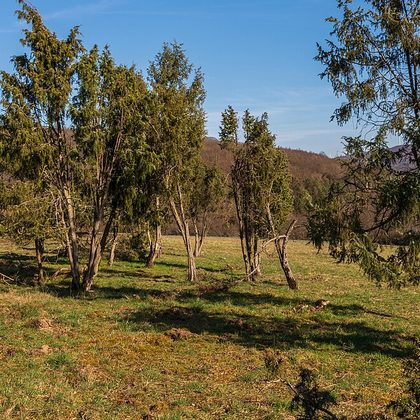
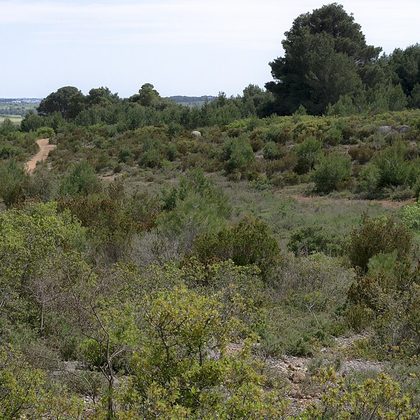
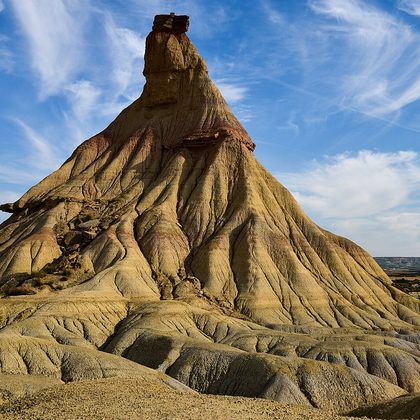
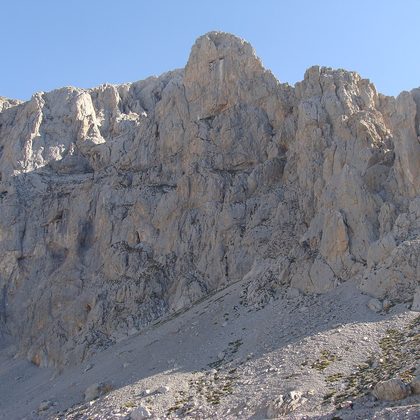
Dry stony hillsides with short grass, herbs, scattered bushes and loose boulders: limestone and basalt slopes, wadi rims, abandoned terraces, garrigue with plenty of open soil between the bushes, and the upper edges of gorges. It needs a combination that is not as common as it sounds: sloping ground, rocks to sing from, and enough grass and herbage on the surface to feed in. Wholly bare desert and closed maquis are both too much of a good thing. The nest is on the ground, hidden under a tussock or against a stone on the slope.
Where the bird is most at home, classified with EUNIS — the European standard for habitats.
Range and movements
As a species it ranges from West Africa through the Levant and Iran to India and South-East Asia, across a series of strikingly different forms. Within the map area only the pale Levantine race captus occurs: Israel, where it breeds on the slopes of the Golan, Galilee, the Judean hills and the Negev highlands, together with Lebanon, western Jordan, western and north-western Syria and the extreme south-east of Turkey, roughly to the edge of this map window. It is resident there; only the highest sites are vacated in winter, the birds dropping to lower slopes and wadis.
- Resident
- Passage
- dark = core range, pale = thinly spread
Where and when to look
Go at sunrise in March or April to a stony slope above a wadi in the Golan, the Judean hills or the Negev highlands, and sit down. Do not search — listen. The slow, far-carrying whistles come with long gaps between them and stand out at once among all the other bird sound. Then follow the sound to a boulder or a low bush, where the bird will be singing upright. If you get it on the ground, wait until it flies and watch nothing but the tail sides: dull buff, not white. That separates it from tawny pipit even if you have seen nothing else properly.
Conservation status
Not threatened (LC). The world range is vast and the species is widespread across all of it. In the Levant captus is a common and well-distributed breeder of the hills, with a few thousand pairs in Israel and a fairly stable picture. The pressures are in the detail: the loss of extensive grazing, which lets slopes close over; conifer planting on open limestone hillsides; and the spread of building and quarrying around the hill towns. Where traditional goat and sheep grazing continues, the bird stays put.
Scientific name
Anthus similis (Jerdon, 1840)
Jerdon described the species in 1840 as Agrodoma similis; because it was later moved to another genus, the author and year stand in brackets. The genus Anthus was introduced in 1805 by Bechstein. Anthus is the Latin name Pliny the Elder gave to a small bird of grasslands. similis is Latin for 'like, resembling'; which other pipit the bird is said to resemble is not stated in the description. The specimen the first description was based on came from Jalna, India.