All species › Passerines › Wagtails and pipits › Berthelot's pipit
Berthelot's pipit | Anthus berthelotii
Berthelots pieper | Bisbita caminero
The pipit of Madeira and the Canary Islands, and of nowhere else on earth. On those islands it is everywhere: on the lava grit of Lanzarote, on the verges of mountain roads, among the banana terraces, on the car park at three thousand metres below the crater rim of Teide. It is also astonishingly tame, running along the path ahead of you — hence its Spanish name caminero, the road walker.

Voice
The call is a short, dry, slightly jangling tchip or chirr, hard and not at all musical, often repeated as the bird trots ahead of you along the track. An agitated bird runs the notes into a rapid rattle. The song is simple and very monotonous: a short phrase of three to six identical thin notes, chee-chee-chee-chee, slightly accelerating and dying at the end, repeated over and over from a rock, a wall, a telephone wire or a low bush, and sometimes in a short song flight in which the bird climbs and then glides down on stiff wings. From January into June that song fills the whole hillside; it is the sound of a dry lava slope in spring.
No freely licensed recording is available for this species yet.
Identification
A small grey-brown pipit of 13 to 14.5 cm, short-tailed, with a fine pointed bill. The face is the clearest thing about it: a long, broad, creamy-white supercilium running from the bill well behind the eye, with a dark eye-stripe and dark ear coverts below it, giving a stern, sharply drawn head pattern. The upperparts are greyish sandy brown with vague, diffuse streaking — nowhere the crisp black streaks of the northern pipits. Below it is creamy white with a buff wash on the breast and a row of fine dark streaks across it that fades out quickly onto the flanks, and a short dark malar stripe runs down each side of the throat. Two pale bars cross the wing. The legs are pale flesh and proportionately long, the outer tail feathers dirty white. It walks and runs over bare ground in a horizontal posture, flicking its tail as it goes. Madeiran birds, the race madeirensis, are slightly darker and warmer brown and rather more clearly streaked than Canarian ones.
Confusion species
On Madeira and the Canaries there is in practice nothing to confuse it with: it is the only pipit present all year. Meadow pipits do arrive in winter, and those are more olive-brown, longer-tailed, with crisp black streaks on breast and flanks alike, a less striking supercilium and a thin high call, and they keep to damper, greener ground. The occasional tawny pipit on passage is bigger, much paler, longer-legged, with a completely clean breast and a dark bar across the median coverts. Fuerteventura's Canary Islands stonechat walks the same stony ground but has a short tail with white at the base, an upright stance on a rock and an orange breast. Anyone who thinks they are looking at a small grey pipit with a blazing supercilium on the mainland should eliminate the common species first: away from the islands Berthelot's pipit has hardly ever been recorded.
Habitat
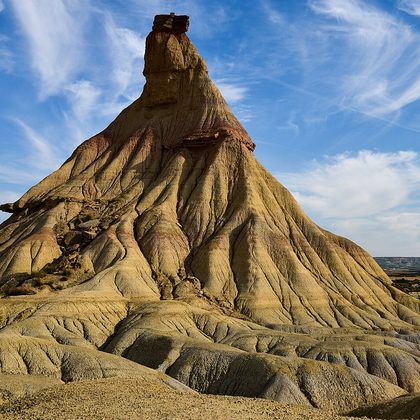
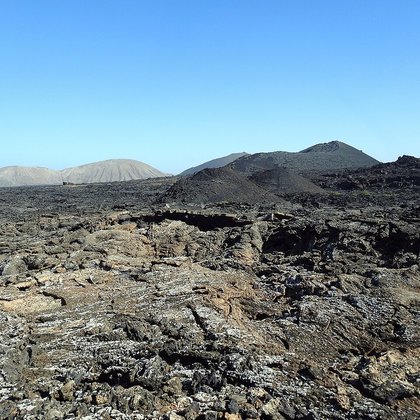
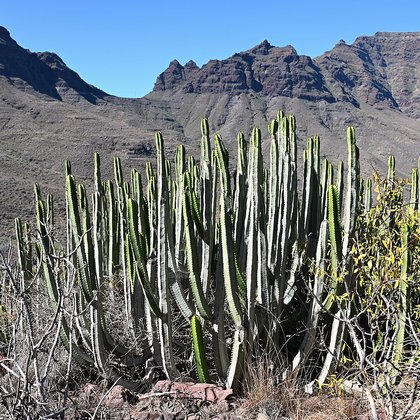
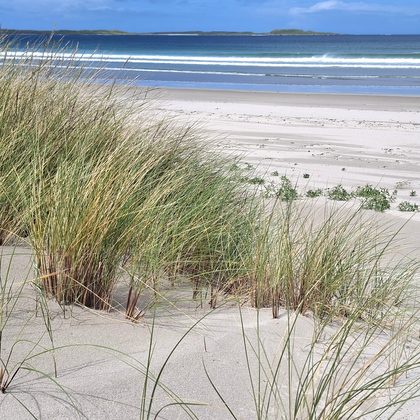
Open, dry, stony, sparsely vegetated ground at every altitude, from the shore to above the treeline. In practice: lava fields and malpaís, bare volcanic slopes, semi-desert with scattered low bushes, coastal dunes and sand flats, verges and lay-bys along mountain roads, abandoned terraces and fallow plots, goat pasture and golf courses, and on Tenerife right up into the pumice of the Cañadas at three thousand metres. It is missing only from closed laurel forest and dense plantation. The nest is a cup on the ground, tucked under a tussock, a stone edge or a small shrub.
Where the bird is most at home, classified with EUNIS — the European standard for habitats.
Range and movements
Occurs on Madeira with Porto Santo and the Desertas, and on all seven Canary Islands, and nowhere else; it is absent from the Azores and from the African mainland. Within that small area it is one of the most numerous land birds: on the dry eastern islands of Lanzarote and Fuerteventura it is present on very nearly every square kilometre, and on Tenerife, Gran Canaria and La Palma it is common from sea level to the summits. The birds stay on their island all year; there is no migration, only some shift in altitude after breeding. The population is put at several hundred thousand birds.
- Resident
Where and when to look
You need do nothing to see it. Step out of the car anywhere on Lanzarote or Fuerteventura and within a minute one will be trotting ahead of you across the grit, often to within two metres. For the best view, go early to a lava field or an old terraced plot in March or April: it will be singing from a wall or an agave, and the broad white supercilium and the fine breast streaks show without binoculars. On Tenerife the most rewarding place is high up among the rocks of the Cañadas del Teide, where it walks beside the car park while the rest of the bird world is absent.
Conservation status
Not threatened (LC). The species is common and widespread across the whole — small — area in which it occurs, and the population appears stable. That does not mean there is no risk: a bird confined to two archipelagos is by definition exposed to whatever happens there, and heavy coastal development in the Canaries, the spread of irrigated cultivation and the pressure of feral cats and rats on ground-nesting birds are all real concerns. So far it is coming through well, helped by the fact that it is perfectly at home on verges, waste ground and other bare places made by people.
Scientific name
Anthus berthelotii Bolle, 1862
Bolle described the species in 1862 and placed it straight away in the genus where it still stands. The genus Anthus was introduced in 1805 by Bechstein. Anthus is the Latin name Pliny the Elder gave to a small bird of grasslands. berthelotii honours the French naturalist Sabin Berthelot (1794–1880), a long-time resident of the Canary Islands. The specimen the first description was based on came from the Canary Islands.