All species › Passerines › Wagtails and pipits › Water pipit
Water pipit | Anthus spinoletta
Waterpieper | Bisbita alpino
Two birds in one species. In summer the water pipit lives high in the mountains, walking the alpine pastures above the treeline, along meltwater rills and the edges of snow patches, from the Pyrenees and the Alps to the Apennines, the Balkans and Turkey, the males grey-headed with a clean, pink-washed breast. In October they come down, and in the lowlands a quite different bird appears: large, cold-toned, white below, boldly streaked and dark-legged, along ditches, watercress beds, cress-fed streams and sewage farms. It is one of the few European birds that migrates vertically rather than south, and in Britain it is a scarce and rather local winter visitor that repays being looked for.

Voice
The call is a single, full, penetrating note: feest or dzeep, hard, slightly rising, with far more body than the thin voice of a meadow pipit — which calls thin and repeats it, where this one calls full and usually once, at most twice. On migration and in winter that is the sound that gives a water pipit away as it goes high over a marsh, and with practice it can be picked out from meadow pipit at range. It cannot be reliably separated from rock pipit: the calls overlap heavily, and anyone claiming to do it every time in the field is overrating themselves. The song belongs to a mountain landscape: four to six groups of repeated notes, each group at its own pitch and pace and closing with a little trill, delivered in a rising song flight from a rock and finished with a gliding, stiff-winged descent — the same parachute as a meadow pipit's, but stronger, fuller and slower, and it carries right across an alpine bowl.
No freely licensed recording is available for this species yet.
Identification
Large for a small pipit at 15.5–17 cm, and long-bodied, with a long tail, long wings and a strong dark bill. Two characters hold all year. The first is the legs: dark brown to almost black, never flesh or pink; together with the size that separates it at a glance from meadow and tree pipits. The second is the outer tail feathers, which are clean, bright white. In summer plumage it is a handsome bird: head and neck plain blue-grey with a broad white supercilium, the mantle grey-brown and nearly unstreaked, and the whole underside unstreaked or faintly streaked and washed pink-buff — a 'clean' pipit, and surprisingly elegant on a rock at 2,000 metres. In winter plumage, which is how we normally see it, the upperparts are grey-brown with vague streaking and the underparts are bright white with clear dark-brown streaks on breast and flanks; the supercilium stays white and prominent, giving a better-marked face than a rock pipit's. Two narrow white wing-bars show on the closed wing.
Confusion species
Everything turns on rock pipit, and it is more honest to say at once that a proportion of winter birds cannot be named in the field. Four things are worth comparing. The ground colour of the underparts: clean white with sharply defined dark streaks on water pipit, dingy grey-buff with blurred, diffuse olive streaks on rock pipit. The supercilium: white and obvious on water pipit, barely there on rock pipit. The outer tail feathers: pure white on water pipit, grey-white to dirty white on rock pipit — the sharpest character there is, but it needs a flying bird and decent light. And the place: a dark-legged pipit on rocks by the sea or on a sea wall in winter is nine times out of ten a rock pipit, one on an inland cress bed or sewage farm almost always a water pipit. But on a saltmarsh, where both occur, in flat grey winter light, 'dark-legged pipit' is sometimes the honest answer. Spring makes it easy: the pink breast and grey head are unmistakable — though Scandinavian rock pipits of the form littoralis can go surprisingly far in that direction by April. Meadow and tree pipits are smaller, browner, warmer and pale-legged. Buff-bellied pipit, described next, is a further degree harder again.
Habitat
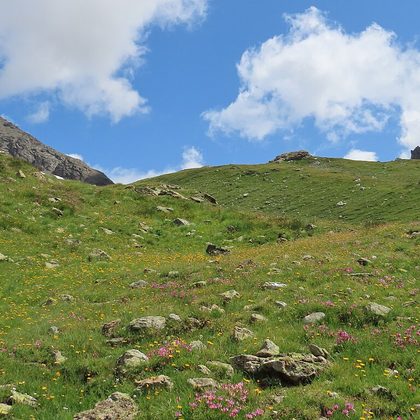
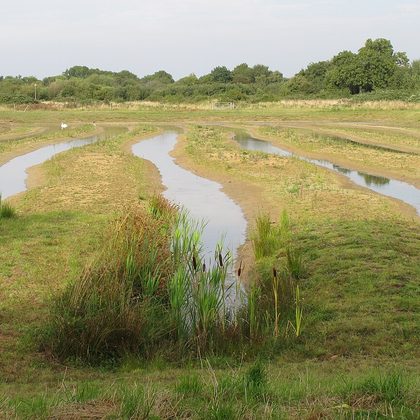
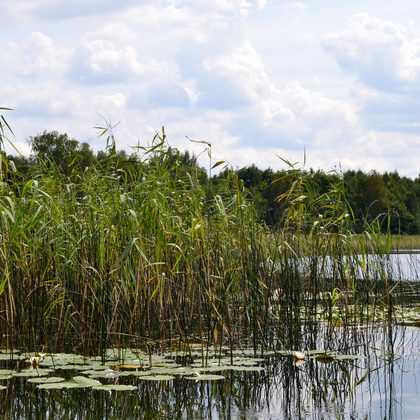
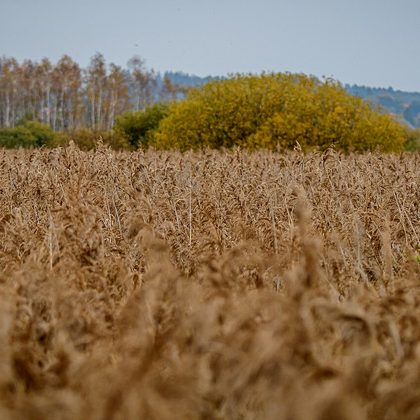
In summer, alpine and subalpine grassland above the treeline between roughly 1,400 and 3,000 metres: short-grazed swards with boulders, vegetated scree, the margins of snow patches and above all the banks of streams and meltwater channels, where the food is. The nest goes in a cavity under a stone or a tussock. In winter it is a bird of fresh and brackish water in the lowlands: watercress beds, ditches and dykes, cress-fed streams, wet meadows, saltmarsh creeks, drained reservoirs, sewage works and the muddy edges of arable fields. The requirement is constant: short grass or bare mud to walk on, with water immediately alongside.
Where the bird is most at home, classified with EUNIS — the European standard for habitats.
Range and movements
Breeds in the mountains of southern and central Europe and the Near East: the Cantabrians, Pyrenees, Massif Central, Alps, Jura, Apennines, Carpathians, Balkan ranges, the mountains of Greece and Turkey, and the Caucasus. It is therefore a genuine mountain breeding bird of this map area. In autumn the birds drop into the valleys and the northern populations move to the lowlands of western Europe. Britain has no breeding birds and receives a modest winter population, mostly from the Alps, concentrated in southern and eastern England — the Kent and Essex marshes, the Somerset Levels, watercress beds in Hampshire and Wiltshire, and sewage works and reservoir margins inland — with numbers building from November and a spring passage in March when birds moult into that grey-and-pink plumage before leaving.
- Resident
- Breeding (summer)
- Winter
- Passage
- Migration direction
- dark = core range, pale = thinly spread
Where and when to look
For the summer bird: late June or July on an alpine meadow above the cable car, in the Alps, the Pyrenees or the Picos de Europa. Walk up a stream and the birds come to you, because that bank is exactly where they feed; the grey head and pink breast show at ten metres, and the song flight carries across the whole valley. For the winter bird: a watercress bed, a marsh ditch or the freshwater side of a sewage farm in December or January, ideally in a frost. Take it in this order — size and dark legs first, then the white in the tail as it flies, and only then the plumage detail. And allow yourself to write 'water/rock pipit' when a silent bird flies off into the light. That is not a failure; it is the state of the art.
Conservation status
Not globally threatened (LC), and within Europe one of the few songbirds whose stronghold is in the mountains and which has therefore largely escaped the collapse of farmland bird numbers. The breeding range is fragmented but densities are high, and the population is considered stable. Two developments are worth watching. In the mountains the breeding zone is shifting slowly upward as the climate warms, and the bird is being lost from the lower ranges at the bottom edge of its range; it is one of the species for which that shift is well documented in Switzerland and Austria. In the wintering grounds the trend runs the other way: water pipits have clearly benefited from wetland creation and from milder winters, and the wintering flocks in Britain and the Netherlands have gone from exceptional to expected within fifty years.
Scientific name
Anthus spinoletta (Linnaeus, 1758)
Linnaeus described the species in 1758 as Alauda spinoletta; because it was later moved to another genus, the author and year stand in brackets. The genus Anthus was introduced in 1805 by Bechstein. Anthus is the Latin name Pliny the Elder gave to a small bird of grasslands. spinoletta is a dialect word for a pipit from the Florence region of Italy. The specimen the first description was based on came from Italy.