All species › Passerines › Buntings › Yellow-breasted bunting
Yellow-breasted bunting | Emberiza aureola
Wilgengors | Escribano aureolado
Until the 1980s a fixture of the autumn on the Northern Isles, now a bird almost nobody sees. The male, with his black face, chestnut upperparts and yellow underparts, is one of the handsomest buntings in Eurasia; the reason he has gone from here lies four thousand kilometres away.

Voice
The call is a short, muffled, rather clipped tsik, less sharp than a little bunting's; on a bird going over it is usually the only sound. The song, never heard here, is a clear cheerful phrase of two repeated motifs with a drawn-out ending, often likened to an ortolan's but faster and brighter.
No freely licensed recording is available for this species yet.
Identification
A bunting the size of a reed bunting, but with a longer, more pointed bill with an almost straight cutting edge and a pale lower mandible. The summer male has a black mask over forehead, cheeks and chin, chestnut crown, nape and mantle, yellow underparts with a narrow chestnut breast band, and a large white shoulder patch that shows at once in flight. Females and juveniles are far duller: yellowish-buff below, a pale median crown stripe between dark lateral stripes, a pale supercilium, a plain brown ear-covert patch thinly outlined in dark, two narrow white wing bars and fine flank streaking.
Confusion species
On a juvenile — and that is virtually all that reaches Britain — three things matter: the yellow wash on breast and belly, the crisply defined pale crown stripe, and the long pointed bill with its pale lower mandible. Reed bunting shows no yellow, has a dark malar stripe and a short bulbous bill. Little bunting is smaller, with a chestnut cheek and a creamy eyering. Ortolan has a yellow eyering and orange-buff underparts without flank streaks. Check the wing too: yellow-breasted bunting shows two narrow but clear white bars.
Habitat
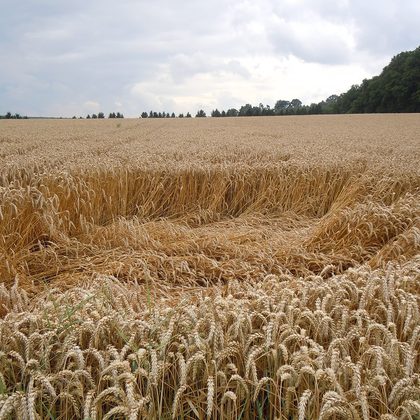
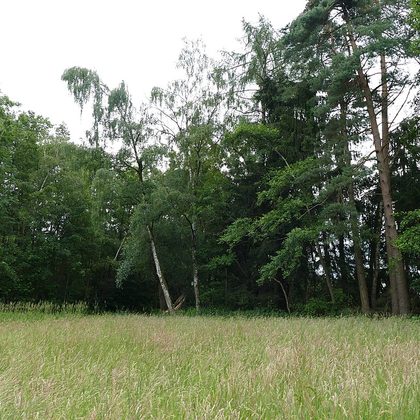
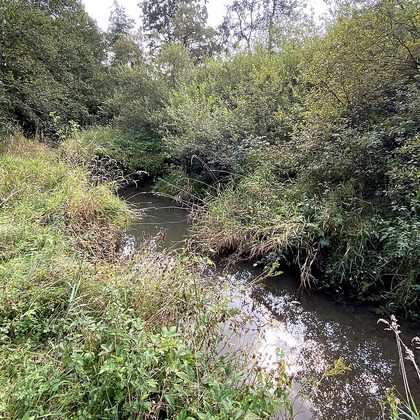
Where it is found here it is a bird of low cover: stubbles, potato and brassica fields, weedy field edges and crofting gardens, along with nettle and thistle beds and the fringe of low scrub. On its breeding grounds it belongs to tall damp herbage and willow scrub along rivers and in wet meadows, but that country lies outside this guide's map.
Where the bird is most at home, classified with EUNIS — the European standard for habitats.

Range and movements
Within the area of this guide the yellow-breasted bunting is now a vagrant. Until the 1980s it still bred in eastern Finland and wandered from there into Sweden; that western outpost has gone. What still arrives are juveniles in September that have drifted west on their way to south-east Asia, almost all of them on the Northern Isles — Fair Isle and Shetland once logged dozens a year, and now count themselves lucky with one. The Dutch and Belgian coasts have a handful of accepted records; in Iberia the species is barely more than an exception.
Where and when to look
Realistically this is not a bird you look for but one you stumble on: a small yellowish-breasted bunting flushing from a potato field or a stubble on a northern island in September. Photograph the wing and the head at once — a records committee wants to see the crown stripe, the outline to the ear-coverts and the wing bars. Anyone who wants to meet the species properly must travel east into what is left of the breeding range, and even there it now takes searching.
Conservation status
Critically Endangered (IUCN), and with that the steepest decliner among Eurasia's songbirds. As recently as 2004 it was listed as not threatened; four successive uplistings followed, reaching the present category in 2017. The cause is known and well documented: on migration and in winter, yellow-breasted buntings gather in vast roosts in reedbeds and rice fields, and it is there that they have been taken in mist-nets in China for decades and sold as a delicacy. Trapping has been illegal since 1997 but continued on a large scale and spread to more provinces as the money grew. The world population has fallen by roughly ninety per cent since 1980 and the range has contracted from west to east; the loss of the Finnish breeders is the western edge of that contraction.
Scientific name
Emberiza aureola Pallas, 1773
Pallas described the species in 1773 and placed it straight away in the genus where it still stands. The genus Emberiza was introduced in 1758 by Linnaeus. Emberiza comes from Old German Embritz, a name for a bunting. aureola is Latin for 'golden', for the yellow underparts of the male. The specimen the first description was based on came from the Irtysh River, Siberia.