All species › Passerines › Buntings › Black-faced bunting
Black-faced bunting | Emberiza spodocephala
Maskergors | Escribano enmascarado
A dark, skulking bunting from the Far East that turns up here rarely, most often in October. It keeps low in wet scrub, shuffles about on mud like a mouse, and gives itself away with a short hard call and with white tail sides as it dives back into cover.

Voice
The call is a short, hard, slightly metallic tzik, louder and fuller than a little bunting's and usually the first sign that something is in the bush. The song, not to be heard here, is a short and rather hesitant series of fluted and rattling notes, closer to a wren than to a bunting.
No freely licensed recording is available for this species yet.
Identification
A stocky bunting with a fairly long notched tail with white outer feathers, a brown streaked mantle and a plain brown rump. The male has an olive-grey head with a blackish mask around the bill base, lores and chin, yellowish-white underparts and fine dark flank streaks; the bill is pink with a dark tip. Female and juvenile are duller: olive-grey ear-coverts, a weak creamy supercilium, a dark malar stripe and creamy yellow underparts with brown streaking. When agitated it flicks the tail and flashes the white sides.
Confusion species
The olive-grey of head and breast is the key: no other bunting likely to appear here has that cool green-grey tone. Reed bunting has a crisp dark malar stripe below a pale submoustachial and chestnut lesser coverts, and no yellow. Ortolan is slimmer, with a yellow eyering and orange-buff underparts. Little bunting is smaller, with a chestnut cheek and a creamy eyering. Any bunting in winter that stays this close to the ground, shows this little of itself and looks this dark deserves a proper look.
Habitat
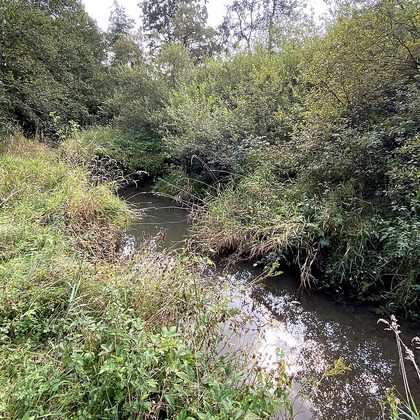
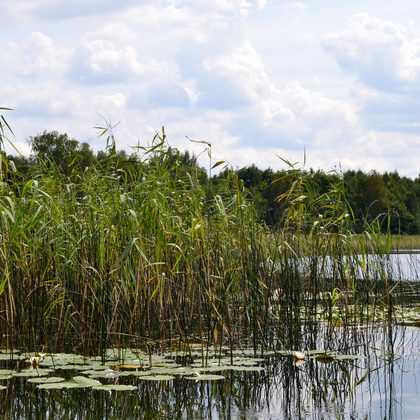
Where it is seen here the setting is invariably low and wet: reed fringes and willow scrub along ditches and pools, rank waterside vegetation, dense gardens and park edges with cover down to ground level, and now and then a feeding station where it appears among sparrows and finches. On its breeding grounds it lives in damp scrub along forest streams and in the understorey of montane forest, far outside this guide's map.
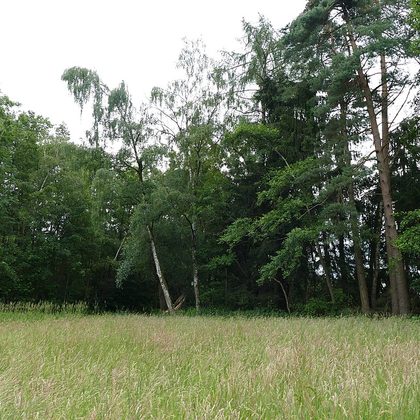
Where the bird is most at home, classified with EUNIS — the European standard for habitats.

Range and movements
A breeding bird of eastern Siberia, north-east China and Japan, wintering from southern China into south-east Asia; within the area of this guide it is a true vagrant. British records are scattered but cluster firmly in October, on the Northern Isles and at coastal watchpoints from Shetland and Orkney to Cornwall and the Gower. Alongside those sits a smaller run of long-staying birds in the late winter half-year: the first for Britain was a first-winter male at Pennington Flash in Greater Manchester from 8th March to 24th April 1994, and a bird wintered inland in Shropshire in 2023.
Where and when to look
Patience serves better than mileage here. If a dark, yellowish bunting sits low in wet scrub in October, or at a feeder in late winter, and refuses to be flushed, stand still and wait for it to come out onto open mud. Watch for the olive-grey head, the pink bill and the white tail edge, and above all get a photograph of the head from the front: the blackish mask around the bill base is what a records committee looks for. Report the bird straight away — a black-faced bunting often stays longer than you expect.
Conservation status
Not globally threatened (IUCN: Least Concern): the breeding range is large and numbers are high. Even so, this species ends up in the nets where buntings are trapped in eastern Asia, and its share of those catches grew as yellow-breasted bunting became scarcer. For the area of this guide the question is not conservation but a handful of records and whether they were correctly identified.
Scientific name
Emberiza spodocephala Pallas, 1776
Pallas described the species in 1776 and placed it straight away in the genus where it still stands. The genus Emberiza was introduced in 1758 by Linnaeus. Emberiza comes from Old German Embritz, a name for a bunting. spodocephala is Ancient Greek, from spodos, 'ashes', and kephalos, 'headed', after the ash-grey head. The specimen the first description was based on came from the Daurian Range, Siberia.