All species › Passerines › Buntings › Red-headed bunting
Red-headed bunting | Emberiza bruniceps
Bruinkopgors | Escribano cabecirrojo
A big, long-tailed bunting of the central Asian steppe, the male combining a rufous head with vivid yellow underparts. It appears in western Europe with some regularity, but almost every report turns quickly into a conversation about where the bird came from.

Voice
The song is a short, slightly jangling and accelerating series that builds in strength and stops abruptly, in tone closest to a black-headed bunting's but higher and drier. Calls are a short hard tsip and a ringing, faintly descending tsyu. In western Europe the song is usually heard from a bird that settles for a while in a field edge in May or June.
No freely licensed recording is available for this species yet.
Identification
Large for a bunting, with a heavy conical bill and a long tail with no white sides — unusual in an Emberiza and immediately useful. The male has a rufous-chestnut head, throat and upper breast, bright yellow underparts, a green-and-yellow streaked mantle and a yellowish-green rump. The female is a plain sandy-brown, almost featureless bird with a pale supercilium, yellowish undertail coverts and a greenish cast to the rump. Juveniles are duller still and virtually unmarked.
Confusion species
Black-headed bunting is the species that matters, and with males it is simple: a black hood and chestnut mantle against a rufous head and a green-yellow mantle. With females and juveniles it often cannot be settled at all. The best handle is the rump — yellowish-green on red-headed, warmer sandy-brown on black-headed — but the difference is slight, and where the two meet in Iran there are birds that fall between the two. A corn bunting is bigger and heavier with a streaked breast; an ortolan is slimmer and has a yellow eyering.
Habitat
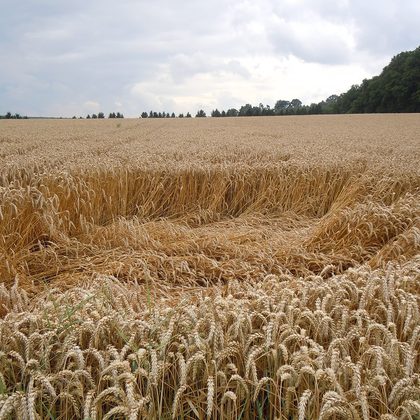
Where it is seen here the setting is open, warm and low: cereal fields and field edges, rough vegetation along sea walls and railway banks, coastal gardens and crofts, and on islands a vegetable plot or a potato field. In its own range it belongs to dry steppe with bushes, tamarisk thickets along rivers and irrigated farmland with hedges.
Where the bird is most at home, classified with EUNIS — the European standard for habitats.


Range and movements
A breeding bird of central Asia — from eastern Turkey and Iran through Turkmenistan and Uzbekistan to Kazakhstan and western China — wintering in India, so its migration leads directly away from the area of this guide. Within that area it is a vagrant. Reports come chiefly from north-west Europe in May and June, with a concentration on the British Isles and the North Sea coast; Britain has recorded many birds over the years, of which only a small number have been judged to have arrived unaided.
Where and when to look
A bright yellow bunting with a rufous head stands out and is rarely overlooked. The work lies in the question that follows. Photograph the legs and the wing every time: look for a ring, for wear at the tail tip and wing points and for missing flight feathers, all of which point to an aviary bird. Watch the behaviour too — a bird that is unusually tame and settles at a feeder raises questions. And note the date: late May and June fit an overshooting wild bird.
Conservation status
Not globally threatened (IUCN: Least Concern) and locally numerous in central Asia. For the area of this guide the issue is not conservation but origin. The species has long been kept and traded as a cage bird on a large scale, and records committees weigh that: many western European occurrences have not been accepted, or have been placed in the category for birds of uncertain origin. That is a judgement about the odds, not about the observer. Since the cage-bird trade within the European Union fell away, reports have fallen with it — an indication that a good share of them really were escapes — while a few later birds, among them one on Shetland in 2010, have been assessed as wild.
Scientific name
Emberiza bruniceps Brandt, 1841
Brandt described the species in 1841 and placed it straight away in the genus where it still stands. The genus Emberiza was introduced in 1758 by Linnaeus. Emberiza comes from Old German Embritz, a name for a bunting. bruniceps means 'brown-headed', from Medieval Latin brunus 'brown' and -ceps '-headed', from caput 'head'. The specimen the first description was based on came from Turkmenistan.