All species › Passerines › Buntings › Pine bunting
Pine bunting | Emberiza leucocephalos
Witkopgors | Escribano cabeciblanco
A yellowhammer with the yellow taken out — as simple as that on a pure male, and as awkward as it gets on any other bird. It arrives in winter with yellowhammers on the stubble, and the real question is not the species itself but the hybrids with yellowhammer, which are common where the two ranges overlap.

Voice
Sound is no help: song and calls are barely separable from a yellowhammer's. The song is the same thin metallic series of identical notes with a drawn-out ending, at most a little shorter and with less stress on that final note, and the call is the same sharp tsik. In winter, which is when the birds are here, they are largely silent anyway.
No freely licensed recording is available for this species yet.
Identification
Same build, same size and the same long white-sided tail as a yellowhammer, and like that bird a warm chestnut rump. On the male everything that is yellow on a yellowhammer is white here: a white crown stripe, a white cheek and a white belly. Set against that is chestnut on the forehead and throat, around the ear-coverts and in a band across the breast, with chestnut streaking on the flanks. The female is brown and streaked and far harder: look for white rather than yellow as the ground colour of supercilium and throat, and for a warmer, more foxy tone overall.
Confusion species
Yellowhammer itself is no trouble on a male, but the hybrids between the two are, and they are the whole issue here. Along the belt where the ranges overlap in western Siberia the two pair freely, and those mixed birds travel west with the rest. They show a shifting combination: yellow bleeding through the white of crown, cheek or throat, a yellowish wash over the belly, or a chestnut mask that does not join up. They are not rare and they cannot be named. The rule is therefore firm: a bird with any hint of yellow on head, throat or underparts is left unresolved. Only a bird with clean white on crown and cheek, chestnut on lores and throat and a white belly free of yellow is safe — yellow restricted to the fringes of the primaries is generally still allowed. On females and immatures the chance of certainty is slim.
Habitat
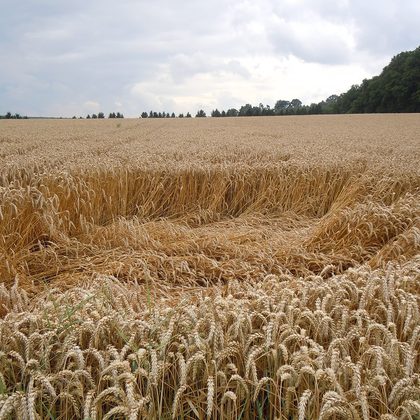
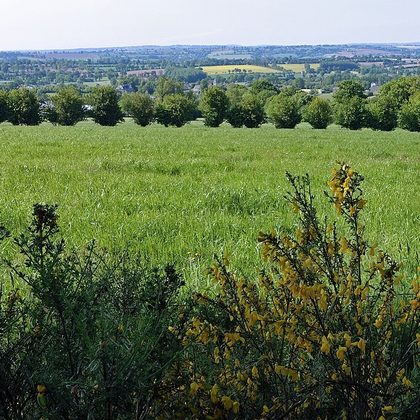
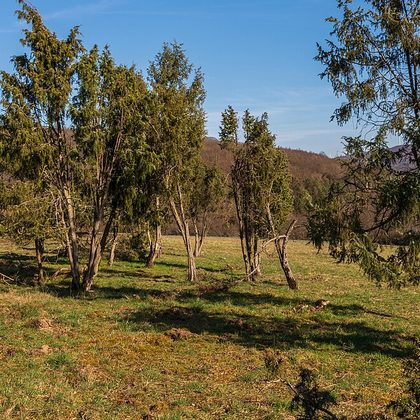
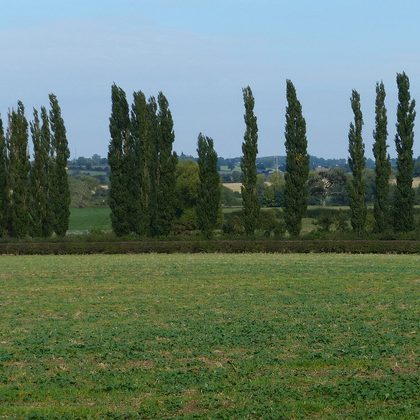
In winter, exactly where the yellowhammers are: stubbles, muck-spread fields and field edges, hedges and hedgebanks to work out from, and rough seedy corners. On the breeding grounds it is a bird of open conifer and birch forest, forest edge and clear-fell in Siberia, all of it outside this guide's map.
Where the bird is most at home, classified with EUNIS — the European standard for habitats.
Range and movements
A breeding bird of Siberia, from the Urals to Mongolia and northern China, wintering in central Asia, northern India and southern China. Within the area of this guide it is a vagrant with a clear pattern: most birds appear between October and March and attach themselves to yellowhammer flocks on farmland. In north-east Italy and Tuscany a small number winters annually at traditional sites — the most reliable place inside the map. Britain has a modest run of accepted records, and in most countries more claims have been rejected than accepted.
Where and when to look
Do not look for it as a species; look for the odd one out in a flock. In December and January work a stubble or a muck-spread field holding yellowhammers and check every bird for white where the yellow should be. If one shows, photograph the head from the front and the side, the spread wing and the undertail: it is the primary fringes and the underparts that decide. Be hard on yourself — most of the whitish-headed birds reported here turn out to be hybrids or pale yellowhammers.
Conservation status
Not globally threatened (IUCN: Least Concern), with a large Siberian breeding range and high numbers. The worry is not the species but the reading of it: in the overlap belt in western Siberia the proportion of mixed birds is considerable, which makes assessing western records one of the hardest jobs in European rarity work. Committees have tightened their criteria over time and gone back over older records, and some of those have not survived the review.
Scientific name
Emberiza leucocephalos Gmelin, 1771
Gmelin described the species in 1771 and placed it straight away in the genus where it still stands. The genus Emberiza was introduced in 1758 by Linnaeus. Emberiza comes from Old German Embritz, a name for a bunting. leucocephalos is Ancient Greek, from leukos, 'white', and kephalos, 'headed', after the male's white crown. The specimen the first description was based on came from Astrakhan, Russia.