All species › Passerines › New World sparrows › Dark-eyed junco
Dark-eyed junco | Junco hyemalis
Grijze junco | Junco ojioscuro
Of the four American sparrows in this guide the junco is the easy one: slate-grey from head to breast, snow-white from the breast down, with a pink bill and two white tail sides that flick open as it goes. In North America it is at every feeder; here it is second in number to the white-throated sparrow, and it is nearly always found in a garden.

Voice
The song is a dry, even, ringing trill of two to four seconds on a single pitch, abrupt and without an introduction — in the American spring woods one of the first sounds of the day. British vagrants have sung in April and May, and more than once that is how they were found. Calls are a sharp smacking tchik, often in series, and a fast twittering rattle on take-off.
No freely licensed recording is available for this species yet.
Identification
Small and compact, with a rounded head and a fairly long tail. The form that reaches Europe is the slate-coloured one: head, throat, breast, mantle and flanks an even dark slate-grey, cut off sharply against a clean white belly, as though the bird had stood breast-deep in snow. The bill is pink to ivory and lights up against the grey; the eye is dark. On take-off the tail is spread and the two entirely white outer feathers flash out against an otherwise blackish tail. Females and first-winter birds are browner grey, sometimes with a faint brown wash over mantle and flanks, but they show the same sharp division, the same bill and the same tail. On the ground it hops and repeatedly flicks the tail open.
Confusion species
No European bird combines a grey head and breast, a sharply cut white belly, a pink bill and white outer tail feathers on a dark tail; see those four and you are done. In practice it goes wrong with a hurried glance in a garden. Dunnock shuffles about in the same place under a feeder and is also grey and brown, but it has a thin pointed insect bill, streaked flanks, a streaked brown back and no white in the tail. A female house sparrow is brown and streaked above, with a pale supercilium and a heavy horn-coloured bill. With a brown-toned junco the question is therefore not which shade of grey you are looking at, but whether the belly is sharply cut off and whether there is white in the tail.
Habitat
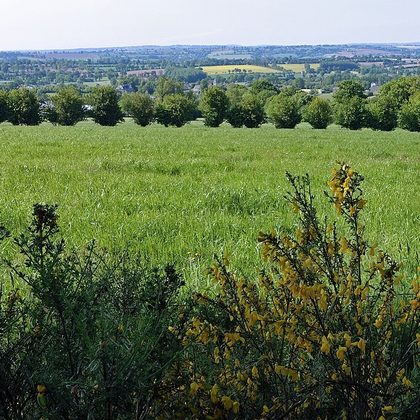
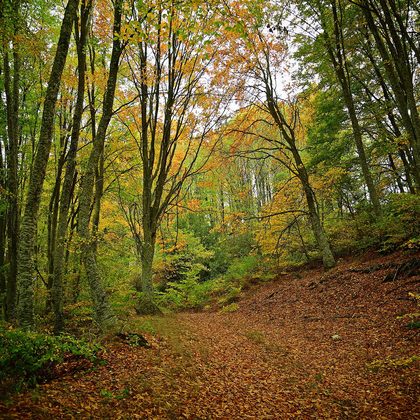
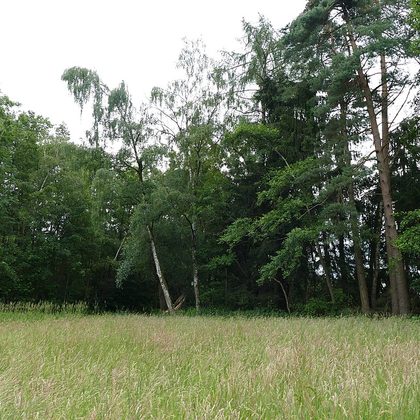
Here it is a garden bird: it feeds on the ground under a feeder or along a hedge, in an orchard, a churchyard or a woodland edge with short grass alongside. Disturbed, it does not go far but slips a few metres into the hedge or the lower branches. At home it is a bird of conifer and mixed woodland and of its edges, dropping in winter to lower farmland and gardens. Several European birds have been recorded not on land at all but on oil platforms in the North Sea.
Where the bird is most at home, classified with EUNIS — the European standard for habitats.

Range and movements
Breeds in the forests from Alaska and Canada down the mountain chains of the United States, in several strongly differing forms; the northern birds move south in winter and those are the candidates for a crossing. Within the map area it is a vagrant with a clear spring pattern: April and May are the peak months, and there is nothing at all from August and September. The first British record was a male trapped at Dengemarsh, Dungeness, in Kent on 26 May 1960; several dozen records have followed, most of them in England and Scotland. Elsewhere in the region there are scattered occurrences, including on the Azores.
Where and when to look
In April and May, look at the ground under the feeder. That is not a joke: most juncos are reported by householders, and the rest by birders on island stations. If you see a small grey bird hopping about under a hedge, flush it and watch for the white tail sides. Photograph the bill — pink — and the sharp division between grey and white, and check the legs for a ring. A junco often stays for days or weeks in the same place and can then be seen by many.
Conservation status
Not globally threatened (IUCN: Least Concern) and, with a population in the hundreds of millions, one of North America's most numerous birds, though a slow decline is recorded. In Europe it is a matter of a handful of records a year and of how those birds got here. The spring pattern and the records on North Sea oil platforms point two ways: birds that made the crossing the previous autumn and wintered on this side, and birds that covered part of the distance by ship. Escaped cagebirds play no meaningful part with this species.
Scientific name
Junco hyemalis (Linnaeus, 1758)
Linnaeus described the species in 1758 as Fringilla hyemalis; because it was later moved to another genus, the author and year stand in brackets. The genus Junco was introduced in 1831 by Wagler. Junco comes from Latin iuncus 'rush', by way of Spanish junco. hyemalis is Latin for 'of the winter'. The specimen the first description was based on came from South Carolina.