All species › Passerines › New World sparrows › White-throated sparrow
White-throated sparrow | Zonotrichia albicollis
Witkeelgors | Chingolo gorjiblanco
The most frequently reported of the American sparrows in Europe, and the one you stand a real chance of finding in a garden. It is a bird with a written-out head pattern: a black-and-white striped crown, a sharply outlined white bib and a small yellow spot between eye and bill. What is unusual is the timing — most European records fall not in autumn but in spring.

Voice
The song is a series of thin, clear whistles on one pitch, the first two drawn out and the rest delivered in triplets; in North America it is written down as oh sweet Canada Canada Canada. A vagrant that settles here in spring sings readily, and that has more than once been how a bird was found. The call is a sharp metallic tink, a little lower than a chaffinch's pink, and in flight a thin drawn-out tseet.
No freely licensed recording is available for this species yet.
Identification
A large, long-tailed sparrow with a grey unstreaked breast and a rusty-streaked mantle carrying two narrow white wingbars. The head settles it: a broad pale central stripe over the crown, a black band on either side of it, a pale supercilium below that and a black line through the eye. In front of the eye, on the lore, sits a small but vivid yellow spot. The throat is clean white and cut off sharply against the grey breast, like a bib tied on. The bill is dark horn-grey. The species comes in two forms, with white or with tan head stripes; both occur in either sex, and the tan form is regularly taken here for an immature. First-winter birds are duller but keep the yellow lore and the outlined throat.
Confusion species
White-crowned sparrow is the species to rule out, and three hard marks do it. One: the yellow lore spot, which white-crowned lacks entirely. Two: the white throat, sharply bounded here, on white-crowned no more than a vaguely paler area blending into the grey. Three: the bill, dark horn-grey here, pink to orange on white-crowned. Young white-crowned sparrows also have rufous-brown rather than black crown bands. Song sparrow is heavily streaked all across the underparts and shows a dark central breast spot. For a European observer there is one further rule that separates all the American sparrows from our own buntings: the tail is dark throughout. If you can see white outer tail feathers, you are looking at an Emberiza.
Habitat
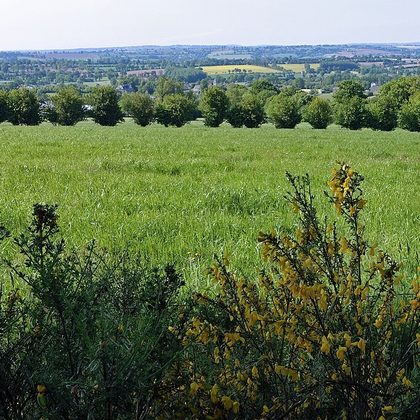
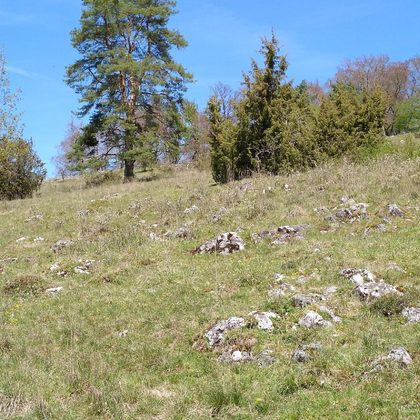
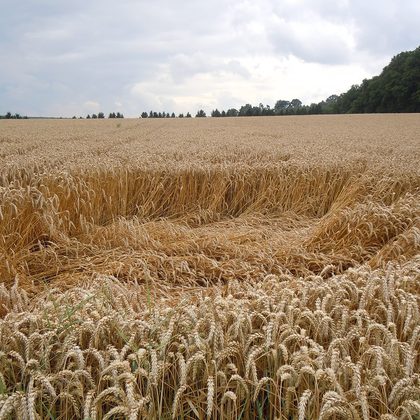
Here it is a bird of gardens and farmyards: it shuffles about under a feeder, in a hedge, beside a compost heap or in a neglected corner of shrubs, and dives into the thickest bush when disturbed. On the coastal islands it means vegetable plots, elder and tamarisk clumps, nettle beds and the sheltered side of a wall. The combination is always the same: bare ground or thin litter to scratch in, with dense cover a metre away.
Where the bird is most at home, classified with EUNIS — the European standard for habitats.

Range and movements
At home it breeds in the woods and woodland edges of Canada and the north-eastern United States and winters further south within the same continent. Within the map area it is a vagrant, but clearly the most reported of the four American sparrows in this guide. Records are scattered across Iceland, Ireland, Britain, the western seaboard of the continent and the Azores. The distribution through the year is the striking part: where most American songbirds arrive in October, about three of every four white-throated sparrows are found in April, May and June.
Where and when to look
This is the vagrant found by householders rather than by searching birders. In April and May look hard at any unfamiliar bird under a feeder or in a hedge, and go straight to the lore: yellow, and you have it. Photograph head, bill and legs, and while you are at it look for wear on the tail and wingtips or for a ring, because the rarities committee will want to know how the bird got here. Report it before you lose sight of it; these birds often stay for days in the same place.
Conservation status
Not globally threatened (IUCN: Least Concern) and, with a population in the tens of millions, one of the commonest birds of the North American forest, though a slow decline has been measured. In Europe the question is not protection but origin. The spring pattern suggests that many of these birds crossed the ocean the previous autumn and wintered on this side, and birds have been recorded aboard ships and on North Sea oil platforms. Escape from captivity hardly arises with this species: American sparrows are not traded as cagebirds.
Scientific name
Zonotrichia albicollis (Gmelin, 1789)
Gmelin described the species in 1789 as Fringilla albicollis; because it was later moved to another genus, the author and year stand in brackets. The genus Zonotrichia was introduced in 1832 by Swainson. Zonotrichia is Greek, from zone 'band' and thrix 'hair', after the banded pattern on the crown. albicollis is Latin, from albus 'white' and collum 'neck', after the sharply defined white throat. The specimen the first description was based on came from Pennsylvania.