All species › Passerines › New World sparrows › White-crowned sparrow
White-crowned sparrow | Zonotrichia leucophrys
Witkruingors | Chingolo coroniblanco
An upright, high-crowned sparrow with a black-and-white striped head and a pink bill, in North America an everyday bird of roadsides and brushy edges. Here it is one of the rarest vagrants in this guide: Britain has four records, and every one of them was an event.

Voice
The song opens with one or two clear thin whistles and then runs into a series of husky buzzing trills, so it sounds less pure than a white-throated sparrow's. Calls are a sharp high pink or tzink and a thin seee. A vagrant here is usually silent, though the Fair Isle bird of May 1977 did sing; in practice do not count on it and work from what you can see.
No freely licensed recording is available for this species yet.
Identification
Slim, long-tailed and with a strikingly tall crown that is often raised to a peak, giving the head a pointed profile. The adult has a clean black-and-white striped crown: a broad white central stripe, a black band either side of it, a white supercilium below that and a black line through the eye again. Face, throat and breast are plain pearl-grey, without a defined white bib and without yellow on the lore. The bill is pink to orange-yellow and shows up at a distance. The mantle is streaked rusty brown with two narrow white wingbars; the tail is long and dark throughout. First-winter birds carry the same crown pattern but in rufous and buff instead of black and white, and those are the birds that catch people out.
Confusion species
White-throated sparrow is where it goes wrong, particularly with young birds. Three marks settle it. First the lore: white-throated has a yellow spot there, white-crowned nothing. Second the throat: on white-throated pure white and sharply outlined against the grey breast, here at most a shade paler and blending in. Third the bill: pink or orange here, dark horn-grey on white-throated. Shape adds to it: white-crowned stands higher on the legs, holds itself more upright and peaks the crown. Song sparrow is heavily streaked below and shows a breast spot. And as with all American sparrows: no white in the outer tail feathers, which rules out every Emberiza.
Habitat
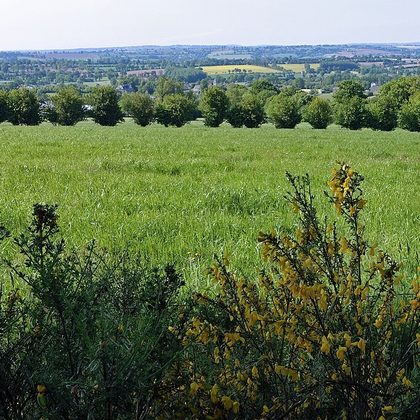
Here it is a bird of gardens, hedges and verges close to the coast: the British records involved a garden hedge, a croft vegetable plot, a dock quayside and the scrubby edge of a path behind the sea defences. It feeds on the ground in the open and, when disturbed, slips a few metres into the hedge before coming back out. At home it is the same sort of bird: brushy edges, clear-fells, verges, car parks and gardens, always with bare ground alongside.
Where the bird is most at home, classified with EUNIS — the European standard for habitats.



Range and movements
At home one of the most numerous sparrows in North America, from Alaska and arctic Canada to the mountains of the west, moving south to the southern United States and Mexico. Within the map area it is an exception. Britain has four records: two in May 1977, on Fair Isle and at Hornsea Mere in Yorkshire; one in October 1995 in Seaforth docks near Liverpool; and an adult at Cley in north Norfolk in January 2008, at once the first winter record for Britain and Ireland. Elsewhere in the region there are only scattered occurrences.
Where and when to look
Realistically you will not find this bird by looking for it, but by looking properly at whatever is in the garden or along the path. Any unfamiliar sparrow with a striped crown deserves two questions: is there yellow on the lore, and is the throat sharply outlined? Two noes, plus a pink bill, and this is the species. Then photograph head, bill, legs and tail, report it at once, and note whether the bird is near a harbour or a dock — that matters for the assessment.
Conservation status
Not globally threatened (IUCN: Least Concern) and very numerous in North America, although numbers are falling in parts of the west. For Europe the question is always the same: did the bird arrive under its own power? With the Seaforth dock bird of 1995 a passage by ship was explicitly weighed, and at any harbour record that remains a real possibility. Escape from an aviary hardly comes into it, since the species is not kept as a cagebird.
Scientific name
Zonotrichia leucophrys (Forster, 1772)
Forster described the species in 1772 as Emberiza leucophrys; because it was later moved to another genus, the author and year stand in brackets. The genus Zonotrichia was introduced in 1832 by Swainson. Zonotrichia is Greek, from zone 'band' and thrix 'hair', after the banded pattern on the crown. leucophrys is Greek, from leukos 'white' and ophrus 'eyebrow', after the white stripe above the eye. The specimen the first description was based on came from the Severn River, Hudson Bay.