All species › Passerines › New World sparrows › Song sparrow
Song sparrow | Melospiza melodia
Zanggors | Chingolo cantor
A brown streaky bird that resembles a good many others, and for that reason asks the most of whoever finds it. In North America the song sparrow is one of the commonest birds of damp scrub and gardens; here it comes down to a handful of records, and almost all of them fall in April and May.

Voice
The song is built from three or four clear, even opening notes followed by a rattling trill and an untidy flourish, always assembled the same way: cheet-cheet-cheet, tirrrr-chidderdit. A vagrant that lingers into May sings readily, and British birds have more than once been found that way. The call is a low, hard, nasal chep, and in flight a thin high tseee.
No freely licensed recording is available for this species yet.
Identification
A medium-sized sparrow with a long, rounded tail that is clearly pumped up and down in the low, laboured flight. The underparts are creamy white and heavily streaked blackish-brown across breast and flanks; on the breast those streaks converge into a single dark central spot, and that is the mark everything turns on. The head is grey with a broad grey supercilium, brown lateral crown stripes and a heavy dark malar stripe with a pale stripe above it. The upperparts are warm rufous-brown streaked black, without obvious wingbars. The bill is short, conical and greyish. The sexes are alike; young birds are more finely streaked and may lack the breast spot.
Confusion species
This is a bird to hold on to by three hard marks rather than by shades of brown. One: the dark breast spot where the streaking gathers. Two: the tail — long, rounded and dark throughout, without a trace of white in the outer feathers, which rules out every Emberiza and every pipit, since all of those show pale outer tail feathers. Three: the heavy dark malar stripe with a pale stripe beneath it. Female or winter reed bunting is the first thought in Europe, but it has white in the tail, finer breast streaking with no central spot, and a shorter, more notched tail. Pipits also have a thin pointed bill instead of a cone. Corn bunting is larger, plainer and without a head pattern.
Habitat
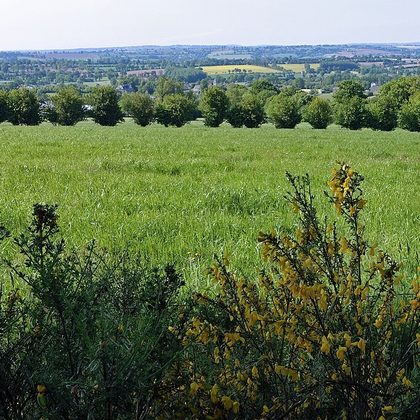
Here it is a bird of damp, dense edges: ditch sides, marshy scrub, nettle and iris beds, neglected vegetable plots and the margin of a dyke behind a garden. It feeds low on the ground under cover, comes briefly into the open and vanishes again. So it is not the bird you see sitting on top of a bush — except when singing, when it deliberately chooses a lookout. At home it is exactly the same: wet thickets, shorelines, gardens and roadside verges, always with water or damp nearby.
Where the bird is most at home, classified with EUNIS — the European standard for habitats.



Range and movements
Breeds across almost the whole of North America, from Alaska and Canada to Mexico, in dozens of strongly differing forms, of which only the northern ones migrate. Within the map area it is a genuine rarity. Britain has about ten records, and the pattern is remarkable: all but one fall between 9 April and 18 May. The first was a bird on Fair Isle from 27 April to 10 May 1959; the only autumn record was one from 15 to 17 October 1994 at Seaforth, on the Liverpool docks. Elsewhere in the region the species is rarer still.
Where and when to look
Anyone wanting to find one works a northern island station in the first half of May — Fair Isle, the Northern Isles, the Outer Hebrides — and looks hard at every brown streaky bird that flushes from a ditch or an iris bed pumping its tail. Let it settle, then find the breast spot. Always photograph the spread tail: the absence of white is what the committee will want to see in the picture, and it is what closes the identification in the field as well.
Conservation status
Not globally threatened (IUCN: Least Concern) and one of North America's most numerous songbirds. In Europe the issue is origin rather than protection, and the song sparrow is the sharpest case among the American sparrows: a species that scarcely ever turns up here in autumn but does so in late spring is hard to explain as a bird that has just come across on a gale. The explanations offered are wintering on this side of the ocean after a crossing the previous year, and travelling part of the way by ship — it is no accident that the one autumn record, in 1994, was in a dock complex. The species is not kept as a cagebird.
Scientific name
Melospiza melodia (Wilson, 1810)
Wilson described the species in 1810 as Fringilla melodia; because it was later moved to another genus, the author and year stand in brackets. The genus Melospiza was introduced in 1858 by Baird. Melospiza is Greek, from melos 'song' and spiza 'finch'. melodia is Latin, borrowed from Greek melōidia 'singing', after the rich song. The specimen the first description was based on came from Philadelphia, Pennsylvania.