All species › Waterfowl › Ducks, geese and swans › Common merganser
Common merganser | Mergus merganser
Grote zaagbek | Serreta grande
Europe's largest sawbill, a long, heavy fish-eater that lies along the water like a torpedo. In winter hundreds gather on the IJsselmeer and the big rivers.

Click a thumbnail to switch the photo above.
Voice
Usually silent. In display the male gives a curious twanging, purring krro-krraa that suggests a distant frog, while the female answers with a hard, short karr karr. Mainly in February and March, when small parties of males swim around a female with their heads raised.
Recording: Pascal Christe — CC BY-SA 4.0 · Wikimedia Commons
Identification
Large, long-bodied and low in the water, with a thin red hook-tipped bill. The drake is creamy white flushed pink on breast and flanks, with a glossy dark green head lacking an obvious crest and a black back. The female has a chestnut head with a short shaggy crest, a white chin patch and a sharp border between brown neck and grey breast. Immatures resemble the female.
Confusion species
Red-breasted merganser is the mirror species. On females the head-to-neck border decides it: clean-cut with a white chin on Goosander, softly blurred and without white on Red-breasted. The drake is white-breasted against rusty streaked, and smooth-headed rather than double-spiked.
Habitat
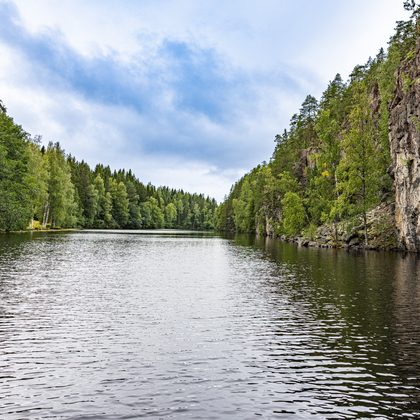
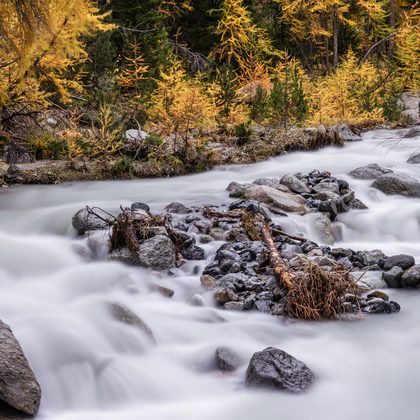
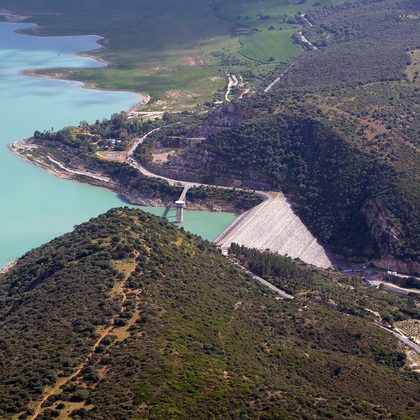
Clear, fish-rich fresh water: large lakes, reservoirs, fast rivers and deep gravel pits, moving to brackish water only in hard frost. Breeds in tree holes and nest boxes along wooded rivers and lakes. Dives after fish, often in groups that herd a shoal together.
Where the bird is most at home, classified with EUNIS — the European standard for habitats.
Range and movements
Breeds across northern and central Europe — Scandinavia, the Baltic states, the British Isles — and along the mountain rivers of the Alps; a few pairs now nest in tree holes in the Low Countries, and a small breeding stock lives in the Pyrenees. In winter the northern birds come to the west and centre of the map area: large numbers winter on the big lakes and rivers of north-west and central Europe, such as the IJsselmeer and the great rivers of the Low Countries. In the Mediterranean region a scarce winter visitor, in Iberia only in the north.
- Resident
- Breeding (summer)
- Winter
- Passage
- dark = core range, pale = thinly spread
How and when to look
December to February, early in the morning on the big lakes and rivers of north-west and central Europe — the IJsselmeer, the border lakes, the great rivers — when the birds fish actively before recreation starts. As frost sets in they concentrate on the last open water at locks and weirs, and those flocks are worth checking for Smew and red-breasted merganser.
Conservation status
The European population is stable to increasing and the species is spreading south-west. Locally the loss of old hollow trees along rivers, disturbance by recreation and illegal persecution at fish farms depress numbers. Drowning in gill nets plays a part on fish-rich waters.
Scientific name
Mergus merganser | Linnaeus, 1758
Linnaeus described the species in 1758 and placed it straight away in the genus where it still stands. He introduced the genus Mergus in that same work. Mergus is the Latin word for an unidentified waterbird mentioned by Pliny the Elder and other authors; some have taken it to be a cormorant or Scopoli's shearwater. merganser is formed from mergus and anser 'goose', that is 'diving goose'. The specimen the first description was based on came from Sweden.