All species › Waders, gulls and terns › Sandpipers and snipes › Spotted sandpiper
Spotted sandpiper | Actitis macularius
Amerikaanse oeverloper | Andarríos maculado
The New World has its own Actitis, and it bobs its rear end just as relentlessly as ours. In summer it gives itself away with bold black spots on white underparts; for the rest of the year you are working with tail length, leg colour and the base of the bill.
Voice
A high, sharp peet-weet of two or three syllables, shorter and less rippling than the five-note trill of common sandpiper. In alarm a single sharp peet. Vagrants call mostly as they flush, and it is often that clipped call that first alerts an observer on a reservoir shore.
Recording: Gean Carlo Valdés — CC0 · xeno-canto
Identification
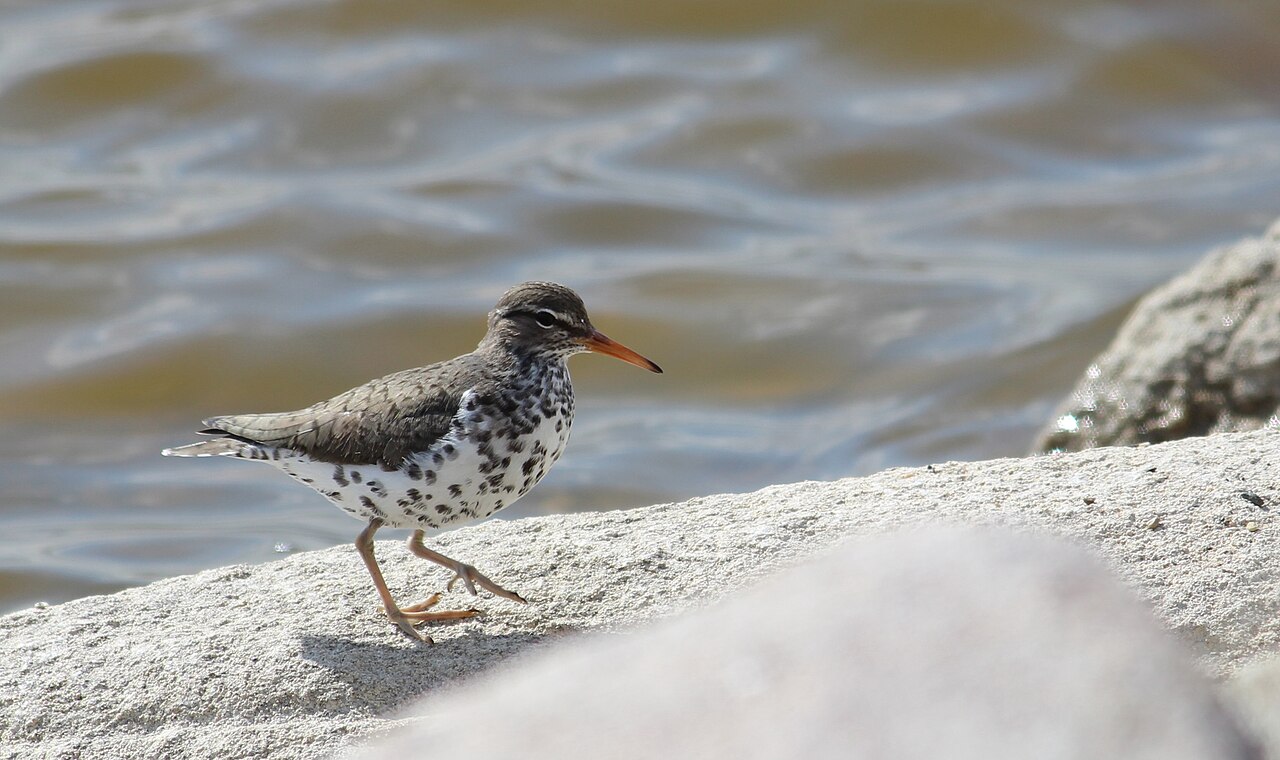
Small and long-bodied, brown above and white below, with the same white wedge between the bend of the wing and the breast side as common sandpiper. Breeding birds have the breast, belly and flanks scattered with round black spots and an orange bill with a dark tip. In non-breeding and juvenile plumage the bird is unspotted: plain grey-brown above, with a distinct dark bar at the bend of the wing and finely barred coverts that contrast with the plain scapulars. The tail is short and the wingbar narrow.
Confusion species
Everything turns on the comparison with common sandpiper, and it breaks into five points. The wingbar on Spotted is shorter and narrower: it fades out around the inner secondaries rather than running as an unbroken white band right in to the body, as it does on Common. The tail is shorter and projects barely or not at all beyond the folded wingtips, whereas on Common it clearly overshoots them; in profile Spotted therefore looks short and blunt at the rear. The legs are flesh-pink to straw-yellow, against grey-green or olive on Common. The bill base is pale and warm, in spring a clean orange with a black tip, while Common shows a dark bill with a dull fleshy base. And in summer there are the spots, which Common never has in any plumage. On an autumn bird check tail and legs first, plumage detail second. Most British and Irish records are of juveniles and winter adults, so the spots are exactly what you will not have.
Habitat
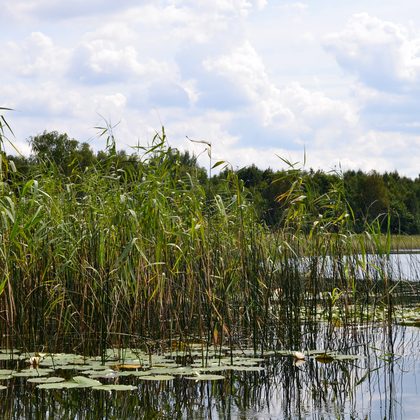
Fresh water margins: reservoirs, gravel pits, streams and small rivers, but in Europe also harbour walls, concrete quays and rocky coves. Wintering birds often hold to a single stretch of shore or pier for weeks. On the breeding grounds it uses shingle bars and sheltered lake shores across almost all of North America.
Where the bird is most at home, classified with EUNIS — the European standard for habitats.



Range and movements
Breeds across North America and winters from the southern United States to South America. On the British Isles a scarce but annual vagrant, with a breeding attempt on Skye in 1975 that failed at the egg stage; records span the year, with a spring scatter in May and June, a heavier autumn arrival from August to October and a few birds wintering on southern and western coasts. On the mainland considerably rarer: on the North Sea coast mostly in autumn, in Iberia a small number of records on the Cantabrian and Galician coasts and on the islands.
How and when to look
Take every common sandpiper on a reservoir or harbour mole seriously in September and October, and read tail length against the wingtips before anything else, then leg colour. A wintering bird will often stay faithful to one quay for months, so a sandpiper on a pier on the Atlantic coast or the Irish Sea in December is worth photographing, ideally with the wing open, and studying at leisure.
Conservation status
Not globally threatened and widespread across North America, though numbers are slipping slowly through shoreline development, recreational pressure on lakes and the loss of natural shingle bars. For Europe the species is mainly a barometer of vigorous westerly depressions in autumn.
Scientific name
Actitis macularius | (Linnaeus, 1766)
Linnaeus described the species in 1766 as Tringa macularia; because it was later moved to another genus, the author and year stand in brackets. The genus Actitis was introduced in 1811 by Illiger. Actitis is Greek, from aktitēs, 'coast-dweller', from aktē, 'coast'. macularius is Latin for 'spotted', after the black spots on the underparts in breeding plumage. The specimen the first description was based on came from Pennsylvania.