All species › Rodents › Squirrels and marmots › Alpine Marmot
Alpine Marmot | Marmota marmota
Alpenmarmot | Marmota Alpina
The Alpine Marmot is a large, burrowing member of the squirrel family. It lives above the treeline in colonies, is active by day and has a long, deep hibernation: up to nine months a year, in a hay-lined chamber under two metres of earth and snow. The presence of a colony is often first detected by the long, shrill alarm whistle.

Tracks
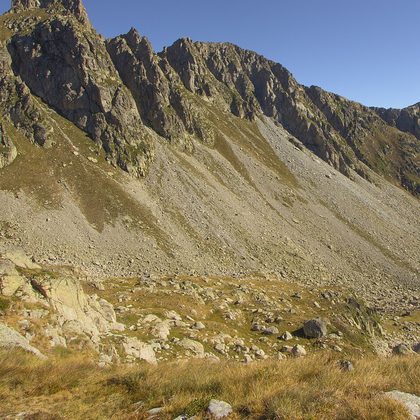
A marmot colony can be recognised from far off even on days when no animals are visible. The burrow entrance is an oblique shaft about as wide as a forearm, usually under a boulder or in a grassy slope. In front of it lies a fan of thrown-out earth and stone chippings running metres down the slope and bare of vegetation, so that from an opposite slope it forms a pale patch in the turf. Around such a patch the grass is short and differently coloured, because the colony grazes it daily. Between the entrances run fixed paths: narrow, worn trails from burrow to burrow and to the feeding areas, which remain visible under a thin layer of snow. One tunnel is used as a latrine, and at fixed places near the entrances lie dark, sausage-shaped droppings the size of a hare's, fibrous with grass. Boulders near an entrance are worn smooth and sometimes slightly greasy from the sentinels that sit on them each year, and show scratches of the digging claws. In September wisps of dried grass lie at the entrance and along the paths: hay is then being carried in for the winter chamber. The most useful sign is the sharp, drawn-out alarm whistle: a single note for a bird of prey, several short notes for danger on the ground, passed on from slope to slope.


In its habitat
Head close-up
The young

Identification
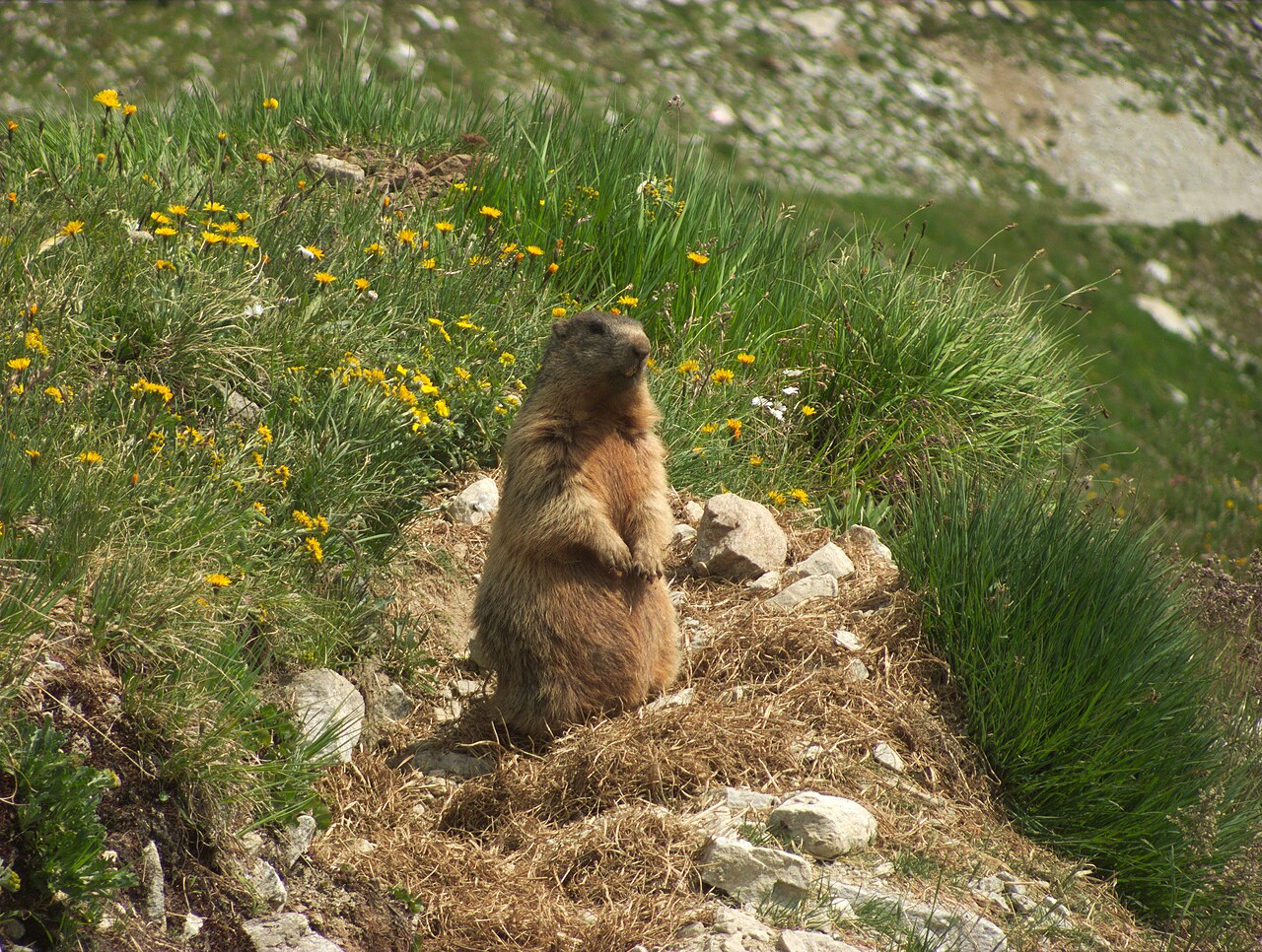
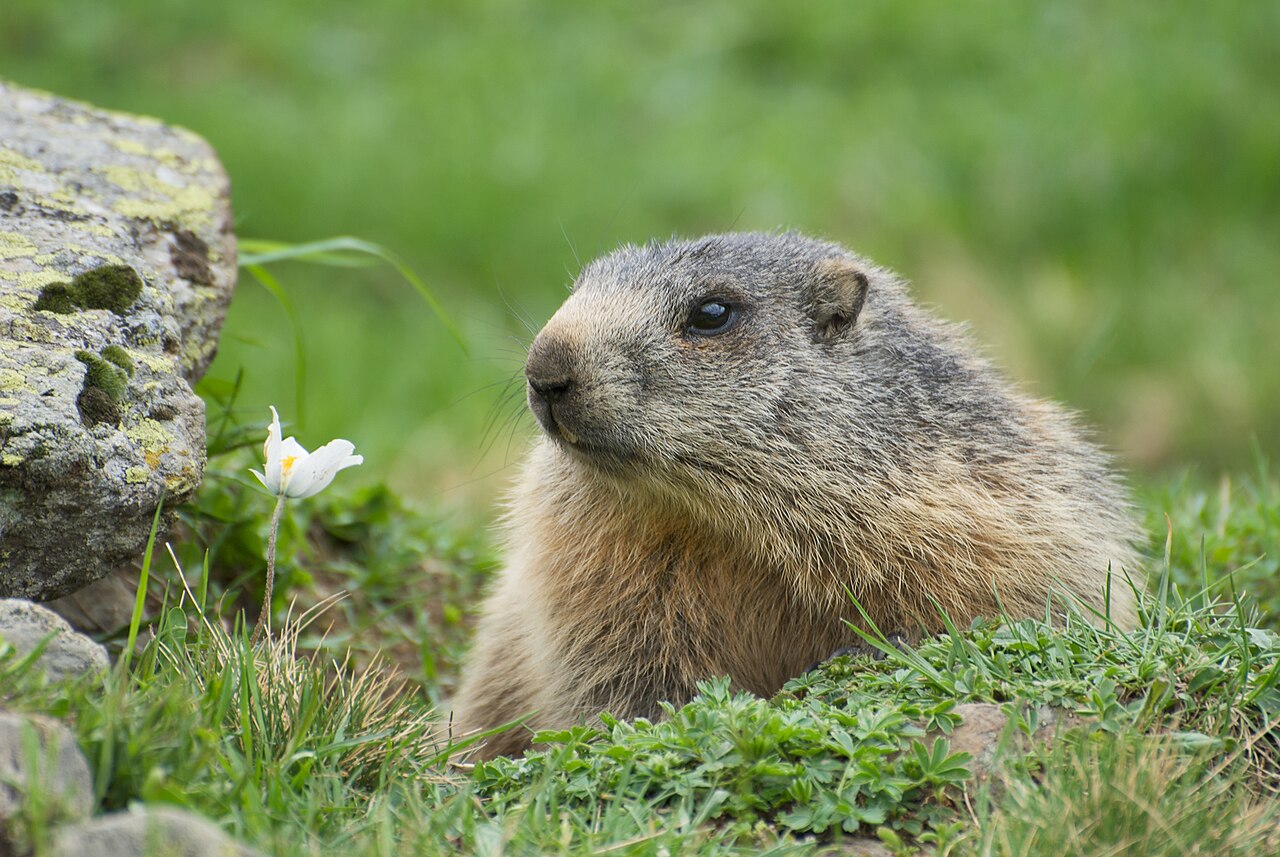
A heavy, thickset ground rodent with short legs and a broad head, head-body 50 to 58 cm, with a short, coarse tail of 13 to 16 cm ending in a dark tip. Weight varies strongly with the season: in spring, straight after hibernation, about three kilos, and at the start of hibernation in October up to eight. The fur is coarse grey to tawny, darker over shoulders and rump, with a pale muzzle and dark eyes; the colour matches that of weathered granite, so that a motionless animal is hard to see at a distance. The ears are small and round, the forefeet carry strong digging claws, and the incisors are broad and yellowish white. The animal often sits upright at the burrow entrance, forepaws against the chest.
Similar species
Within its range there is no species with which confusion is likely: no other European mammal of this size lives by day in colonies above the treeline. At a distance and against the light it is sometimes taken for a hare, which is longer-legged, long-eared and makes no spoil heaps. The Snow Vole and Alpine Shrew live on the same scree slopes but are much smaller. In eastern Europe the Bobak Marmot lives on the steppes of Ukraine and southern Russia, yellower and shorter-tailed; the ranges of the two species do not overlap. The Bobak is a species of flat grassland, the Alpine Marmot of high mountains. In the Pyrenees, the Massif Central and the Apennines all marmots are introduced Alpine Marmots.
Habitat
Alpine and subalpine grassland and flower-rich mountain pasture above the treeline, roughly between 1,200 and 3,000 metres, with a strong preference for open south-facing slopes where snow melts early. The species needs soil deep enough and not too stony to dig in (half a metre of loose soil is not enough), as well as boulders and scree that provide a view and cover. Below the treeline it occurs only in open larch woodland and on avalanche tracks; closed forest is avoided, because there is no view of approaching predators.
Where the animal is most at home, classified with EUNIS — the European standard for habitats.



Distribution
The natural range is the Alpine arc, from the French Maritime Alps through Switzerland, northern Italy, southern Germany and Austria to Slovenia, with a long-isolated population in the High Tatras and the Carpathians. At the end of the last glaciation the species was far more widespread across central Europe; the present natural range is a remnant of that. In the Pyrenees it disappeared at the end of the Pleistocene. In the twentieth century a series of introductions substantially changed its distribution: the Pyrenees in 1948, and further the Massif Central, the Jura, the Vosges, the Black Forest, the northern Apennines and the Romanian Carpathians. In the Pyrenees releases were first made on the French side; from there the species colonised the Spanish side. It is now common there and still spreading, in Huesca, Lleida, Girona and Navarre, from the Val d'Aran and Alta Ribagorça to Ordesa and Aigüestortes, and through its own dispersal it is also appearing in the eastern Cantabrian Mountains. It is present in almost every Alpine or Pyrenean valley with ground above the treeline. It does not occur in the British Isles or the Low Countries.
- Native
- Reintroduced
- dark = core range, pale = thinly spread
Way of life
Exclusively diurnal, most active in the morning and late afternoon; on hot summer days it rests in the burrow at midday. The species lives in families of a dominant pair with young of several years, sometimes fifteen or twenty animals, in a tunnel system enlarged over generations and occupied by one family. There are two types of burrow: shallow escape burrows scattered through the home range, and the deep winter burrow with a central chamber lined with dry grass. Hibernation begins in October and lasts until April or May, up to nine months without interruption. The whole family lies curled up in one chamber, with the tunnels sealed from inside with earth and hay; the heart rate falls to a few beats a minute and breathing to one to three breaths a minute, and roughly every ten days the animals briefly warm up. This is true, deep hibernation; in this the marmot differs from the Red Squirrel, which only has winter rest and regularly comes out to feed. The young are born in June, two to seven per litter, after a gestation of 33 to 34 days, and weigh under thirty grams at birth; they come above ground at about six weeks and overwinter two or three times with their parents before becoming sexually mature. The diet consists of grass, herbs, flowers, roots and tubers; the species almost never drinks. Family members warn each other with whistles from fixed lookout posts. In the wild an animal may live fifteen years.
Where and when to look
In July or August walk a path above the treeline between seven and ten in the morning and search with binoculars for the pale earth heaps on south-facing slopes; then sit down about a hundred metres away and wait. Once the whistling stops and the colony resumes grazing, the family's behaviour can be followed: playing, wrestling and sniffing one another. Pay attention to the whistles: a single long note usually means a Golden Eagle is flying over, which can then also be seen. Ten-power binoculars or a telescope are sufficient; approaching closer is pointless, because the animals then flee into their burrows. In late September the animals are heavy, less active and mainly occupied with carrying in hay. From October to April they are in hibernation.
Conservation status
Least Concern (LC, 2016), numerous and expanding. In the Alps, releases in the last century have returned the species to valleys from which it had disappeared, and in the Pyrenees, the Massif Central and the Apennines it now lives in places where it did not occur in historical times. It is hunted in France, Switzerland, Austria and Italy, locally intensively, without demonstrable effect on numbers. Climate is a risk factor: the marmot depends on a thick, early snow cover that insulates the burrow against frost, and on a spring that does not begin too early. In warm winters with little snow the winter burrow cools further and the animals use more reserves; in the French Alps it has been measured over several decades that young marmots emerge from winter at a lower weight. In addition, the introduced populations in the Pyrenees and Apennines are spreading into areas where the species did not naturally occur; their effect on the vegetation of the highest meadows and on other Pyrenean species is under discussion. With climate change the species is expected to shift to higher altitudes.
Scientific name
Marmota marmota | (Linnaeus, 1758)
Linnaeus described the species in 1758 as Mus Marmota; because it was later moved to another genus, the author and year stand in brackets. Marmota goes back to the word marmot, whose origin is uncertain: it is traced either to a Gallo-Romance stem marm-, 'to mumble', or to post-classical Latin mus montanus, 'mountain mouse'. The specific name repeats the genus name. The specimen the first description was based on came from Switzerland, Alps.