All species › Rodents › Squirrels and marmots › Bobak Marmot
Bobak Marmot | Marmota bobak
Bobakmarmot | Marmota bobak
The Bobak Marmot is a marmot of the steppe and forest-steppe of eastern Europe and northern Kazakhstan. It lives in colonies in open grassland, digs burrows with large earth mounds that remain in use over successive generations, and hibernates for about half the year. The alarm call is a high whistle. The earth mounds at the burrows remain visible in the landscape for a long time.

Tracks
The most conspicuous sign is the butan, the mound of excavated earth around the burrow entrance. An occupied burrow is a sloping tunnel 20 to 25 cm across; the soil removed from it over generations forms a round mound half a metre to a metre high and five to twenty metres across. The vegetation on such a mound differs from that of the surrounding steppe, often wormwood, henbane or other nitrogen-loving plants, sometimes none. The mound therefore forms a pale patch in the grass or crop, recognisable from hundreds of metres and on aerial photographs from kilometres. Butans persist after a colony has disappeared: on ploughed land in Ukraine and southern Russia they are sometimes still visible as faint rises in fields that have held no marmots for a century. Around an occupied burrow the grass is short and of a different colour from daily grazing, and worn paths run between the burrows. There is a separate latrine tunnel, and at fixed places by the entrances lie sausage-shaped, dark, strongly fibrous droppings two to four centimetres long. On the mound the digging marks of the front claws form parallel grooves in the loose soil, and where sentinels sit for years the earth is trodden flat and hard. In September dried grass is carried into the winter chamber; tufts of hay then lie along the paths. The alarm call is a sharp, high whistle, a single drawn-out note taken up by the whole colony; the animals are then underground within two seconds.
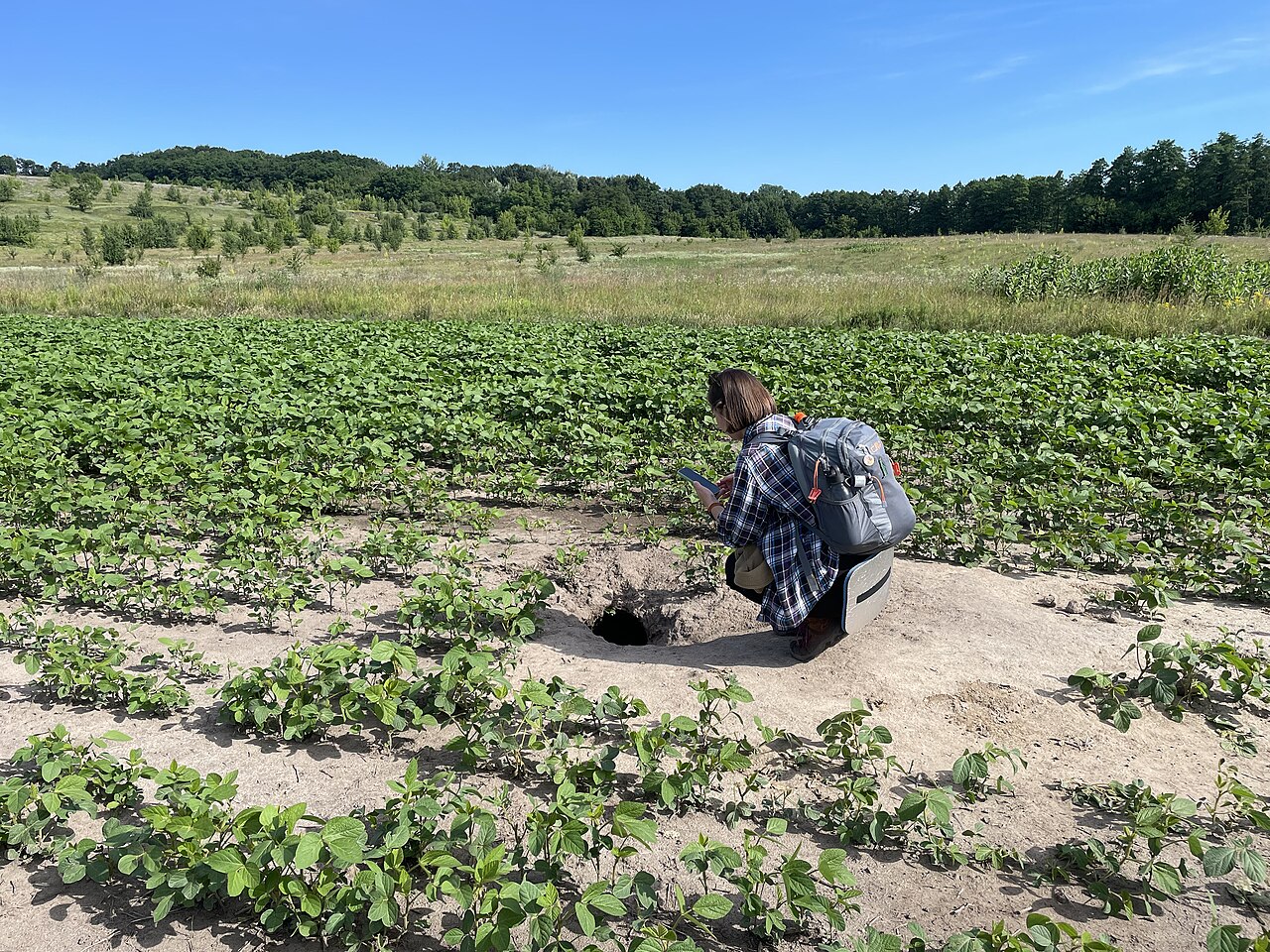

In its habitat
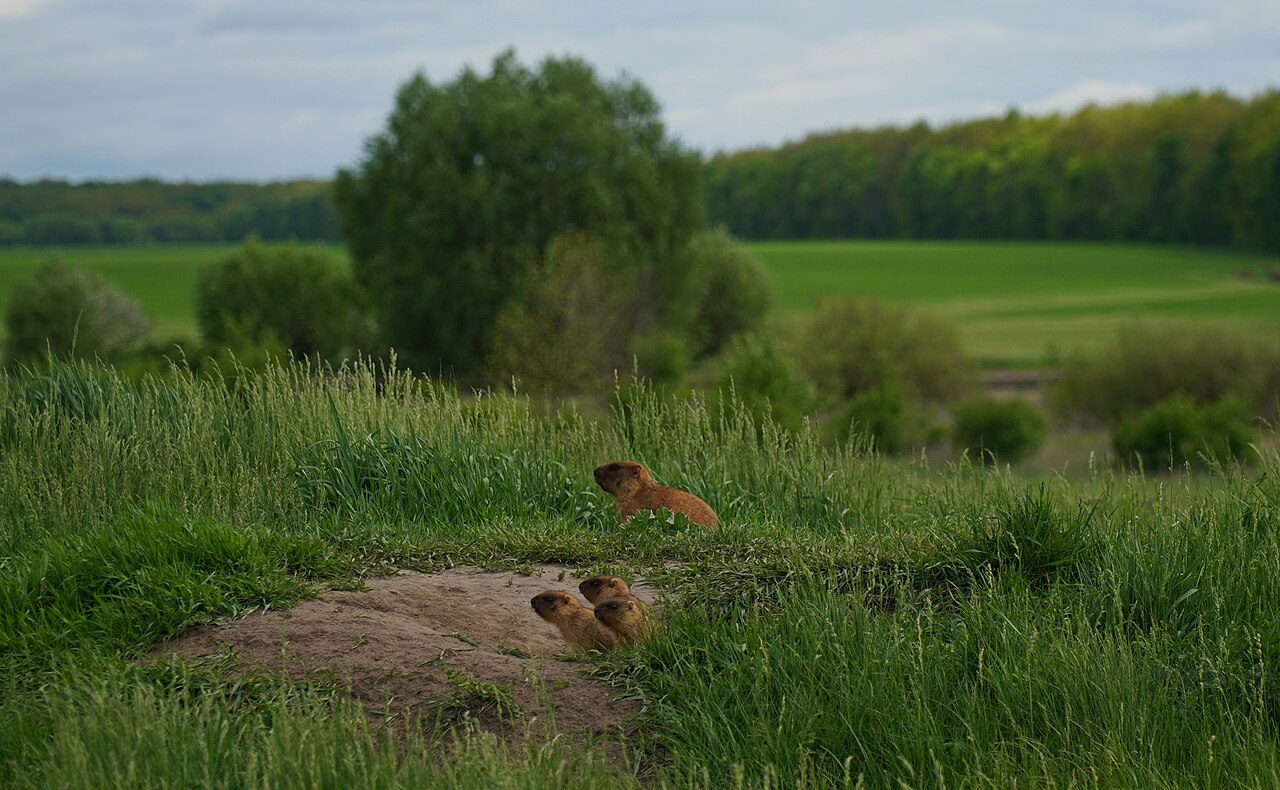
Head close-up
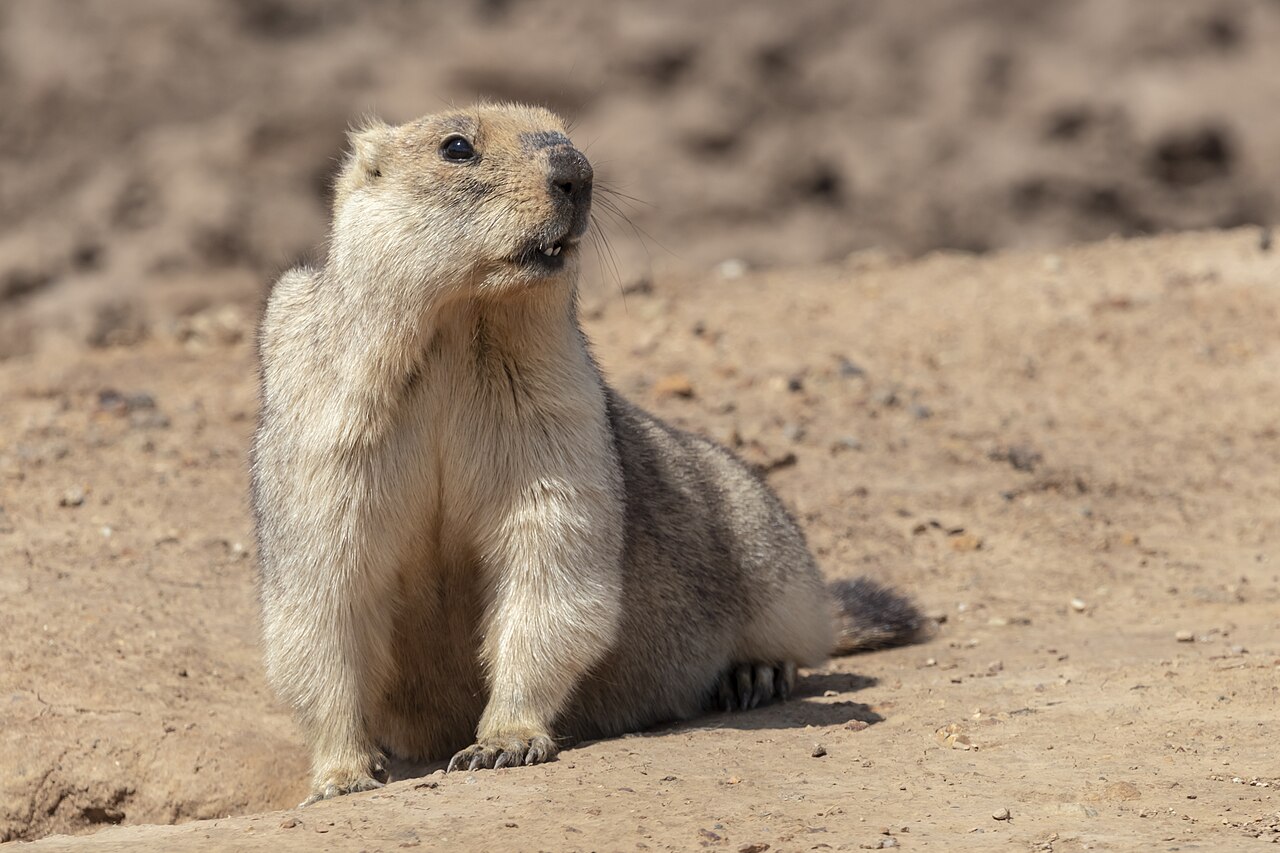
The young
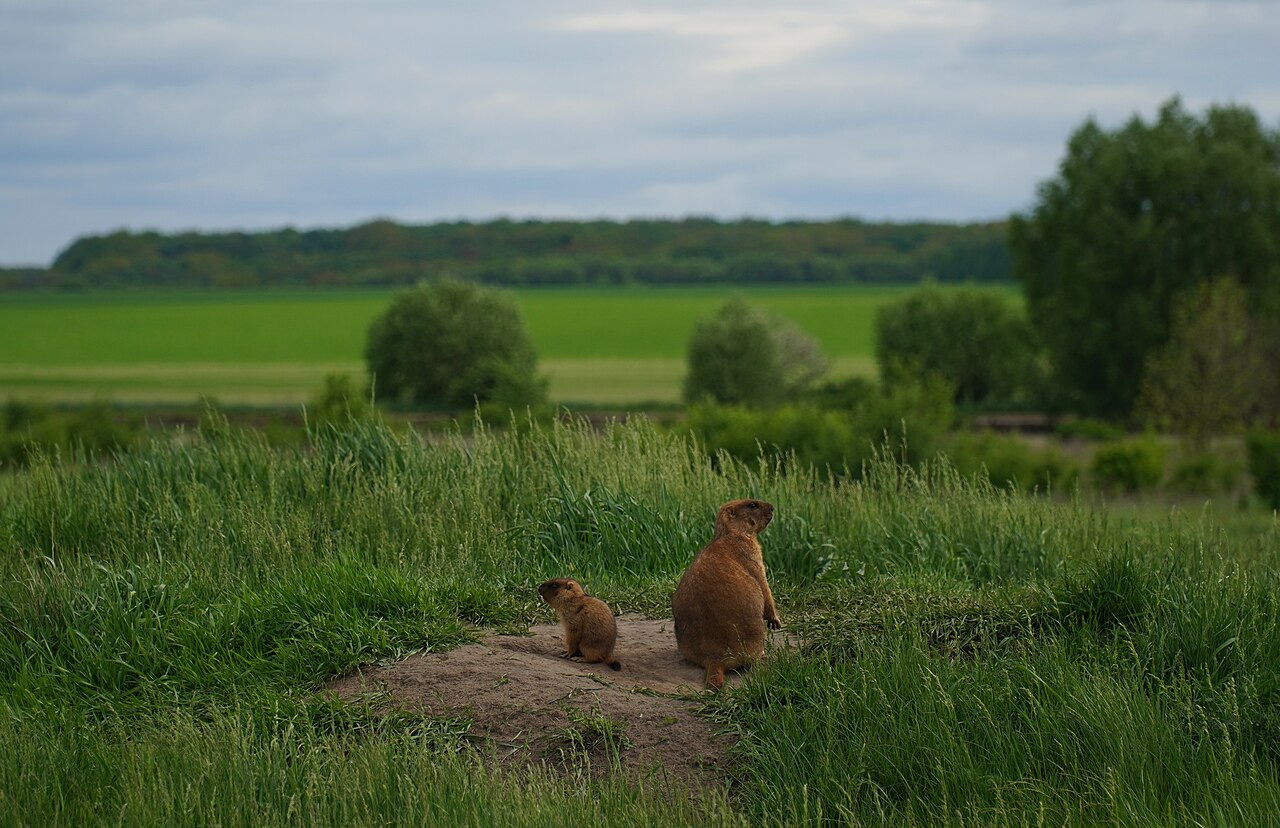
Identification
A heavy, thickset ground dweller: head-body 49 to 57.5 cm, tail 10.5 to 13 cm, and a weight of around four kilos in spring rising to seven kilos or more by September. The coat is sandy-yellow to ochre, with black-tipped guard hairs on the back giving a finely grizzled pattern; the belly is rusty-buff. The head has a dark brown to black crown that contrasts sharply with the pale cheeks; this is the best character at a distance. The tail is short, the colour of the back, and ends in a dark brown tip. The ears are small and round, the eyes set high in the head, the legs short and the front claws heavy and curved. In the sentinel posture the animal stands upright on its hind legs with the forepaws against the chest; the pale, unmarked breast is then visible at a distance.
Similar species
Within its range no other animal of this size lives by day in colonies on the steppe; confusion is rare. The Alpine Marmot is greyer-brown, has a longer tail (13 to 16 cm, against at most 13 cm in the Bobak) and lives above the treeline among scree and boulders. The ranges of the two species do not overlap: the Bobak lives in flat grassland, the Alpine Marmot in high mountains. East of the Volga and in the Kazakh mountains the Grey or Altai Marmot also occurs; it is greyer and lives higher in the mountains. Confusion with the smaller ground squirrels is more frequent: European, Speckled and Little Ground Squirrel live in the same grassland but are much smaller (a European Ground Squirrel weighs about 300 g, a Bobak about twenty times as much) and have a slimmer body, a longer neck and a thin tail. At long range an upright Bobak can be mistaken for a hare; a hare is longer in the leg, has long ears and makes no earth mounds.
Habitat
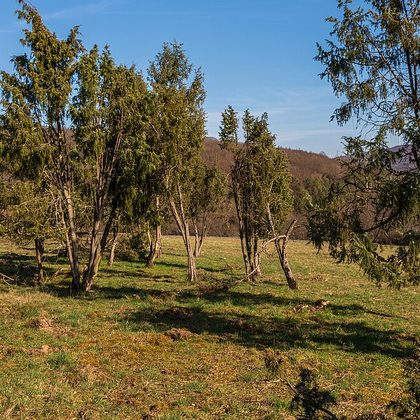
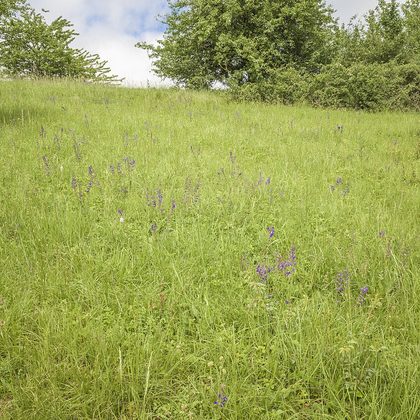
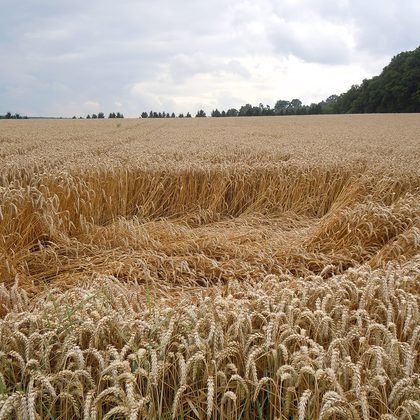
Steppe and forest-steppe: feather-grass steppe, herb-rich dry grassland, wormwood steppe and shrub steppe, from lowland steppe into the arid regions of Kazakhstan. The species needs deep, free-draining soil in which the burrow can reach well below the frost line, and open ground with a clear view for sentinels; where grass grows tall or scrub encroaches, the species disappears. In farmland it occurs on uncultivated slopes, along gully and ravine edges, on fallow land, along railway embankments and on field margins; in Ukraine burrows also lie in the middle of soya and sunflower fields.
Where the animal is most at home, classified with EUNIS — the European standard for habitats.

Distribution
The steppes of eastern Europe and northern Kazakhstan: central and eastern Ukraine, south-western Russia to beyond the Volga, and northern and central Kazakhstan. In Europe the range lies mainly in Ukraine (the forest-steppe of Poltava, Sumy, Kharkiv and the Luhansk region) and in the adjoining Russian black-earth belt. The range was formerly continuous and is now fragmented: the species has disappeared from south-eastern Belarus, and a single Neolithic find is known from the eastern edge of the Great Hungarian Plain; reintroductions have been carried out in several places. Three subspecies are recognised; the nominate form lives from eastern Ukraine to the Volga, and the Kazakh form has been released in the Caucasus.
- Native
- dark = core range, pale = thinly spread
Way of life
Diurnal, with a peak in the morning and again in the late afternoon and a rest period during the midday heat. The species lives in colonies made up of several families; a family consists of a dominant male with an adult female, their two-year-old and yearling offspring and the young of the year, so up to three cohorts. Young males leave after their second winter. About sixty per cent of adult females breed each year, with an average of five young, and the animals do not reach sexual maturity until the age of three, which for a rodent means a low reproductive rate. The diet is entirely plant-based: grasses, herbs, flowers and young shoots; the species scarcely drinks. Hibernation lasts from September or October to March or April, thus six to seven months. The whole family then lies together in one winter chamber deep underground, with the tunnels sealed from within with earth and dung. Body temperature falls to a few degrees above freezing and an animal loses up to a third of its weight. Because the animals lie close together, they lose less heat; young animals survive their first winter only in a group.
Where and when to look
Colonies are easiest to find by their earth mounds. In May or June, search the Ukrainian forest-steppe or the Russian black-earth region for pale mounds in the grass or crop; where they lie, a colony is usually present. Sit still about two hundred metres away: within a quarter of an hour the sentinels reappear. The best period is late April and May, shortly after the end of hibernation, when the animals are above ground all day and last year's young still belong to the family; the young of the year first appear in late May and early June. Avoid the midday heat and the months of July and August, when the colony is least active. The alarm call can reveal a colony that is not yet in view, and also indicates that you have come too close.
Conservation status
Least Concern (2017), with a large population (in the Kazakh steppes alone estimated at millions of animals) and a range that is growing again in many places after the steep decline of the twentieth century. The Bobak was hunted for centuries for its fat and its fur, which in the nineteenth and twentieth centuries was made into hats and coats on a large scale; in addition, the conversion of steppe to arable land removed most of its habitat. By the middle of the twentieth century most western Ukrainian and Belarusian colonies had disappeared. Since then, hunting restrictions, reserves and reintroductions have led to recovery. The main factor now is the quality of the remaining grassland: where steppe is ploughed, or where grazing ceases and the grass grows too tall, the species disappears. It is locally controlled on arable land. The species is a host of plague; in the nineteenth century this led to outbreaks in Russia.
Scientific name
Marmota bobak | (P. L. S. Müller, 1776)
P. L. S. Müller described the species in 1776 as Mus Bobak; because it was later moved to another genus, the author and year stand in brackets. Marmota goes back to the word marmot, whose origin is uncertain: it is traced either to a Gallo-Romance stem marm-, 'to mumble', or to post-classical Latin mus montanus, 'mountain mouse'. bobak is the animal's Russian and Ukrainian name, which Müller took over unchanged as the specific name; the word is probably borrowed from a Turkic language. The specimen the first description was based on came from Ukraine.