All species › Rodents › Squirrels and marmots › Eurasian Red Squirrel
Eurasian Red Squirrel | Sciurus vulgaris
Euraziatische rode eekhoorn | Ardilla Roja
The Red Squirrel (Sciurus vulgaris) is a diurnal tree rodent of woodland, parks and gardens with large trees, distributed from Ireland and the Iberian Peninsula to Kamchatka. It is not shy and is usually noticed by movement along trunks and through the canopy, seldom by sound. Where the animal itself is not seen, the feeding signs are useful: stripped cones and opened nuts can be distinguished from those of mice and woodpeckers.

Tracks
The feeding signs identify the species without the animal being seen; the stripped pine or spruce cone is the clearest example. The squirrel holds the cone in its fore paws, turns it and bites the scales off from the base to the tip down to the core. What remains is a bare, somewhat rough core with short, bitten-off scale bases and almost always three to five untouched scales at the tip. The gnawed scales lie around it, split and ragged-edged. Where such cones lie by the dozen on a stump, a thick side branch, a fallen trunk or a stone, the site is a feeding place, which is used for years. On a mouse-eaten cone, from Wood Mouse or Bank Vole, the scales are gnawed off more neatly: the core is smooth and thin, without scale bases and without a tuft at the tip, and the cone lies on the ground under cover rather than on a raised spot. At a woodpecker anvil the Great Spotted Woodpecker wedges the cone in a crack in the bark and hacks it open from above; the scales are levered apart and frayed but not gnawed off, and the cone keeps its shape. Beneath such an anvil hundreds of cones accumulate over a winter at the foot of the same tree. Nuts are also opened differently: the squirrel splits a hazelnut into two halves or bites a large, ragged hole in it, the Wood Mouse gnaws a round hole with a smooth rim and clear tooth marks across that rim, and a woodpecker hacks an irregular hole in a wedged nut. The drey is a domed structure 25 to 30 cm across, of leafy twigs, lined with moss and shredded bark, placed against the trunk or in a fork at least six metres up and closed underneath; a magpie nest is looser, larger and has a roof of thorny twigs. Other signs: bark stripped from young spruce and pine in the canopy, where the animal feeds on the sap, and in snow the bounding trail of four prints in a group, with the five-toed hind feet side by side in front of the smaller four-toed fore feet.


In its habitat

Head close-up
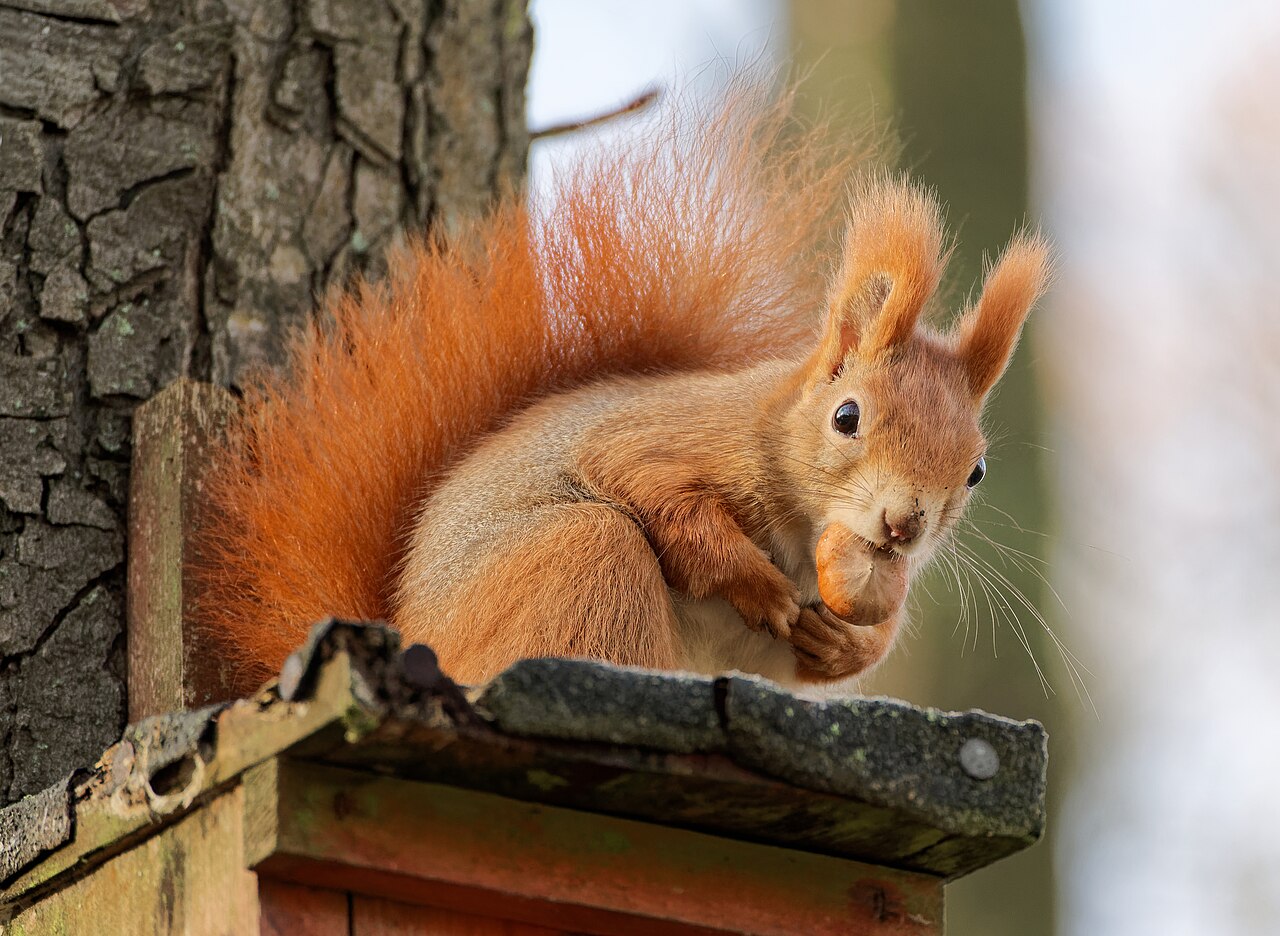
In winter coat
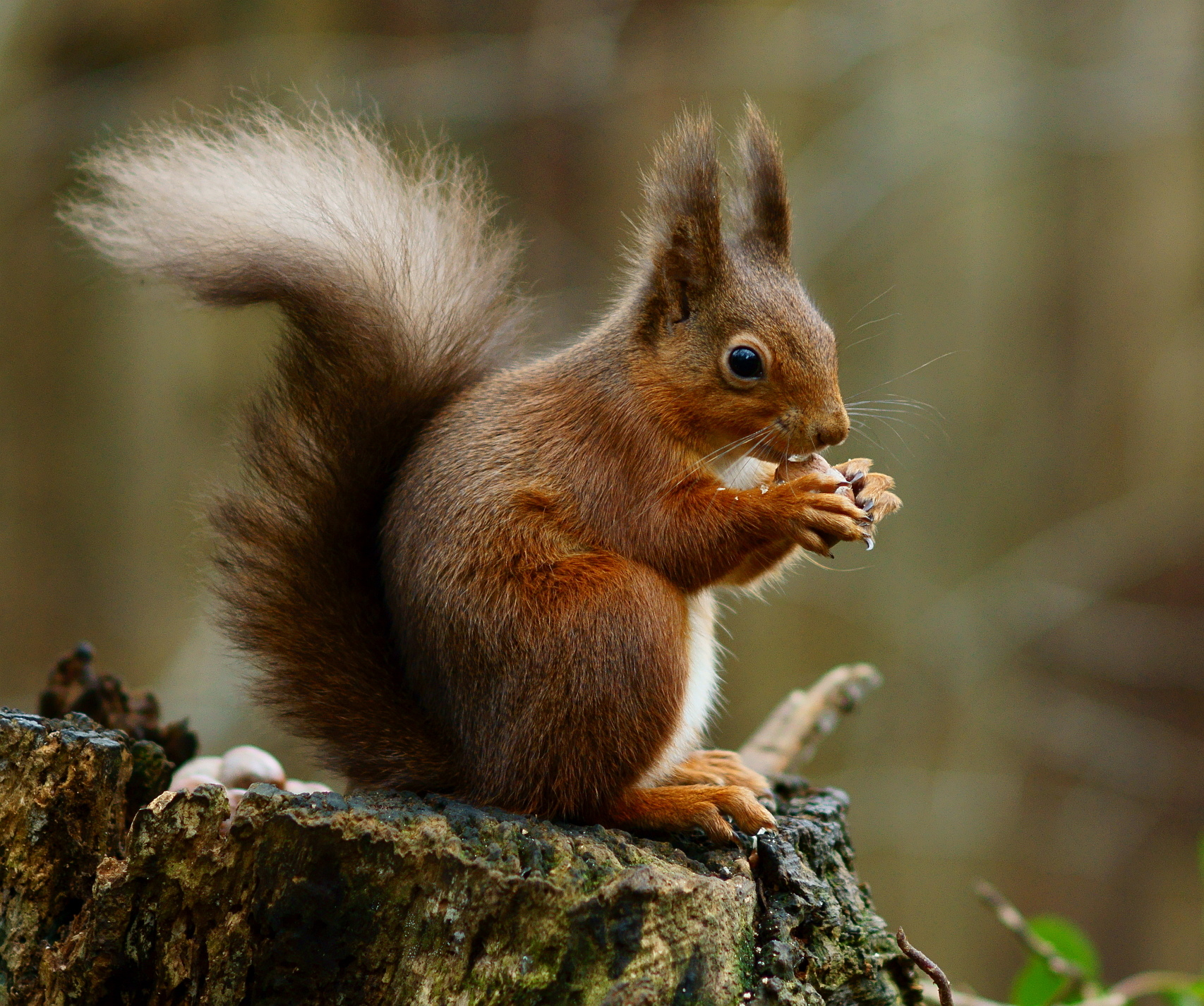
Identification
A slender tree rodent, head-body 19 to 23 cm, with a plumed tail of 15 to 20 cm, almost as long as the body, weighing 250 to 340 g. Colour varies greatly: rusty red in western Europe, greyish, dark brown or nearly black in the mountains and the north; the tail can be much paler than the back on the same animal and often bleaches to cream in summer. The belly is always white and sharply demarcated. In winter it has long ear tufts, lost in the summer moult, and denser, greyer flanks; it moults twice a year, but tail and ear tufts are renewed only in late summer. It sits upright with the tail curved over the back and holds food in the fore paws. The fore foot has four long fingers and a blunt thumb pad, the hind foot five toes; the hind feet can be rotated far backwards, so that the animal can descend a trunk head first.
Similar species
On the European mainland there is no woodland species with which the Red Squirrel can be confused: a red-brown animal with a bushy tail moving through the canopy by day is a Red Squirrel. In Great Britain, Ireland and northern Italy the introduced Grey Squirrel also occurs: it is larger and heavier, grey with a rusty wash on flanks and head, has a grey tail edged white and never has ear tufts. The latter is the quickest character in winter; in summer size and tail colour are decisive. Many Red Squirrels are themselves grey-brown, so colour alone is not conclusive. The Siberian Chipmunk, feral in a few woods in Belgium, the Netherlands and France, is much smaller, has five dark stripes down the back and lives mainly on the ground. The dormice Garden Dormouse and Edible Dormouse also climb, but are nocturnal, much smaller and have a black mask or a smooth grey tail.
Habitat
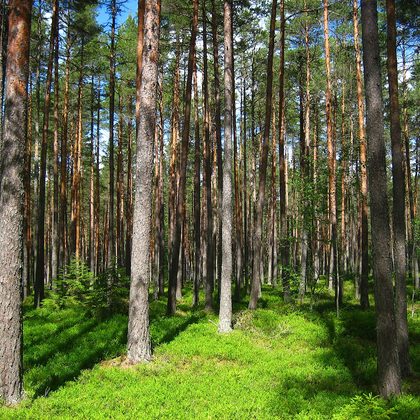
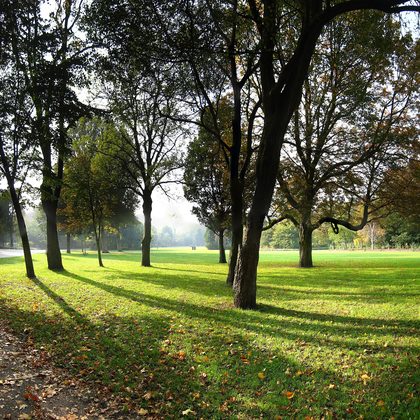
Woodland of many types, provided the canopy is closed and the trees bear seed: preferably mature conifer forest of Norway spruce and Scots pine, where cones provide food throughout the year, and also mixed woodland, beech and oak woodland, and in southern Europe forests of black pine and other pines, pine plantations and holm oak woodland. Also small woods, avenues, cemeteries, parks and gardens with large trees, into town centres. The species depends on connected woodland: open ground is seldom crossed, and a wood divided by a road or clear-fell holds fewer squirrels than its area would suggest.
Where the animal is most at home, classified with EUNIS — the European standard for habitats.


Distribution
Continuous from Ireland and the Iberian Peninsula to Kamchatka and from Lapland to southern Italy; the Red Squirrel is one of the few European mammals with an almost unbroken distribution across the whole continent. It occurs from sea level to the treeline, including in the Pyrenees and the Sierra Nevada. In the Iberian Peninsula the species expanded during the twentieth century with large-scale pine planting and is absent only from the treeless parts of the Ebro valley and the arid south-east; southern populations are markedly dark, and genetic studies are examining whether the south-eastern form merits separate taxonomic rank. The Red Squirrel is absent from the Balearic and Canary Islands; on Fuerteventura lives the Barbary Ground Squirrel, an African species introduced in 1965 that has spread invasively. In Great Britain the species has been greatly reduced, to an estimated 160,000 animals, about 120,000 of them in Scotland; the remaining populations are in Northumberland and Cumbria, on Anglesey, at Formby, on Brownsea Island and the Isle of Wight, and in a number of managed refuges. In Ireland the distribution is wider and the species has been increasing again in the Midlands over the last two decades. In the Netherlands the Red Squirrel is mainly a species of the sandy soils (Veluwe, Utrechtse Heuvelrug, Drenthe, Twente, North Brabant, Limburg) and increasingly of urban parks, cemeteries and older residential areas in the west; after a strong decline in the nineteenth century due to felling and persecution it recovered with twentieth-century afforestation. In Belgium it is common in the Kempen, the woodland belts around Brussels and Antwerp and the Ardennes. The species is also common in Germany, the Alps and Scandinavia. No Grey Squirrels occur on the mainland except in northern Italy.
- Native
- dark = core range, pale = thinly spread
Way of life
Diurnal, with a peak shortly after sunrise and a second in the late afternoon; in winter these merge into a single activity period around midday. The species does not hibernate but has periods of winter inactivity: during gales, rain or hard frost the animal stays curled up in the drey for days, coming out in between to feed. The winter store is scattered: hundreds of nuts and seeds are each hidden separately a few centimetres deep in the soil or in a bark crevice and are relocated by smell and spatial memory. What is not recovered can germinate; in this way the Red Squirrel contributes to the dispersal of trees. Food consists of conifer seeds, hazelnuts, acorns, beech mast, fungi, buds, bark and occasionally an egg or a nestling. There are two litters a year, in February–March and May–June, after a gestation of 38 to 39 days; three to five young are born naked and blind, open their eyes at about four weeks and are independent at eight to ten weeks. Each animal uses several dreys and moves when disturbed or when flea numbers are high. The Red Squirrel is not territorial; its home range overlaps those of other animals. The alarm call is a hoarse, rattling chuk-chuk-chuk, accompanied by jerking tail movements.
Where and when to look
Stand still for the first two hours after sunrise in mature conifer forest and listen: the sound of falling cone scales in the litter often indicates a feeding squirrel in the canopy before the animal itself is visible. Feeding places and cone heaps then show where the animal feeds in the morning. February and March are the best months: the trees are bare, animals chase each other spirally up the trunks in the mating season, and the ear tufts are at their longest. In winter the forks of old trees are the place to look for dreys: a ball of leafy twigs, closed underneath, belongs to a squirrel. In urban parks squirrels allow people to approach closely. In Great Britain reserves with feeding stations (Formby, Brownsea, Kielder, Anglesey) offer a high chance of a sighting; elsewhere patience at a known drey gives the same result. Bread and peanuts make squirrels ill.
Conservation status
Least Concern (LC, 2016); across Eurasia as a whole the species is not at risk. In Great Britain and Ireland the Red Squirrel has been largely displaced since the introduction of the North American Grey Squirrel around 1876. The Grey Squirrel is a stronger competitor for food, partly because it can digest unripe acorns and the Red Squirrel cannot, and it carries squirrelpox virus, which does not make it ill but kills Red Squirrels; at Formby one outbreak killed eighty per cent of the animals. Conservation rests on control of Grey Squirrels, on refuges of conifer forest where the Grey Squirrel does less well, and on landscape-scale projects in the Scottish Borders and Northumberland. In Ireland the Grey Squirrel declines where the Pine Marten returns, and the Red Squirrel increases; the Grey Squirrel is heavier, slower and more terrestrial and is therefore caught more often. In northern Italy, where Grey Squirrels were released in Piedmont in 1948, the species continues to spread; expansion across the Po plain to the Alps and the rest of the mainland is considered possible. The EU ban on importing invasive species keeps the Grey Squirrel out of other countries; keeping it out is the most important conservation measure for the Red Squirrel on the mainland. Other threats on the mainland are traffic, the loss of old seed-bearing trees and fragmentation of woodland.
Scientific name
Sciurus vulgaris | Linnaeus, 1758
Linnaeus described the species in 1758 and placed it straight away in the genus where it still stands. Sciurus is the Latin word for 'squirrel', from Greek skiouros, from skia, 'shadow', and oura, 'tail': the animal that shades itself with its tail. vulgaris is Latin for 'common, ordinary'. The specimen the first description was based on came from Sweden, Uppsala.